From the report: “Our most significant challenge this year was the erosion of the MPCC’s ability to exercise civilian oversight of the military police. The MPCC used a great deal of resources and effort to obtain relevant documents from the CFPM to enable it to conduct fair and fulsome investigations. In too many instances, we have seen resistance or refusal to disclose information the MPCC needs to investigate complaints; a reduction in the number of recommendations accepted by the CFPM; a refusal to respond to recommendations; a refusal to provide updates on files currently being reviewed by the Office of Professional Standards of the CFPM; and restrictive and unilateral interpretation of the MPCC’s jurisdiction. The MPCC has been forced to turn to the Federal Court to obtain the documents it is legally entitled to review as part of its mandate. These unfortunate barriers dilute the will of Parliament in setting up a strong oversight system for the police and must be addressed.”
The MPCC was created in 1998 as part of the passing of Bill C-25 in 1998 and the restructuring of the military police in the aftermath of the fallout from the failures of the military police to conduct proper criminal investigations in Bosnia and Somalia when the Canadian Forces were on “peace keeping” missions there but ended up with members of the CAF conducting illegal activities.
The Military Police Complaints Commission was created with input from the Canadian Armed Forces and the Department of National Defence, meaning that the CAF and the DND knew how they wanted their new police forces to operate and that through careful consideration the MPCC would be relegated to the status of toothless hound dog.
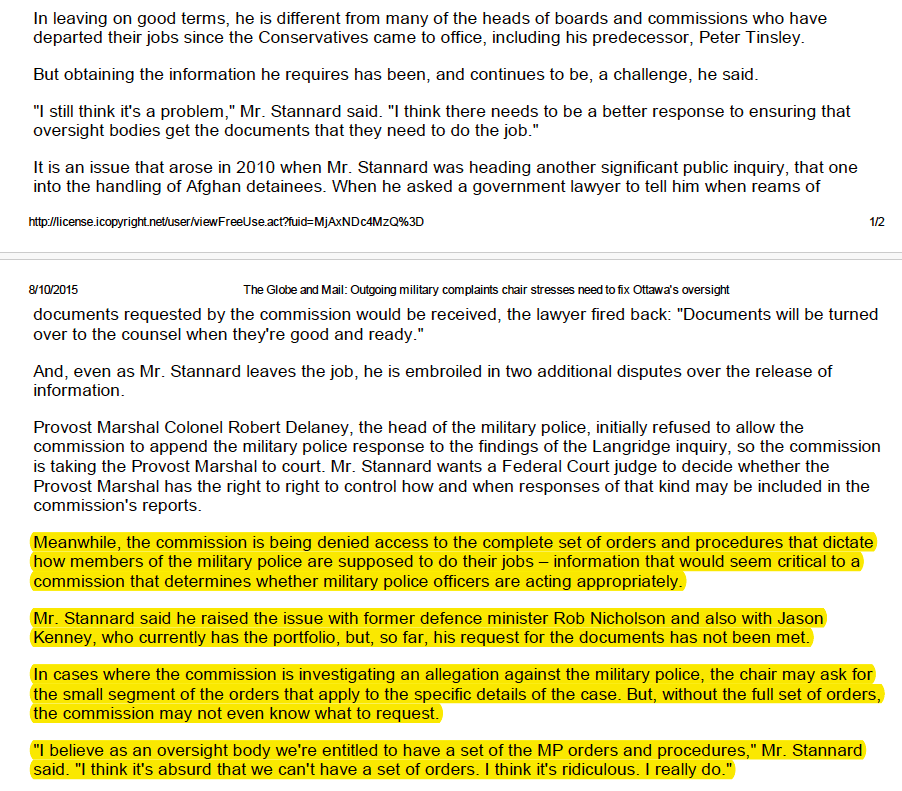
The issues that Madame Tammy Tremblay raised above are nothing new. In 2015 then outgoing MPCC chairman Glenn Stannard has this to say in his interview with Gloria Galloway of The Globe and Mail.
The Canadian Forces Provost Marshal has the ability to control the findings of the Military Police Complaints Commission.
During a review, the MPCC cannot subpoena documents or witnesses. The MPCC also cannot administer oaths.
Without the ability to administer oaths the members of the CFNIS subject to the complaint can utter falsehoods all day long and there will be absolutely no repercussions.
If a person such as myself wishes to make a complaint against the base military police or the Canadian Forces Special Investigations Unit we have to first submit our complaint to the Provost Marshal. The Provost Marshal then knows what the complaint is about and can then tailor the documents released to the MPCC to paint the narrative that the Provost Marshal or the Vice Chief of Defence Staff which for the MPCC to see.
Even if the MPCC suspects that something is off and not right, there’s nothing the MPCC can do as the MPCC cannot demand the release of documents from the Provost Marshal. Sure, they can go to Federal Court to ask the court to instruct the Provost Marshal to hand over the records, but that would mean that the MPCC would have to know what documents to request.
As I learnt during the 2012 review of my complaint against the 2011 CFNIS investigation, the complainant cannot simply supply the MPCC with all the documents in their possession. The MPCC can only consider documents that are relevant to the documents supplied to the MPCC by the Provost Marshal.
And as the Provost Marshal is under no obligation to tell the complainant what they’ve supplied and what they’ve withheld from the Military Police Complaints Commission, following through with a MPCC review is almost 100% a waste of time.
This is why when I was interviewed by Claude Bergeron and Peter Cicalo of the MPCC in July of 2012 they were practically popping the champagne and cheering for the CFNIS.
I’m on the left….. the MPCC is on the right.
Peter and Claude were very impressed with the CFNIS investigation even though the Provost Marshal had actually withheld all of my email communications between myself and Master Corporal Christian Cyr detailing the 5 visits to the chapel.
After my interview with Peter and Claude I was so fucking nauseated that I just wandered around the city aimlessly until about 03:00 in the morning trying to work up the courage to jump off the Granville Street bridge.
The Provost Marshal withheld the fact that the CFNIS had in its possession the 1980 CFSIU investigation paperwork and the 1980 courts martial transcripts from the MPCC.
Both of these sets of documents indicated that in 1980 the military police and the CFSIU were very well aware of the babysitter’s abuse of young children on the base and the fact that it was the investigation of the babysitter that exposed the actions of Canadian Armed Forces officer Captain Father Angus McRae.
This of course ran counter to was I was told by Petty Officer Steve Morris on November 4th, 2011 when he stated that the CFNIS could find absolutely no evidence that the babysitter was capable of what I accused him of.
Well, if you don’t like the findings of the MPCC, file an application for Judicial Review.
Don’t think that the Federal Court will be of any relief. The Federal Court can only render judgements based upon the documents that the Provost Marshal submitted to the MPCC. Anything else is considered “New Evidence” and the Department of Justice will fight tooth and nail to have all “new evidence” dismissed.
When I entered all of my emails between myself and Master Corporal Christian Cyr detailing the visits to the chapel the DOJ demanded that these be struck from the proceedings as they were “new evidence”. Because the Provost Marshal failed to notify the MPCC about these emails, I couldn’t introduce these emails at Federal Court level.
And it gets goofier than this.
In 1998, the Provost Marshal issued CFPM 2120-4-0 to the commanding officers of the new CFNIS, and all of the detachments across Canada. This document was further reissued in 2006. This document stated that matters involving civilian victim are to be handed over to the outside civilian authorities having jurisdiction. This document further stipulated that the CFNIS could only conduct an investigation of offences involving civilian victims if the outside civilian authorities outright refused to conduct the investigation.
I introduced this document into my applicant’s records for my application for judicial review.
The Department of Justice requested this document be struck from my hearing as this was also “New Evidence”. New evidence even though this was a standing operating procedure of the Canadian Forces Military Police. But it appears that the Military Police Complaints Commission was never given a copy of this document even though this document has guided military police and CFNIS operations since 1998.
I can’t help but wonder if the Provost Marshal’s new found energy to fight the MPCC over documents has to do with the fact that the MPCC went around the firewall that the CFNIS and the Provost Marshal had constructed around the investigation into my complaint of sexual abuse on Canadian Forces Base Namao and accesses a parallel investigation being conducted into the sexual assaults on CFB Namao and discovered the CFSIU investigation paperwork and the 1980 courts martial transcripts in the possession of the CFNIS.
Militaries like the Canadian Armed Forces really don’t like outside civilian agencies and do-gooders sticking their noses into the military’s business. Militaries view themselves as being the saviours of their respective country, and therefore they should never be questioned.
The Catholic church did the exact same thing that the Canadian Armed Forces are doing. And that’s using their immense power and prestige to place themselves above examination by pesky civilians.
The only difference between the Catholic church and the Canadian Armed Forces is that the Catholic church is subject to civilian laws and the civilian courts. The Canadian Armed Forces are a law unto themselves.
If you’ve been paying attention to the media you might have encountered a “don’t blink or you’ll miss it” news story from Murray Brewster of the CBC.
I had my first dealings with the Military Police Complaints Commission back in 2012 through 2013. And from my experience this is an agency that is intentionally set up to fail.
The MPCC is hamstrung by the rules that created it.
Why would the Department of National Defence, the Canadian Armed Forces, and the Canadian Forces Provost Marshal allow an agency to exist that would put their defective “justice system” in peril?
The DND and the CAF have fought long and hard to maintain their own separate justice system, and for good reason. It’s hard to maintain an air of dignity if the public learns that you have an epidemic of child sexual abuse on the bases.
The MPCC was created back in 1998 with the passing of Bill C-25, “An Act to make Amendments to the National Defence Act”.
But right from the word go, the DND and the CAF worked tirelessly to ensure that the MPCC would not pose a risk to their separate and distinct justice system.
That’s how we ended up with the following process to make a complaint.
How to make a complaint to the MPCC
If a person wishes to make a complaint against a CFNIS investigation, you can’t. Only members of the CFNIS or Military Police can make a complaint about an investigation.
And only members of the Canadian Armed Forces can make interference complaints.
Victims dissatisfied with a CFNIS investigation are limited to making a complaint against individuals. This isn’t accidental. This is intentional. You now have to figure out how to make a complaint against individual members of the CFNIS for their conduct even if there was nothing wrong with their conduct.
Being that members of the Canadian Armed Forces must obey the lawful commands of their superiors, what you allege as negligence or improper conduct may actually just be the results of lawful commands. And investigators with the CFNIS can’t be faulted for following lawful commands, can they now?
And because you can’t make a complaint against an investigation, you can’t make a complaint about the validity of those “lawful commands” as you’ll more than likely never know who gave those commands.
The most significant flaw with the MPCC review process is that you have to make your complaint to the Provost Marshal first.
Yes, this is the same Provost Marshal that will decide what documents to hand over to the MPCC and which documents will not be handed over to the MPCC.
This makes about as much sense as the police calling up a robbery suspect to tell them that they’re coming over in 2 hours to look for evidence of a robbery.
The Provost Marshal will then conduct a review via the Professional Standards section of the Canadian Forces Military Police Group.
Only after the Professional Standards group conducts their review and the Provost Marshal informs you of the results, can you then request a review from by the MPCC.
Requesting an MPCC Review.
You have 90 days after the review of the Professional Standards to request a review by the MPCC.
I would like to say that a review is a worthwhile endeavour, but quite frankly it isn’t.
An MPCC review is like pissing your pants. Sure, it brings you some relief, and it gives you a warm feeling. But when the warm feeling goes away, you’re wet and you stink like piss.
The problem with an MPCC review is that it is very powerless.
The MPCC cannot subpoena witnesses
The MPCC cannot subpoena documents
The MPCC cannot administer oaths
The MPCC didn’t really understand how the military police or the CFNIS operate as they have never (as per Stannard’s 2015 interview) been given documents that explain the operational hierarchy of the military police and the CFNIS, so they wouldn’t know what documents to request and who to request them from.
The MPCC can only review the documents handed to them by the Provost Marshal.
The MPCC are not allowed to share with the complainant the documents that the Provost Marshal supplied to the MPCC.
These points basically allow the Provost Marshal to hobble any MPCC investigation right from the start. And there’s nothing that the MPCC can do about it.
Yes, the MPCC could call for an Inquiry, but an MPCC Inquiry occurs just about as frequently as the birth of a unicorn.
The MPCC must obtain the consent of the Minister of National Defence in order to call an inquiry.
That’s not going to happen in a matter that has the potential to expose how the defective military justice system in the pre-1998 days was able to hide and bury military child sexual abuse on the bases, and how the modern day Military Police group can conduct “feel good” investigations that don’t accomplish anything but make the victim(s) think that the military police conducted a “real” investigation.
Remember, due to flaws in the pre-1998 National Defence Act, if you were a child living in military housing on a defence establishment, and you were molested by an active member of the regular force, you will never be able to lay charges against the former member due to either the 3-year-time-bar flaw or the summary investigation flaw.
Prior to 1998, it was the serving member’s commanding officer that was required to act as the Crown Prosecutor to decide if charges were warranted or not.
Prior to 1998 the military could not try a member for service offences if more than three years had elapsed between the date of the offence and the commencement of the tribunal.
In my matter the CFNIS knew about the intimate connection between my babysitter and the military chaplain, Captain Father Angus McRae.
And at the start of the investigation in March of 2011, Angus McRae was still alive. And the National Defence Act states that former members remain liable to be tried for service offences committed while they were active members.
But, the 3-year-time-bar and the summary investigation flaw would have out right prevented the laying of charges. And in the pre-1998 days, there was no language in the National Defence Act that allowed for service offences to bypass the required summary investigation by the commanding officer of the accused and simply be tried in civilian court.
A brief detour into the absurd.
Many reporters have been whamboozled by the military police and the CFNIS stating that there’s nothing stopping them from arresting someone for child molestation that was committed prior to 1998 and trying them in civilian court.
The general accepted practice for trying persons charged with committing historical crimes is that you have to charge them and try them as the law prescribed the offender to be charged and tried at the time.
Prior to 1998 when a member of the Canadian Armed Forces committed a Criminal Code offence while on duty and while on a defence establishment, the National Defence Act stated that these offences were to be tried as service offences with the specific exceptions of Murder, Manslaughter, and Rape prior to 1985, and Murder, Manslaughter, and Sexual Assault (not including crimes against children), between 1985 and 1998.
Members of the regular force are subjected to the Code of Service Discipline from the time they enlist until the time they are released, 24/7/365.
The Canadian Armed Forces, prior to 1998, could try for sexual crimes against children so long as “consent” was a possibility. This meant that the military could try a member for any sexual assault involving a child between the ages of 14 to 18.
If the military wished to proceed with charges related to children under the age of consent, those charges had to be tried in the civilian courts.
Any service charge of child sexual abuse that had been brought against a member of the Canadian Armed Forces had to be approved by the commanding officer of the accused.
The commanding officer had the full authority pre-1998 to dismiss ANY service offence charge that had been brought against a member of the Canadian Forces.
Gross indecency and indecent assault could easily become drunk and disorderly, or behaviour unbecoming. The offender gets punished, and the public doesn’t find out about a child sexual assault.
Take all the time you need to think about that.
Judicial Review
I’ve begun to realize that the laws in this country are written by naive politicians assuming that no one has anything to hide and everyone is interested in justice.
After I received the findings of the 2012 MPCC review that found the CFNIS in 2011 did a stellar and upstanding investigation I filed an application for Judicial Review with the Federal Court of Canada.
The nice thing about filing an application for Judicial Review is the Military Police Complaints Commission was compelled to hand over to men certified copies of the documents that were provided to the MPCC by the Provost Marshal.
The sad thing about filing an application for Judicial Review is realizing that the CFNIS fucked up the 2011 investigation beyond all comprehension and that there is literally nothing I can do to prove to the court that the CFNIS willfully withheld documents and information from the MPCC.
Remember, during an MPCC review, they don’t share with you any of the evidence that the Provost Marshal supplied to them.
And by the time you get to Judicial Review you are not allowed to introduce new evidence.
So you are literally fucked seven ways from Sunday.
Federal Court gives you the opportunity to give the Provost Marshal a polite “fuck you”, but other than that the Department of Justice will strike all “new” evidence that you introduce to prove that the CFNIS conducted an inept investigation.
Sure, you can approach the Supreme Court of Canada and ask them to review the admissibility of the new evidence and whether or not the MPCC should have known that they were being actively deceived.
But doing this is $$$$$$$$$$$$$$$$$$
What evidence was withheld actively withheld from the MPCC by the Canadian Forces Provost Marshal?
My social service records that indicated that my grandmother lived with us and raised my brother and I on CFB Namao
That I was in foster care due to major dysfunction in the household that stemmed from my father’s inability to accept responsibility for his family.
That I was suffering from mental health issues that are all standard indicators of child sexual abuse.
That I had a military social worker.
That my father’s statement to the CFNIS denying the presence of any babysitter or the knowledge of any sexual assaults was wrong as both Captain Totzke and my father blamed me exclusively for what had happened on the base and for the fact that I allowed the babysitter to molest my brother.
These were all important items as my father in his statement to the CFNIS claimed that there never was a babysitter, that his mother only briefly looked after my brother and I, and that my brother and I were never sexually abused.
It also turned out that the CFNIS scrubbed any and all mention of Canadian Armed Forces officer Captain Father Angus McRae from the investigation.
As part of my application for Judicial Review I gave my father a written examination. My father, when presented with excepts from my social service records and foster care records contradicted everything he said to the CFNIS in 2011.
The CFNIS had my social service records and my foster care records in 2011. The CFNIS could have easily called my father back in to ask him why his statement to the CFNIS didn’t come anywhere near to what my social service records and my foster care records revealed.
The second CFNIS investigation
In around August of 2015 I was contacted by RCMP inspector Akrum Ghadbhan. This was the result of a letter that I had sent to the RCMP Commissioner and the Minister of National Defence in which I mentioned the details of a recorded phone call that I had with the father of the babysitter.
Inspector Ghadbhan said that he had reviewed the CFNIS investigation and that it didn’t meet contemporary policing standards and that he was recommending that the CFNIS reopen the investigation with the new evidence that I had provided.
Evidence that I provided:
My father’s written examination to the Federal Court
My brother’s written examination to the Federal Court
Very specific excerpts from my social service paperwork and my foster care paperwork.
Details of my conversation with Fred R. Cunningham that occurred on November 27th, 2011.
A copy of the recorded phone call between myself and the babysitter’s father that occurred in July of 2015.
My grandmother’s vital stats.
My step grandfather’s vital stats.
Proof that I had told the CFNIS during my initial video interview in March of 2011 that I had attempted twice before to report this to the military police but that both times the military police refused to look at the matter citing the civilian status of my babysitter.
Proof that Captain Terry Totzke had extensive involvement with me in the aftermath of CFB Namao.
Sgt. Damon Tenaschuk of the CFNIS Pacific Region was given this case to investigate.
About the only thing outstanding about the second CFNIS investigation is when Sgt. Tenaschuk called me to let me know that he had obtained a copy of CFSIU DS-120-10-80 and that this document had the following to say:
What Fred Cunningham had told me on Nov. 27th, 2011 was the truth and that Fred was in a position to know what he had told me.
That much like I had told Mcpl Christian Cyr on May 3rd, 2011 about the visits to the chapel and the sickly sweet grape juice that Captain McRae openly admitted to the military police inn 1980 that he had brought numerous children over to the base chapel and that he would give them alcohol and that sometimes they’d fool around in the bedroom afterwards.
That the investigation of Captain McRae was only initiated AFTER the investigation of the babysitter due to numerous complaints of the babysitter molesting much younger children on the base.
That paperwork such as CFSIU DS-120-10-80 is only supposed to be retained for 7 years according to DND rules and the fact that it still existed in 2017 meant that it had been used within 7 years of McRae’s court martial, and then again within 7 years of the second use, and so on.
After this phone call I filed an ATI for the court martial transcripts and the CFSIU paperwork. DND fought me on this. I had to enlist the help of the Information Commissioner of Canada.
MPCC part 2
In early 2018 I received a phone call from Sgt. Tenaschuk stating that the Crown was not recommending charges.
So I filed another complaint with the MPCC.
This time around the Provost Marshal outright refused the request for a review implying that the review that occurred in 2012 was more than sufficient.
The MPCC commenced a review anyways.
This time I gave the MPCC copies of recorded phone calls, copies of emails, copies of the original video statement in which I explain what home life was like, and that I had tried to report this abuse twice before.
I also specifically mentioned the discussion Sgt. Tenaschuk and I had about Fred Cunningham, CFSIU DS-120-10-80, and DND’s outright refusal to grant me access to the investigation paperwork or the court martial transcripts.
I wasn’t expecting too much this time around.
But I think the MPCC realized just how badly the Provost Marshal fucked them over during the 2012 MPCC review.
The MPCC conducted their review of my complaint against Sgt. Tenaschuk and found that Sgt. Tenaschuk had followed the investigation framework as laid down by his superiors.
The MPCC didn’t make any mention of CFSIU DS-120-10-80 in relation to the investigation of my complaint against the babysitter, which would seem to indicate that it wasn’t in the documents that were handed over to the MPCC by the Provost Marshal.
The MPCC looks elsewhere.
The MPCC did however look at a parallel investigation in which the CFNIS was investigating the complaint of another former military dependent against the same babysitter. This investigation was being conducted by the CFNIS Western Region.
The MPCC went to great pains in the October 2020 final report to indicate that they looked at this parallel investigation just for curiosity.
It was during this look that they noticed that the CFNIS Wester Region had in its possession the infamous CFSIU DS-120-10-80 and the 1980 Courts Martial transcripts for Captain Father Angus McRae.
The Information Commissioner of Canada.
I had been involved with the Information Commissioner of Canada ever since DND first refused to release Captain McRae’s courts martial transcripts to me in 2012.
When DND refused to provide me with a copy of DS-120-10-80 in 2018 I enlisted the help of the ICC again.
The ICC wasn’t too hopeful of a resolution as DND and the CSIS are tied for being the government agencies most likely to stonewall ATI requests.
But in mid 2019 I was contacted by the ICC and told that DND had just granted access to the documents to another requestor, so I should refile my request, and that DND could not refuse to honour my request.
DND did release to me the documents.
They were so redacted that it was a joke.
It was almost as bad as the documents that the DOJ released to me about the settlement between the babysitter and the DND when the babysitter sued the DND for the abuse he endured on CFB Namao at the hands of Captain McRae.
David Pugliese
I had been trying to interest David in my story over the years, but there just weren’t any bites. To be honest, absolutely nobody in the media was willing to buy into the topic of child sexual abuse in the Canadian Forces or the fact that the military loves to hide and bury this stuff as much as possible.
It was sometime in the late winter / early spring of 2020 when David ran a story on DND stonewalling ATI requests. I contacted David and gave him the low down on what I was encountering.
David ran a couple of stories, and poof, I had my documents, this time with many fewer redactions. I got my documents around the late summer of 2020, just before the MPCC released their final review of my second complaint against the CFNIS.
The Courts Martial transcripts and the CFSIU investigation paperwork confirmed everything that I had been piecing together over the years.
The babysitter was a prolific child abuser
There were living quarters attached to the chapel
Captain McRae was known to be bringing children to the chapel and giving them alcohol.
The MPCC second review final report.
I now understand why the DND and the Minister of National Defence gave in so easily when David Pugliese started asking questions. The DND and the MOD both knew that the MPCC had obtained the Courts Martial transcripts and the CFSIU investigation paperwork.
And sure enough the MPCC mentioned both of these documents in its final report.
I received the final MPCC report in November of 2020.
The MPCC did take issue with the CFNIS for relying on the Crown’s reluctance to prosecute as an indication that no crime had occurred. The MPCC said that it was quite evident that I and my brother were victims of crime at the hands of the babysitter. The MPCC then explained the difference between civil liability and criminal liability. The CFNIS should never had said that there was no evidence to indicate a crime had occured. The CFNIS should have indicated that the evidence presented wasn’t enough to secure a conviction.
And as clipped as the wings of the MPCC are, they found a way to stick a dagger in the back of the Provost Marshal.
As mentioned, they looked at the parallel investigation into a complaint made by another former military dependent who had been abused by the babysitter.
That’s when the MPCC confirmed the existence of the courts martial transcripts and the CFSIU investigation paperwork.
The MPCC was the other requestor that the Information Commissioner had informed me had received a copy of the CFSIU investigation paperwork and the courts martial transcripts.
The Provost Marshal must have told the CFNIS in 2012 and the CFNIS in 2018 to withhold those documents from the MPCC.
And the MPCC wouldn’t have known any better, but they did go look at that parallel investigation, probably without informing the Provost Marshal, and lo-and-behold look at what they found.
They just couldn’t grab a copy of the documents from the CFNIS. Instead they’d have to file the required ATI. And when DND complied with that ATI request that would have triggered the Information Commissioner to call me to let me know that I too could now request a copy of the released documents and DND would be very hard pressed to deny me a copy.
The MPCC couldn’t include the contents of the CFSIU paperwork or the courts martial transcripts within the findings of my complaint as the Provost Marshal didn’t include a copy of these documents in their submissions to the MPCC in 2012 and 2018.
But the MPCC did include a separate section in the final report outside of the section that dealt with my complaint against Sgt. Tenaschuk that talked about these two documents and the contents.
The MPCC noted that Captain McRae was a prolific pedophile.
The MPCC noted that the investigation into Captain McRae was triggered by the base military police investigating the babysitter as the result of numerous parents on base complaining about the babysitter molesting young children.
The MPCC noted that the babysitter’s attraction to young children was used by Captain McRae’s defence officer as a means to discredit the babysitter.
The MPCC noted that the babysitter’s criminal record for molesting children was far more extensive than what the CFNIS had indicated to me.
The MPCC highlighted that the babysitter was known on one occasion when he was almost 15 years old to have had anal intercourse with three 10 year old boys behind the recreation centre.
The MPCC also noted that it was revealed during Captain McRae’s courts martial that the babysitter was receiving psychiatric treatment for his attraction to young children.
And more importantly, the MPCC reached all the way back to the 2011 CFNIS investigation and specifically the actions of Sgt. Christian Cyr.
On May 3rd, 2011, master corporal Christian Cyr contacted me and asked me if I knew anything about the base priest molesting children during the same period of time that I was accusing the babysitter of molesting my brother and I.
During the same phone call, master corporal Cyr tried in earnest to get me to believe that the babysitter was only 12 or 13 years old at the time and therefore couldn’t be charged under the juvenile delinquent’s act. During the 2012 MPCC review, Cyr denied telling me this information or asking me about Captain McRae. The 2012 MPCC review took issue with this as Cyr noted in his records that he did ask me these questions.
As the MPCC noted in the November 2020 Final Report, the only place that the mistake is made in regards to the babysitter’s age occurs within the CFSIU DS-120-10-80 investigation paperwork. That mistake in age exists nowhere else, especially not in the babysitter’s CPIC file.
The CFNIS would have run the babysitter’s name through the CPIC database at the start of the investigation in 2011 after the Edmonton Police Service transferred the file over to the CFNIS.
So yes, the CFNIS had the CFSIU investigation paperwork right from the start of the 2011 investigation, but their goal from the start was never to bring me justice.
The sole goal of the CFNIS in 2011 was to conduct a Dog and Pony show investigation.
But this house of cards collapsed all because one CFNIS investigator thought that he knew the truth and wanted to play Mr. Bigshot.
Class Action
And of course, without CFSIU DS-120-10-80, the transcripts from Courts Martial CM62 July 15 – July 18, 1980, and Captain McRae’s Ecclesiastical trial with the Archdiocese of Edmonton there wouldn’t be a class action.
Dog and Pony Show
I honestly don’t know where I’d be right now if master corporal Christian Cyr had just kept his mouth shut about what he knew about Captain McRae and Captain McRae’s connection to the babysitter.
When petty officer Steve Morris called me on November 4th, 2011 to tell me that the CFNIS could find no evidence to indicate that the babysitter was capable of what I accused him of, I probably would have left it at that.
If I hadn’t put the plea out on the base brat groups and been rewarded with Fred Cunningham’s number I never would have learnt first hand from the former Acting Section commander of the CFSIU, that had been personally tasked by the base security officer, Captain David Pilling, with investigating Captain McRae, just how large and extensive this scandal was.
I would never know about the babysitter’s two convictions for child molestation in 1985 if James hadn’t come forward in the spring of 2012 and pointed me right towards the specific newspaper article.
I would have just accepted the results of the Dog and Pony show CFNIS pretend investigation.
After all, captain Totzke and my father blamed me for what had happened on CFB Namao.
Maybe they were right.
Maybe my father was right when he said that it was no use me trying to escape my responsibility for what I had allowed to happen.
Provost Marshal
I will say this though, from my dealings with the Provost Marshal’s office way back in the days of Lieutenant Colonel Gilles Sansterre, the provost marshal is a trickster fox.
The provost marshal is the least believable character in the Canadian Armed Forces.
And the provost marshal will lie and obstruct without a second thought if it helps to keep the dirty laundry hidden in the closet.
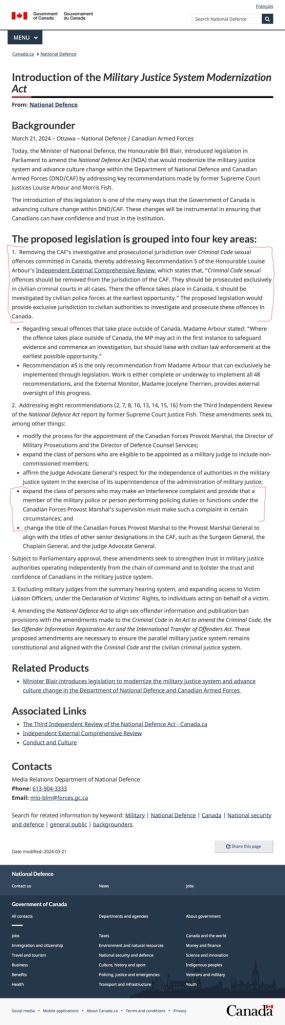
If you haven’t paid attention to the media over the last few days you missed out on some major changes coming to the Canadian Armed Forces.
The Minister of National Defence is calling for the removal of sexual assault from the purview of the Canadian Forces Military Police Group, including the Canadian Forces National Investigation Service.
The Minister is requesting that all sexual assaults that occur on Defence Establishments in Canada be investigated and prosecuted by the civilian police and the civilian justice system.
I will be very curious to see how this affects military dependents that were sexually abused on military bases in Canada, especially in the days prior to 1998.
I also wonder how this will affect pre-1998 child sexual assault investigations that rely on access to the service files of retired service personnel.
This of course is 13 years and three weeks too late to be of any benefit to me.
In my case the CFNIS, the Provost Marshal, and the Canadian Forces will always be able to say that the Military Police Complaints Commission and Federal Court justice Yves De Montigny found no issues with the 2012 MPCC investigation which in turn found no issues with the 2011 CFNIS investigation and therefore the 2011 CFNIS investigation was an example of superb police work.
That of course only works so long as the CFNIS, the Provost Marshal, and the Canadian Forces forget to tell the Canadian public that they willingly withheld from the Military Police Complaints Commission and ultimately Federal Court Justice Yves De Montigny the fact that the CFNIS in 2011 had in their possession the 1980 CFSIU investigation paperwork, and the 1980 Court Martial transcripts that show that it was the babysitter’s abuse of young children that brought him to the attention of the base military police and that this subsequently brought Captain Father Angus McRae to the attention of the CFSIU which found that McRae had been molesting well over 25 children on the base and that McRae had been obfuscating this abuse by administering alcohol to the children that he was abusing in the rectory of the chapel.
I also like the fact that the Minister of National Defence is willing to expand those who can make interference complaints to the Military Police Complaints Commission. Up to now the only persons who can make complaints are the investigators with the military police or the CFNIS. But if your superior gives you a “lawful command” is that really interference?
The destruction of evidence by the CFNIS is nothing new to me.
There was a recent story in the Ottawa Citizen by David Pugliese. It had to do with the CFNIS being ordered by a commanding officer who wasn’t even in the military police hierarchy ordering the destruction of evidence in a CFNIS investigation. Due to the chain of command structure within the Canadian Armed Forces, the CFNIS had no choice but to comply with the order.
Now, if you’ve been following this blog, or my other blog at http://cfbnamao.ca you understand that I’ve been very leery of the claim by the Canadian Armed Forces that the CFNIS are “outside of the chain of command”.
During the investigation of my complaint against Peter, my babysitter from Canadian Forces Base Namao, there were many questionable issues with the investigation, but none so alarming as what happened on May 3rd and May 4th during my interactions with CFNIS investigator Mcpl Christian Cyr.
On May 3rd, 2011, just before lunch, Mcpl Cyr called me and left me a message on my phone to call him back immediately.
When I called him back, Cyr kept pressing me to understand that Peter was only 12 or 13 in the spring of 1980. However, as we all know, Peter was born in June of 1965.
The funny thing is, Peter’s CPIC file would have his correct date of birth, which is in June of 1965. The only place that Peter’s age is misstated is in the CFSIU transcript.
And, there’s no way that Peter was under the age of 14 at the time of McRae’s court martial. The Canadian Forces could only conduct a court martial for Gross Indecency and Indecent assault if the victim was over the age of consent, which was 14 in 1980. If the Canadian Forces wanted to try Captain McRae for gross indecency and indecent assault against children under the age of 14, the CF would have had to hand this case over to the civilian courts.
Near what should have been the end of the phone call, Mcpl Cyr just blurted out the matter of Captain Father Angus McRae. I broke down and lost my composure when he mentioned that the base chaplain had been arrested and charged with molesting children during the same period of time that I was accusing Peter of molesting myself and my brother.
Further, I told Mcpl Cyr about the five visits to the living quarters at the chapel in which Peter would escort me over from different parts of the base and that I never remembered anything after the sickly sweet grape juice. I don’t remember leaving the chapel. And I don’t remember how I got back home.
I had to leave work early as I was sickened and nauseated by what I discovered when I did a simple Google search for “CFB Namao Molesting Priest” on one of the computers at work.
When I got home from work I did some more searching for information on McRae.
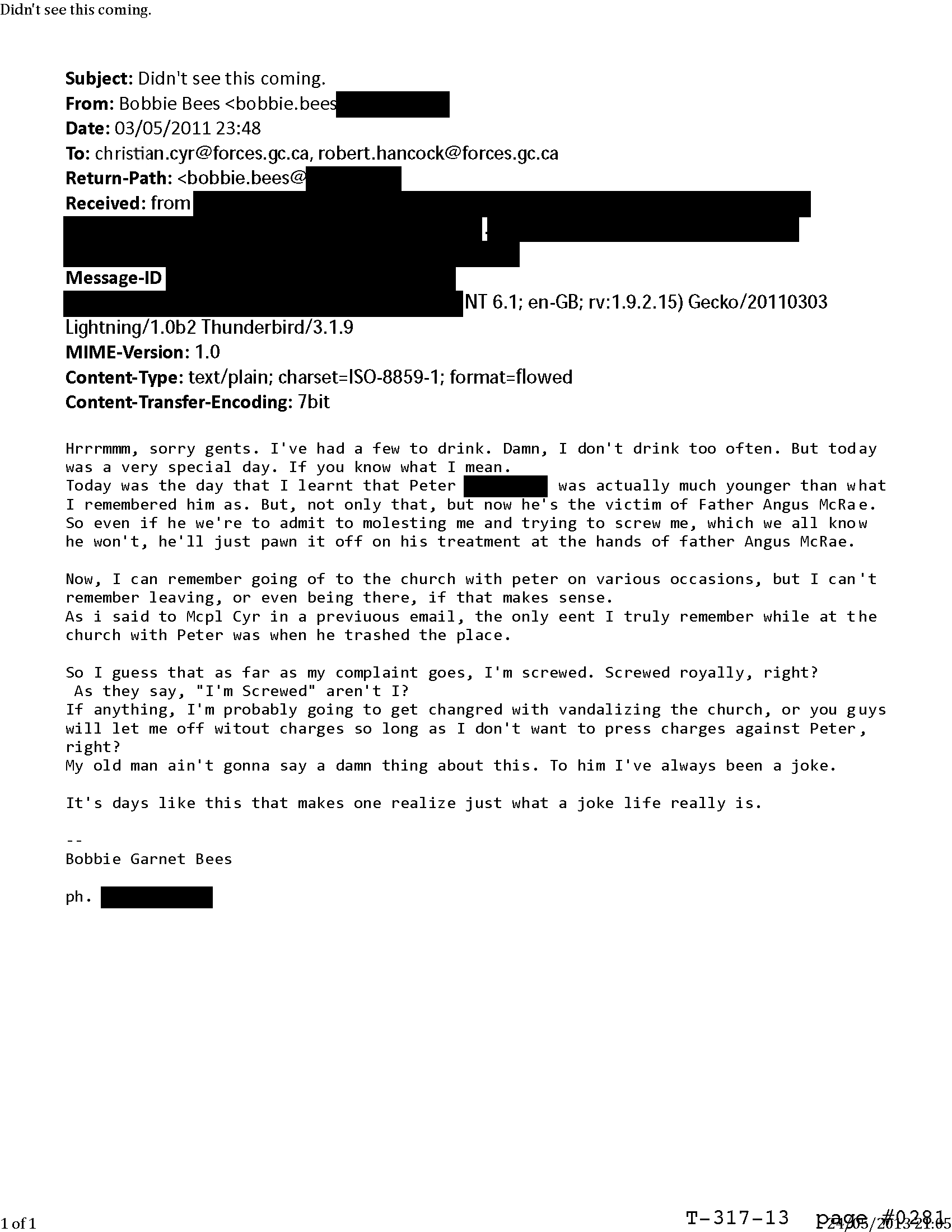
I sent off a pair of emails that evening to Mcpl Cyr.
First email sent to CyrOur Lady of Loreto Chapel Second email to CyrEmails that I sent to Mcpl Cyr after he called me at workThese are Mcpl Cyr’s notes of the telephone conversationThis is the SAMPIS record of Mcpl Cyr’s interaction with me.
It should be noted from above that the first item #4 is incorrect. I told Mcpl Cyr that I remembered 5 visits that Peter had taken me on over to the chapel to see Captain McRae. All of the five visits ended with what I remembered as being a “sickly sweet grape juice”. I told Mcpl Cyr that I didn’t remember anything after the “grape juice”, not even how I got home from the chapel.
Just as an aside, and for the record. In October of 2020 with the assistance of Ottawa Citizen and Defence Watch writer David Pugliese, the DND and the Minister of National Defence conceded in their fight to keep Captain McRae’s Court Martial Transcripts away from me.
According to the Military Police Complaints Commission, the CFNIS had access to these court martial records as well as the CFSIU investigation paperwork from 1980.
Why is this important?
Warrant Officer Frederick Cunningham being examined during Captain McRae’s Court Martial
Me. The fucker gave me wine.
I wouldn’t learn until 2013 when I received the Certified Tribunal Records from the Military Police Complaints Commission that Mcpl Cyr had been creative with what I told him, and he also failed to mention the receipt of my emails in his notebooks or occurrence reports.
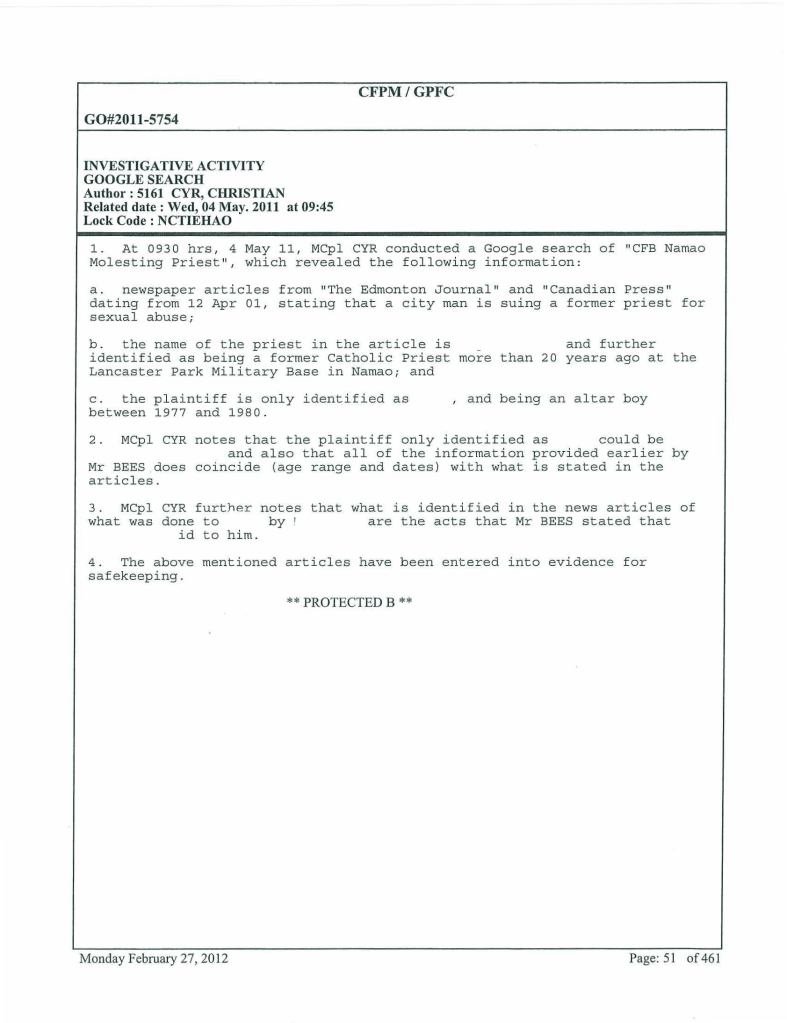
Cyr does a Google Search
So here, Mcpl Cyr does a Google search for an exact phrase that I searched for the day previous which I mentioned in an email that he fails to indicate that he received.
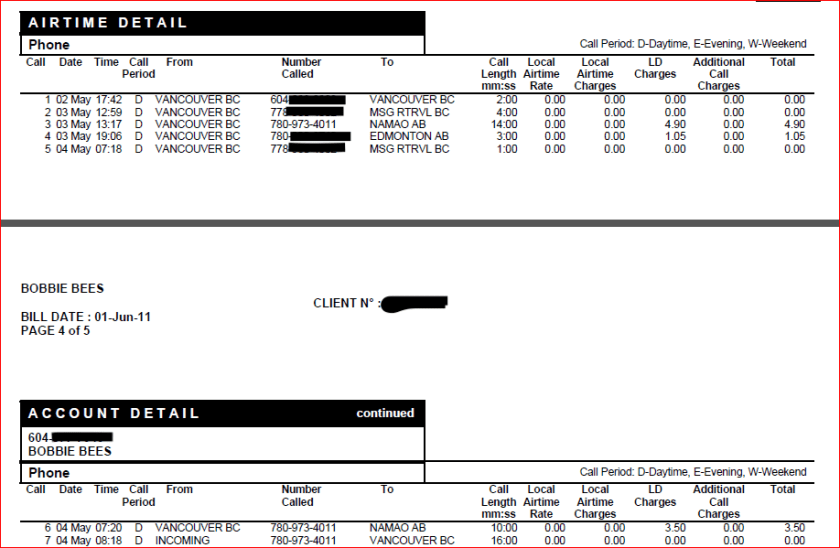
On the morning of May 4th, 2011 I called Mcpl Cyr and told him more information about the rectory.
Call #3 was the call I made to Mcpl Cyr on May 3rd, 2011 Call #6 was the call I made to Mcpl Cyr on May 4th, 2011
It was during this phone call that Mcpl Cyr informed me that there never was a rectory at the chapel, and that the chapel that I had indicated on my email was a new chapel, the chapel that was on the base when I lived there in ’79 to ’80 was in a different place. He also said that the padre never lived on the base. This phone call is not mentioned anywhere in his log book or his SAMPIS report.
Well, the blueprints for Our Lady or Loreto Chapel show the rectory.
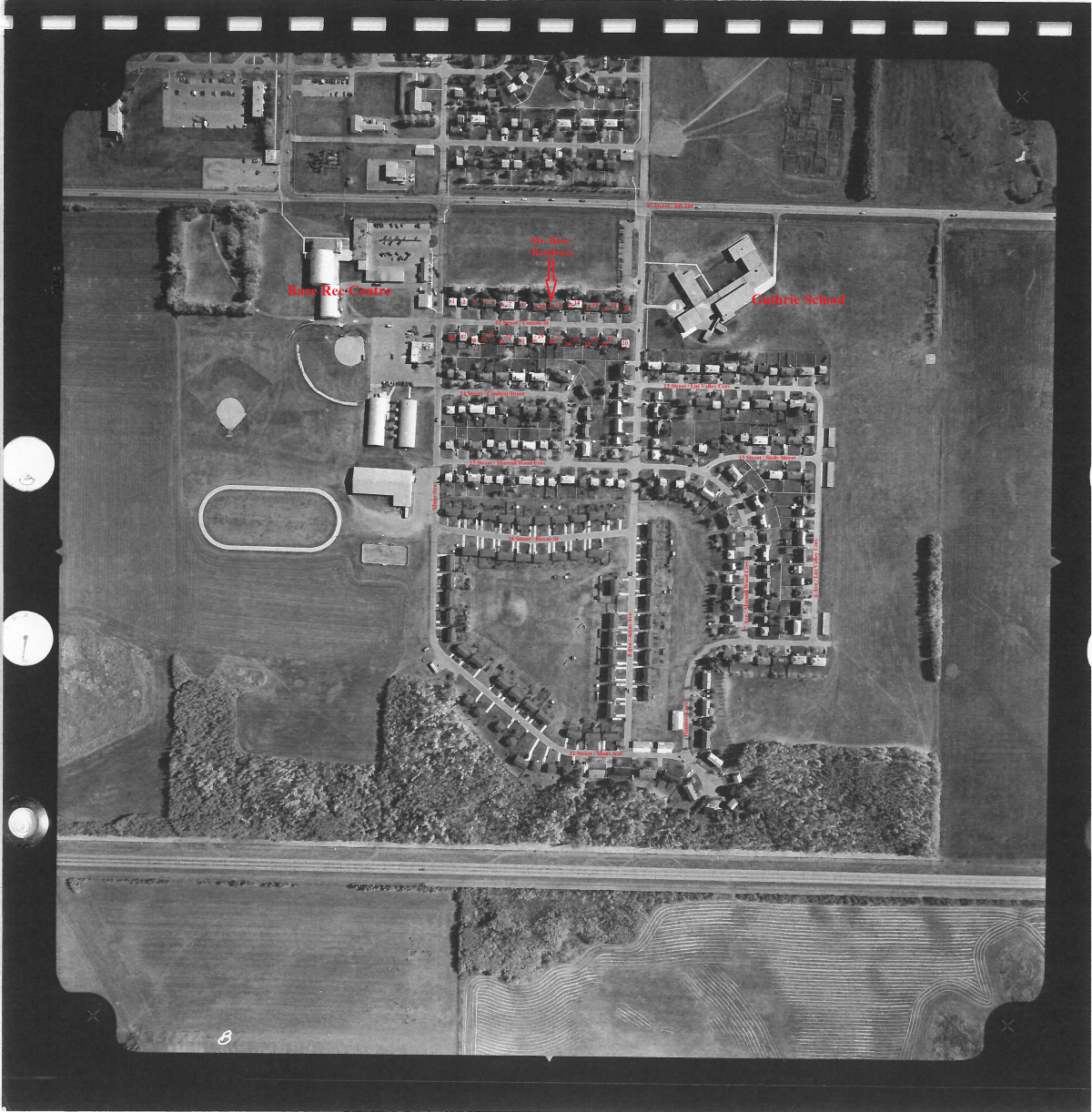
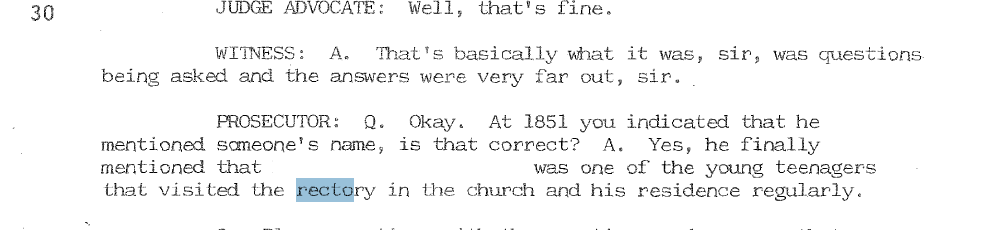
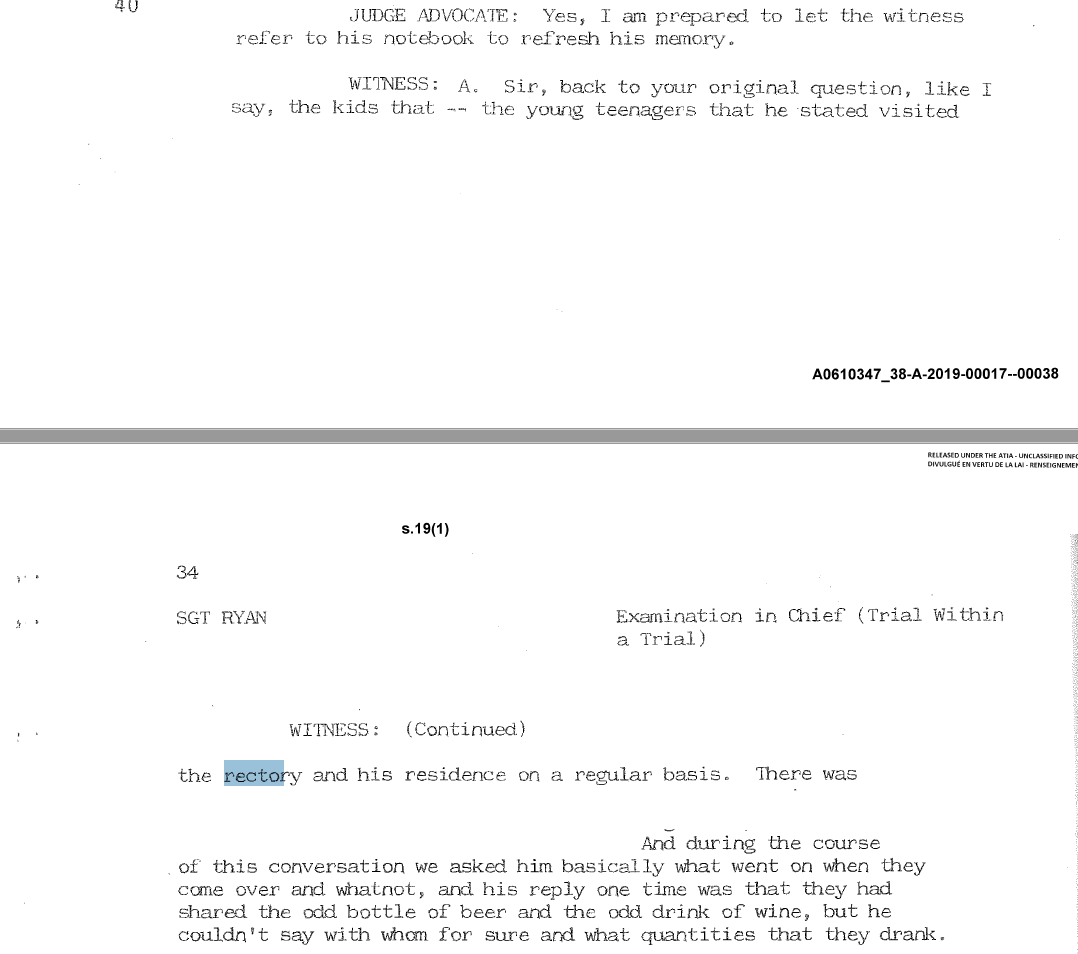
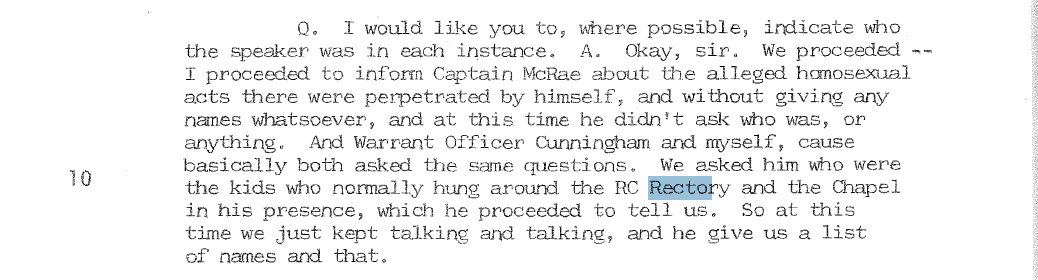
The red circle highlights the Rectory. The dates on these drawings are hard to make out, but the blueprints were drawn for The Royal Canadian Air Force HQ. The RCAF ceased to exist in 1968.RectoryRectoryRectoryRectoryRectoryIn Captain McRae’s court martial transcript, there are 33 mentions of “RECTORY”
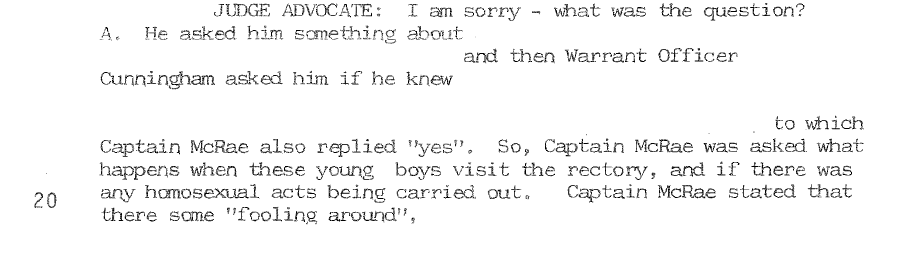
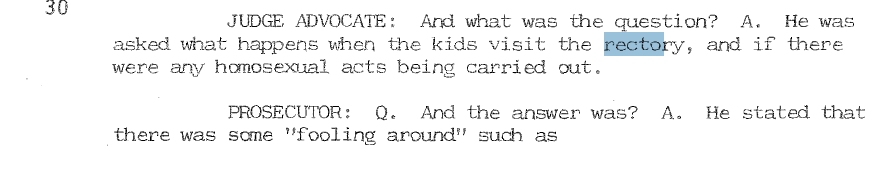
See the CFNIS had Captain McRae’s court martial transcript. The CFNIS had the CFSIU investigation paperwork. In that paperwork was this document from McRae’s Court Martial transcript.
Angus McRae’s admission to the Catholic Church that he had been committing “homosexual acts” with several minors over the past couple of years.
Peter was the main witness for the prosecution. Peter’s testimony is completely blanked out in Captain McRae’s court martial transcript. However, the Military Police Complaints Commission was kind enough to summarize how Peter came to be involved with the prosecution of Captain McRae.
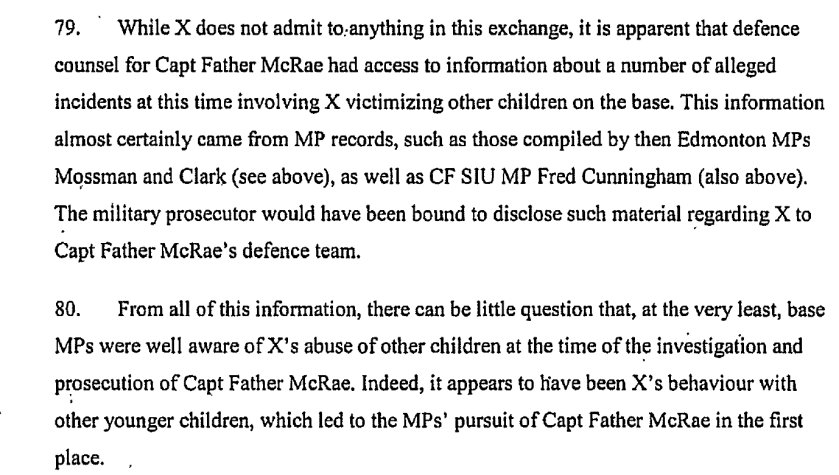
In the MPCC final report, the MPCC indicates that the court martial transcripts indicate this about Mr. X Mr. X is Peter, my babysitter.
Peter was the only boy that Captain McRae was actually charged with abusing, even though the Canadian Forces Special Investigation Unit knew in 1980 that he had been molesting more than just Peter.
In 2011 the CFNIS knew.
In 2011 the Provost Marshal knew.
In 2011 the Judge Advocate General would have known.
In 2011 the Vice Chief of Defence staff would have known.
In 2011 the Chief of Defence Staff would have known.
In 2011 the office of the Minister of National Defence would have know.
As soon as the Alberta Serious Incident Response Team transferred my complaint against Peter from the Edmonton Police Service to the Canadian Forces National Investigation Service the CFNIS would have known who Peter was and what risk my complaint against Peter posed to the Canadian Armed Forces.
And this is why ANY mention of Captain Father Angus McRae was removed from the CFNIS investigation GO 2011-5754.
Someone up the chain of command had made the decision that my complaint against Peter was to go absolutely no where.
The knew the liability risk that this would pose if a connection was made between myself, Peter, and Captain Father Angus McRae.
This is why I fully believe that my father was encouraged to “forget” that his mother was raising my brother and I. There could be absolutely no way of linking Peter to us, especially not in the authority roll as our babysitter.
When I went to Federal Court in 2013 asking for the court to quash the findings of the 2012 MPCC review the Attorney General of Canada argued that the CFNIS were correct to strike any mention of Captain McRae from CFNIS investigation GO 2011-5754 as my complaint had been against Peter S. and not Captain McRae. The Justice hearing my matter agreed with the Attorney General on this point.
I’ll tell you first hand, this lunacy, and this subterfuge is enough to drive a sane person mad.










 Beeshive