The complete lack of concern for the mental health of its members.

In late August of 1985 my brother and I flew back from Edmonton after having spent the entire summer staying with our grandmother in Edmonton.

Upon our return to Canadian Forces Base Downsview in Ontario our father had to alert the base military police to our arrival back home.

The military police came to talk to my brother and I about a rage-out that our father had in the PMQ that had contributed a significant amount of damage to the PMQ and required 3 military police officers to bring him under control.

Richard’s rage-outs were nothing new, but during this one he had completely lost control and smashed out all of the ground floor windows and damaged a lot of the furniture.

Richard used to self medicate by getting himself pickled drunk. But since Sue moved in with us in the summer of 1980, she tried to get Richard to sober up.

Richard also had a thing for prescription pain meds. Beyond that I can’t say if he was ever into hard drugs or not. But yes, he was an alcoholic.

And by not self medicating, Richard’s physical rage and temper would often peak at boiling over.

The military police implored my brother and I to NOT call 9-1-1 but to instead call the base military police as the Toronto cops couldn’t just come on to the base.

The two military police officers told us that we shouldn’t call for help unless we got out of the PMQ first, and that we should be prepared to jump from the second story of the PMQ if we had to get away from Richard.

Looking back I now realize that the base military police didn’t want us calling 9-1-1 as the civilian police were duty bound to report domestic violence to civilian social services where as the military police and the Canadian Armed Forcesliked to keep things in house an out from under the noses of those nosey civilians.

The MPs gave my brother and I business cards with the direct phone number for the MPs so that we didn’t have to go through base switchboard.

I was going to go show one of my friends the business card and tell him how the military police promised me that they would protect me from Richard and his anger outbursts as the MPs had heard things from the neighbours about the way Richard treated my brother and I.

Bill Parker intercepted me as I walked across the common lawn that the PMQs surrounded.

Bob! Bob, come here, I need to talk to you.

Bill promised me that if my father ever got angry again that I could come stay with his family, just like my mother and I had done on Canadian Forces Base Shearwater. I would find out about the CFB Sheawater “Battered wives club” in the 2010’s.

I showed Bill the business card and told Bill that if the fucker ever hit me again that I’d call the military police and they’d come take care of Richard. Bill told me that I had to take it easy on my father, that I simply didn’t understand what my father had been through and how the Canadian Forces had abandoned him.

Bill went on to explain something about my father having sailed to England with the Sea Kings in 1969 and that there had been an explosion in the engine room on one of the ships and that my father lost three of his drinking buddies from when he had been in the Navy.

“Bob, I wish you knew your father before that. He was a completely different man. He would have been nice.”

Bill implored me to never ask my father about this, that I was supposed to keep this a secret and just understand and accept my father’s anger and temper.

August of 1985 was long before the advent of Netscape Navigator and Google.

I was in Sea Cadets at the time, so I devised a way in which I’d ask my father about this “engine room explosion” without asking him directly about it.

I came home one night after cadets and told him that as part of studying naval history in the Canadian Navy that I was supposed to write a report on ship explosions that would have occurred in 1969.

The blood drained from his face, his cigarette hung from his lower lip, and his fists clenched up. All he said was that if I ever asked him a question like that again that I wouldn’t have to worry about ship explosions because of my broken neck.

It was the early 2000’s when I discovered the HMCS Kootenay incident that occurred in October of 1969 when the ships from CFB Halifax and the Sea Kings from CFB Shearwater were returning from exercises to the UK. It wasn’t an engine that exploded. It was oil vapour in a high-speed gear box that ignited due to an overheated main bearing. 11 members of the navy died. The explosion had been swift and hot. It was so hot that it melted all of the aluminum ladders that lead out of the engine room / gear box room.

My father had been on the Kootenay in his navy days before unification gave him the opportunity to get out of the Navy and into the Air Force. His name won’t show up on any of the ship’s registers as he was with the Sea Kings in the Air Force and not the Navy.

When I met my mother, Marie, in 2013 she confirmed Richard’s involvement with the Kootenay incident saying that Richard became a different man in the days and weeks after. His drinking had increased, his violence increased, he started to exhibit a hair trigger temper.

When Richard was posted to CFB Summerside his temper and his drinking became even worse, hence why she tried to take my bother and I back to Nova Scotia to stay with our uncle Al, but why she ended up being ejected from the PMQ by the base military police.

I met a gentleman by the name of Chris Legerre in the summer of 2014 when I went to Halifax to see the city that I had been born in 42 years previously. Chris had been on the HMCS Kootenay on the day of the gearbox explosion.

Yep, the Canadian Armed Forces literally and figuratively fucked everyone over that had been involved in the incident. A complete lack of compassion. No mental health treatment, nada, zip, zilch. Drug use became rampant amongst the survivors. Families of the deceased were booted out of the military housing with absolutely no compassion shown to the kids.

And you’d think that things would have changed in the last 55 years, but you’d be sadly fucking mistaken.

The Canadian Armed Forces and the Department of National Defence don’t give one sliver of a flying fuck about the mental health of the members of the Canadian Forces . And from my personal experience the Canadian Armed Forces care even less about the family members of mentally ill service members that have to experience the untreated mental illness of the serving member.

See, in my day of living on the bases in Canada military dependents were of absolutely no concern to the Canadian Armed Forces and the Department of National Defence. We were referred to as D.F.&E., Dependents, furniture, and effects. It took lobbying by the Ombudsman to get the Canadian Armed Forces to change this and to stop lumping dependents in as the personal belonging of the serving member.

But that really didn’t change things.

David Pugliese of the Ottawa Citizen posted a link to a story by Morgan Lowrie of National News Watch that was about two member of the Canadian Armed Forces that committed suicide. They were brothers. Both had served in Afghanistan. The article talks about how the Canadian Armed Forces are going to give the mother of the two soldiers a silver star. The article however mentions nothing about the spouses of the deceased members, nor the children of the deceased members.

https://nationalnewswatch.com/2024/11/01/new-brunswick-woman-who-lost-two-sons-to-ptsd-named-national-silver-cross-mother

Children of service members that die in action or die as a result of committing suicide due to mental stress endured during service should automatically receive guaranteed scholarships to college or university or support through trade school.

Spouses should receive compensation up until the retirement age of the service member.

The Canadian Armed Forces asks a lot from its service members, and by extension it asks a lot from the families of the service members.

It should then have to look after the families of service members, and stop treating military dependents like an afterthought.

The Canadian Forces, Suicide, and Military Dependents.

I honestly don’t believe that at any point in time the mental health wellbeing of military dependents has ever been a concern of the Canadian Armed Forces or the Department of National Defence.

Sure, the DND, the CF, and the Minister of National Defence will bloviate about the Military Family Resource Centre and other meaningless programs that the DND and the CF have instituted over the years.

But if they really cared, why does the CF and the DND draw such a hard line in the sand as to which dependents they will support, and which dependents can piss off and go get bent?

In my day as a military dependent the maximum age for a dependent to live in a PMQ on base was 18. The only way you could remain living in the PMQ after your 19th birthday was if you were mentally disabled or if you were attending an institution of higher learning. But even if you were attending an institution of higher learning 24 was the maximum age that you could live in a PMQ on base.

In my day dependents were officially referred to as “D.F.& E.” which means “Dependents, Furniture, and Effects”. The Office of the Ombudsman for the Canadian Forces, which only existed as of 1999, was so taken back by this callousness that they kept asking DND to stop dehumanizing the military dependents and to stop referring to them as D.F.& E. which implied that military dependents were of no more worth than the service member’s furniture.

As a kid, there were times when kids would just stop coming to school. Or kids would just one day leave the base. Never to be seen again. And this wasn’t due to postings. If it was a posting nine times out of ten the posting would occur between late June and early September. These absences were often due to their serving parent dying. Training exercise, workplace incident, health issue, it didn’t matter. PMQs could only be rented to active service members. Deceased persons cannot serve in the military. So off the base the family went.

It was rare that a base commander would intervene and make an exception, because once you’ve made one exception how can you not make another? And allowing the deceased member’s family to remain on base in a PMQ could prove to be an issue for DND and the CF. DND and the CF had fought numerous court battles over the PMQs with regard to civilian family courts granting the non-serving spouse possession of the PMQ in which to raise their children. DND would obviously have an issue on their hands if non-serving spouses were suddenly taking possession of PMQs in the PMQ patches. And schools on base prior to 1994 were run by DND and the CF. These schools were exclusively for the children of active service members. How long was the DND and the CF supposed to support the education of a deceased member’s children?

So, back in my day once a service member died, that was it, the DND and the CF washed their hands of the service member’s dependents.

There was no support.

There was no aftercare.

There was nothing.

We weren’t eligible for social programs from the provinces related to a serving parent’s death as the provinces considered that the be the responsibility of the DND and the CF.

Living on base wasn’t as easy as it’s often portrayed.

The children of dysfunctional families were often tormented and ostracized by their peers. When you live in a regimented community like a military PMQ patch you either conform or you will have trouble.

Dysfunctional parents, like my father, could easily use the Canadian Forces to stay one step ahead of civilian social services. Sure civilian parents could move to a different town, but at great expense. In the Canadian Forces your dysfunctional parent’s moving and travel expenses were covered.

Back in my day the military social workers were more concerned with containing problems. But again, that’s the way the military functioned back then and still functions to this day.

The rank of your serving parent had its privilege, especially if your serving parent was an officer or above. Anybody who says that this wasn’t the case is absolutely full of shit.

There was no way that the base military police were going to go after the son of a Lt. Col. for beating the crap out of the son of a Corporal. No Warrant Officer MP is going to risk getting transferred to CFS Alert over two kids having a donnybrook out behind the rec centre. And yes, this still holds true to today. The provost marshal himself even said that he would never investigate a senior officer of the military.

https://www.thestar.com/politics/federal/2021/12/03/publicly-the-head-of-canadas-military-police-said-hed-investigate-any-officer-privately-he-said-that-didnt-include-his-boss.html

Sure, Simon Trudeau was talking about investigating his commanding officer. However, if his commanding officer is good buddies with a lower ranking officer, and the Trudeau’s commander doesn’t want the PM to investigate the other lower ranking officer who is the Trudeau to argue with a lawful command from his superior?

Don’t forget, the Canadian Forces didn’t have a Provost Marshal from about 1968 until the office of the Provost Marshal was stood up again in 1998. Prior to that, the base military police and even the Canadian Forces Special Investigations Unit were under the influence of the local chain of command. Yes, when the CFNIS was created in 1998 along with the Provost Marshal being stood back up, the idea was that the CFNIS and the base military police would operate without chain of command influence. That’s all fine and dandy, but someone forget to rewrite the National Defence Act and the Queen’s Regulations and Orders to exempt members of the CFNIS and the base military police from section 83 of the National Defence Act.

The Provost Marshal was stood up in 1998 as a result of the findings of the Somalia Inquiry. The Inquiry found that the base military police and the CFSIU were ripe for interference from the local chain of command and that superior officers would often put their own parochial interests above any semblance of justice. So it was suggested that the command of the base military police and the new CFNIS be transferred to the command of the freshly stood up Provost Marshal who would be of significant enough rank that they would be immune from chain of command influence. That hasn’t worked out.

How many wife beatings or child beatings were the base MPs and the CFSIU told to ignore and look away from?

And as I said, things were far worse back in my day as a military dependent.

As retired Warrant Officer Fred Cunningham told the CFNIS in 2016 when he was interviewed, the Assistant Judge Advocate General threw Cunningham and the CFSIU “to the dogs” in 1980 during the Captain Father Angus McRae Investigation and subsequent court martial.

When I spoke with retired Warrant Officer Fred Cunningham on November 27th, 2011 he said that it was the “brass” that made the decision to limit the number of charges brought against Captain McRae and that the military police had “many, many more” charges ready to go against McRae but that the “brass” wasn’t going for it, and that the military police tried to move the Captain McRae matter into the civilian system, but again the brass wasn’t going for it.

Most of Captain McRae’s victims were under 14 years of age. In 1980 the age of consent at which a child could agree to have sex with an adult was 14. P.S. was the only boy over the age of 14. If the Canadian Forces had insisted on prosecuting Captain McRae for abusing the children under the age of consent, this whole matter would have had to have been moved into the civilian courts. For obvious reasons the Department of National Defence and the Canadian Armed Forces were not going to ever agree to this as in the civilian courts the DND and the CF would be hard pressed to “throw a veil of secrecy” over the trial and the evidence. A trial and evidence that would have shown that Captain McRae sexually abused over 25 children on Canadian Forces Base Namao and an untold number of children on Canadian Forces Station Holberg, Canadian Forces Base Portage La Prairie, and Canadian Forces Base Kingston.

So the fact that the “brass” and the “AJAG” were able to insert themselves into a criminal matter again shows that rank in the Canadian Armed Forces carries a significant amount of weight.

And according to retired Warrant Officer Fred Cunningham it was also the Assistant Judge Advocate General that made the decision to not call in the Royal Canadian Mounted Police to deal with P.S. under the false assumption that P.S. was only 12 years old in 1980. P.S. was born on June 20th, 1965. P.S. turned 15 on June 20th, 1980. And as the court martial transcripts and the CFSIU paperwork indicate, it was the abuse of young children on base that brought P.S. to the attention of the base military police and it was that attention that brought Captin McRae to the attention of the CFSIU.

Again, the base military police and the CFSIU were not independent. They followed the whims and desires of the chain of command.

That’s why spousal abuse was grossly under reported on the bases.

That’s why child sexual abuse was grossly under reported on the bases.

That’s why child physical and mental abuse was grossly under reported on the bases.

Far too much chain of command influence and far too many parochial decisions.

Most of the children from CFB Namao never received any form of meaningful help. Some went on to have troubled lives. Some have attempted suicide. Some have committed suicide. And that’s only on CFB Namao. What about the other bases that McRae was at?

In 2010 retired Brigadier General Roger Bazin was investigated by the CFSIU for having sexually abused a young boy on Canadian Forces Base Borden in 1974. How many other kids, now adults, are out there that may have been abused on Canadian Forces Base Borden who have never come forward due to not knowing their abuser’s name? How many other former military dependents have never come forward because they were posted around so many times that they can’t remember on which base the abuse occurred on?

Our attempts at suicide and our suicides will never be recorded as being military related. Our deaths and our psychological trauma will always be written off as having been due to something unrelated to our time living on base as children.

When I die it won’t be recorded as being the end result of untreated childhood sexual trauma.

My death will simply be recorded as someone who sought Medical Assistance in Dying due to psychological issues caused by childhood trauma.

And that’s it.

There will be no mention of Captain Father Angus McRae;

There will be no mention of Captain Terry Totzke;

There will be no mention of Colonel Dan Munro

There will be no mention of AJAG J.D. Boan.

The media won’t really show any interest, because what’s interesting about one person seeking M.A.i.D. to get away from their demons?

Between 1950 and today, how many military dependents have attempted suicide, committed suicide, or have wound up with profound psychological issues due to the childhood spent living on military bases?

No one knows.

And the Department of National Defence and the Canadian Armed Forces would love for it to stay this way.

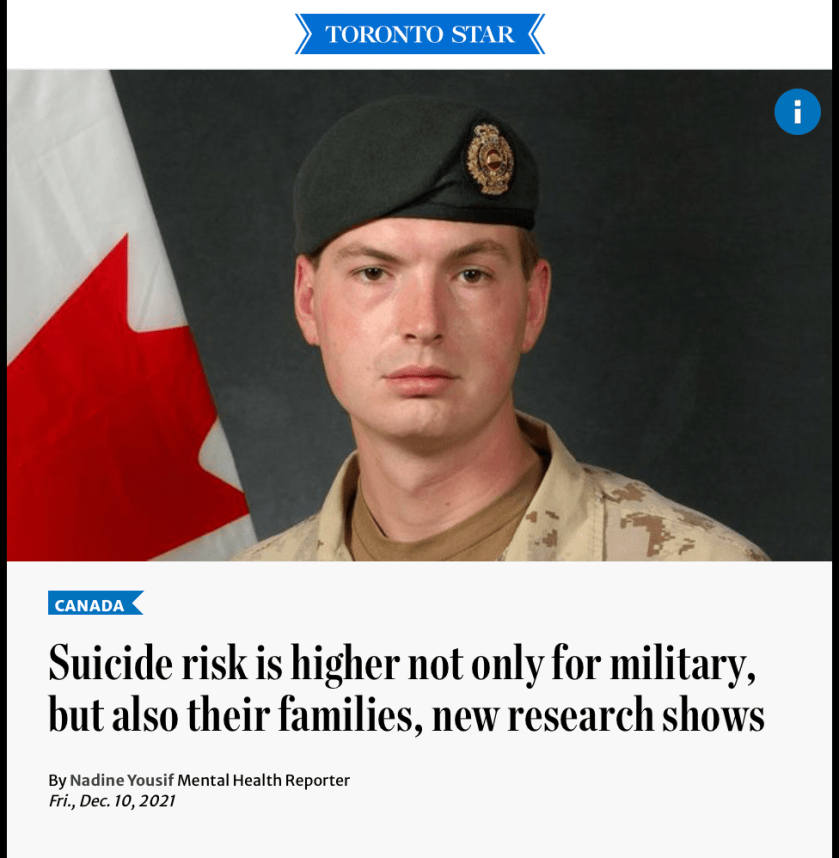
https://www.thestar.com/amp/news/canada/2021/12/09/suicide-risk-is-higher-not-only-for-military-but-also-their-families-new-research-shows.html
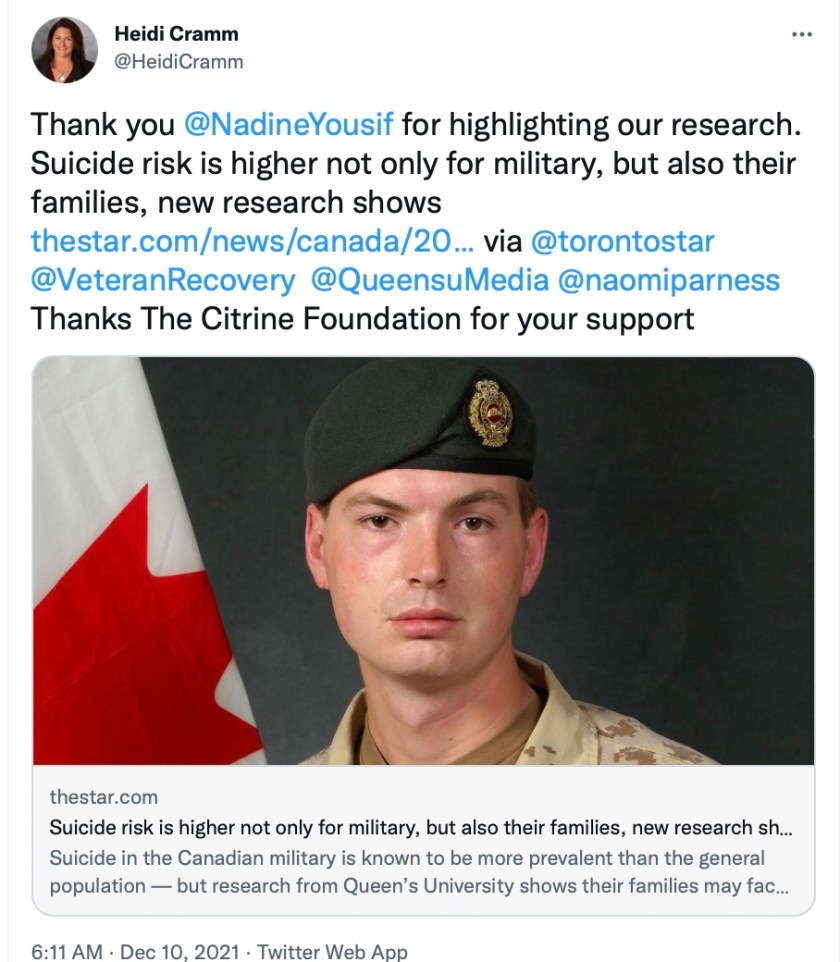
https://twitter.com/HeidiCramm/status/1469308730797920261?s=20
https://veteransmentalhealth.ca/about-us/events/families-matter/

In the past there have been murmurs and burbles of organizations noticing that children of service members or adult who once were children living on base are committing suicide.

However, sadly this latest research falls well short of other research projects in the past.

The common flaw being that these researchers overlook events that occurred on base and how these events impacted the children living on the bases. This current research looks at how events that impacted service members might lead to family members of the service member committing suicide. For example, if a serving member of the Canadian Forces commits suicide and then their parent commits suicide.

However, what this research seems to completely overlook and omit are suicides or attempted suicides that came about due to events that occurred on the base that the military dependent endured first hand and received little or no support after the event or received inappropriate support.

Like it or not, children were sexually abused on base, children were physically abused on base, children were neglected on base, children were ostracized on base, children couldn’t cope with postings, children couldn’t cope with constantly losing friends, children had to deal with serving parents that had issues made worse by military service such as excessive drinking, anger outbursts, and untreated PTSD.

Persons who lived on base between the 1950s and the 2000’s grew up in a very homophobic, LGBTQ phobic, misogynistic, environment in which psychological issues were to be hidden away and not discussed.

Is it any wonder that no one in the DND, the CF, or even the media really wants to tackle this subject.

Kids who committed suicide already will forever be silent, so the DND and the CF don’t have to worry about them ever talking.

Kids who were 8 years old on base in 1950 are now in their late 70s. They won’t be around for much longer.

Kids who were 8 years old on the bases in 1970 are now pushing 58. Even if the CF and the DND were serious about tackling issues that may have effected these persons, by the time DND and the CF have finished the requisite number of committee meetings these people will easily be in their late 60s and early 70s.

So far as the Government of Canada, the DND, and the CF are concerned, military dependents were never the responsibility of the DND or the CF. As such, they’re more than willing to play the waiting game until we’re all gone.

I’ll be gone in about 2 years. And that’ll be one less issue for the DND and the CF to worry about.