Psychiatry, Silence, and the Cost of Survival

Let me be very clear about something.

Modern psychiatry is not primarily about repairing damaged minds. In practice, it is far more often about teaching damaged people how to function quietly—how to mask distress, suppress history, and remain acceptable to everyone else. Recovery is measured less by relief from suffering than by how little discomfort one causes others.

If you’ve followed my story, you’ll know that my first sustained contact with psychiatry and social services came in 1980 during the aftermath of the Captain Father Angus McRae child sexual abuse scandal on Canadian Forces Base Namao.

Three Systems, One Child

During that period, I was trapped between three systems, each with competing priorities:

  • the military social work system,
  • the civilian child welfare system, and
  • a deeply dysfunctional family, headed by a low-ranking CAF member struggling with untreated psychiatric issues, alcoholism, anger, and fear for his own career.

My civilian social workers recognized that my home environment was harmful and attempted to remove me from it. My military social worker, however, worked just as hard to prevent that outcome—not because civilian foster care was inherently worse, but because civilian intervention threatened military control of the situation.

This distinction matters.

Because my family lived in military housing on CFB Griesbach, Alberta Social Services could not simply enter the base and remove me. Civilian court orders had little practical force on base. Jurisdictional ambiguity worked entirely in the military’s favour.

Containing the McRae Scandal

At the same time, the Canadian Armed Forces and the Department of National Defence were doing everything possible to keep the McRae scandal minimized and out of public view. The decision to move McRae’s court martial in camera—despite the general rule that courts martial are public—was not incidental.

From an institutional perspective, it was far more convenient to present the case as involving a single fourteen-year-old boy, the then-legal age of consent in 1980, framed as “homosexual activity,” than to acknowledge the reality: more than twenty-five children, some as young as four.

Under military law, sentences were served concurrently. Whether McRae abused one child or twenty-five, the maximum punishment remained the same. The difference lay only in public perception.

Blame as a Containment Strategy

This context explains much of what followed.

Captain Totzke, the military psychiatrist assigned to me, appeared deeply invested in ensuring that I—not the system, not the institution—was framed as the source of dysfunction. Civilian social workers were treated as adversaries. The unspoken fear was that if I were removed from my father’s care and placed into foster or residential care, I might stabilize, improve, and begin speaking openly about what had happened on CFB Namao.

Instead of being treated for trauma-induced depression, I was told—explicitly—that I suffered from a mental illness called “homosexuality.” I was warned that I would end up in jail. I was told I was a pervert for having “allowed” my brother to be abused.

I was informed by Captain Totzke that he had the military police watching me, and that any expression of affection toward another boy would result in confinement at a psychiatric hospital. I was barred from change rooms, removed from team sports, and excluded from normal childhood activities under the justification that I could not be trusted to control myself even though I had been the victim of the abuse and not the abuser. In the military’s lens at the time, any sexual encounter between two males, no matter the age difference or the lack of consent, was treated as an indication of homosexuality. The victim was just as guilty as the perpetrator.

Age and Diagnosis

I was six years old when my family arrived on CFB Namao. I was eight when the abuse was discovered. Psychiatric intervention began about four months later just after my 9th birthday. By that point I was diagnosed with major depression, severe anxiety, haphephobia, and an intense fear of men. My father was so angry with me for having been found being abused that I was terrified that he was going to kill me.

None of these conditions were meaningfully treated.

What I did learn was how to perform wellness—how to mask distress just well enough to avoid punishment. That skill would define my later interactions with mental health professionals and the world in general. When I’d go for counselling with my civilian social workers, my father and Totzke would often warn me to watch what I said to the civilian social workers as they’d “twist my words” to make it sound as if I had said things that I didn’t say.

The Mask Never Comes Off

For decades afterward, my attempts at counselling followed a familiar pattern. My history was unwelcome. My symptoms were reframed as resistance. The stock phrases appeared reliably:

  • “Stop living in the past.”
  • “Move on.”
  • “You don’t want to change.”
  • “You’re playing the victim.”

It was not until 2011, when I finally received my own records, that I understood how early—and how thoroughly—my life had been derailed.

Group therapy or one-on-one it didn’t matter. Especially back in the days before I had obtained my social services paperwork. My inability to get out of bed on consistently was just because I’d stay up too late. My ability to sleep for days on end and miss work was just because I was a lazy asshole. My preference to be left alone was nothing more than my superiority complex. My debilitating fear of courses and exams wasn’t due to low self esteem, hell no, it was that I thought that I was too good.

Medical Assistance in Dying

For a while now I have been very open about my desire to access Medical Assistance in Dying.

What continues to astonish me is how many people believe this wish can be dissolved through optimism, pharmacology, or spiritual novelty. Ketamine infusions, microdosing, mantras—anything except acknowledging that some damage is permanent, and that survival itself can be a form of ongoing harm.

Don’t forget, in my case it wasn’t that the sexual abuse was unknown and no one ever knew about the issues I was facing. The CFB Namao child sexual abuse scandal was well known about in the military community. My diagnoses were known to my father and to Captain Totzke. But I wasn’t allowed to receive any help due to the desire to keep the proverbial “lid on things”.

Statistics and Comforting Fictions

This is why much of the anti-MAiD commentary rings hollow.

Recent opinion pieces lean heavily on selective statistics about suicide attempts and “recovery,” while ignoring the realities of under-reporting, stigma, misclassification of deaths, and survivorship bias.

Suicide statistics rely on narrow definitions: notes, explicit intent, immediate death. Overdoses are coded as accidental. Single-vehicle crashes are ambiguous. Deaths occurring months or years after catastrophic attempts are often excluded entirely.

The result is a comforting fiction.

A failed suicide attempt is not a victory. Often, it is survival driven by fear—not of death, but of catastrophic impairment. That fear should not be celebrated as evidence of restored hope or desire to live.

What Psychiatry Refuses to Admit

If psychiatry were being honest, it would admit what it does not know: the precise causes of depression, why some people do not recover, why treatment sometimes merely dulls experience rather than alleviating suffering.

It would also acknowledge the role of compliance and performance—the pressure to appear “better” so as not to be labeled the problem.

Instead, responsibility is quietly transferred back onto the patient.

And that, more than anything, is what I am unwilling to accept anymore.

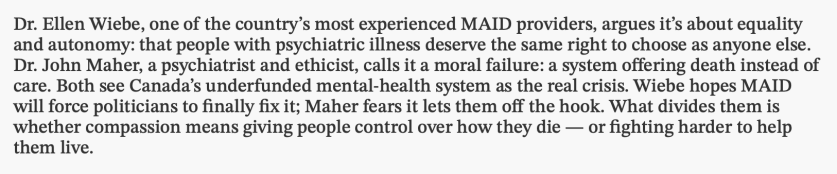
Recently in the Toronto Star was an opinion piece

M.A.i.D. really isn’t an issue that requires “both sidesing”, but that’s what this opinion piece strives to do. It tries to mush a person’s right to self determination with personal opinions. And sadly the writer of the opinion piece concludes that if Canada could only fix its mental health system, then everyone would live happily ever after

Dr. Maher is dead set against M.A.i.D., to him any psychiatric illness can be easily treated, and if it can’t then the person should simply hold on and wait for a treatment that might possibly eventually work.

Dr. Maher was interviewed for an article published by the Canadian Mental Health Association.

https://cmhastarttalking.ca/from-pallbearer-to-psychiatrist-how-childhood-loss-propels-one-of-canadas-leading-medical-ethicists/

I have some questions for Dr. Maher.

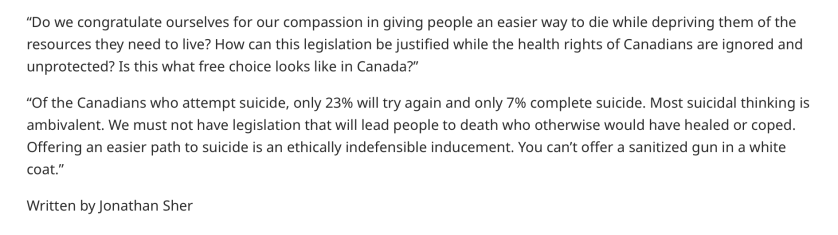
23% of what? What is the number of Canadians that attempt suicide? 10 people, 100 people, 1,000 people, 100,000 people? How many people are we talking about?

Do we even know how many people attempt to commit suicide every year?

How many overdoses or single vehicle collisions are actually suicides?

How many people killed during risk taking activities are actually suicides?

How many work place “accidents” are actually suicides?

How many times does the coroner resist calling a death a suicide to spare the family the stigma of a suicide death?

How many times does the lack of a note cause the police and others to overlook a suicide?

How many people attempt suicide only to back away at the last moment, not out of the fear of dying, but out of the fear of fucking it up and ending up living for 20 years as a vegetable in a nursing home?

How many people that have attempted suicide never try to commit suicide again, not because they don’t want to take another attempt, but because their first attempt left them either physically or cognitively unable to make another attempt?

I guess we’ll never know.

And that’s sad.

This lack of understanding allows suicide to be pawned off as some random irrational behaviour that is driven by temporary bouts of sadness that some people just get too hysterical about instead of admitting that the human brain has an actual breaking point that once crossed can never be uncrossed.

Is there any chance?

Is there any chance that I will pass up on Medical Assistance in Dying?

No.

But Bobbie, aren’t you on hormones?

Yes, yes I am.

And aren’t you on anti-depressants?

Yes, yes I am.

Well then, you should be feeling much better, you should be happy.

No. No I’m not, and it’s nothing to do with being happy.

My brain is burnt out.

I can’t escape the ghosts of so many years ago.

40 years of untreated mental illness has taken its toll.

40 years of living with the fallout of Captain Totzke.

A dysfunctional childhood spent hopping from one Canadian Forces base to another being raised by a rage fuelled alcoholic and his cruel alcoholic mother.

I’m going through with the hormones because this is something that I always wanted to do. This was something that I would not have been able to undertake when I was younger. But the hormones won’t fix a damaged brain nor will the hormones erase 40 years of horrific memories.

I get the feeling that society believes that I owe it to society to fix myself and to live so that I continue to be a benefit to society.

I owe nothing to society.

Society in fact owed it to me to allow me to enjoy a normal childhood and a normal adulthood. Society instead said that it valued the image and prestige of the Canadian Armed Forces over my well-being. And as such society really has lost its “right” to tell me that I have live because I owe it to society.

Well, why don’t you commit suicide?

I’ve known for a very long time that if I were to commit suicide that the babysitter and my father would win and their version of reality would become my truth.

Since learning the whole entire truth about the events that occurred on Canadian Forces Base Namao and how the modern day Canadian Armed Forces are so very hellbent on keeping the secrets of child sexual abuse on Canadian Forces hidden from the public consciousness, committing suicide would be giving the Canadian Forces an easy way out. And you can bet your bottom dollar that the Canadian Forces would pull out all of the stops to tar and feather my name.

So, you’re not really going to take your own life, you’re just doing this for theatrics, right?

Nope. Just waiting to see if the Department of Justice or the Canadian Armed Forces are willing to do the right thing or if they’re going to do everything in their power to keep this matter hidden and buried from the public eye.

The hospital where I work is in the process of moving. The new facility is supposed to be opened by 2027. The acute portion of the hospital is expected to transfer from the old site to the new site in a couple of weeks. The old hospital will stay in operation for a little while longer as it will have to support the various research programs on site until the new research building is constructed. I’ve already made it very clear that I have no interest in going to the new site, that I’m more than content to stay at the old site and run it until I either decide to pull the plug or the site shuts down.

Management for the most part doesn’t know why I have no interest in going to the new site, but there are a few managers that do. Some co-workers know of my plans, but most don’t.

My plan for when I decide the time is right to die is to simply announce that I’ve received an excellent job offer in the maritimes and that I want to take it as I want to return to Nova Scotia to retire there.

And that’s it.

The complete lack of concern for the mental health of its members.

In late August of 1985 my brother and I flew back from Edmonton after having spent the entire summer staying with our grandmother in Edmonton.

Upon our return to Canadian Forces Base Downsview in Ontario our father had to alert the base military police to our arrival back home.

The military police came to talk to my brother and I about a rage-out that our father had in the PMQ that had contributed a significant amount of damage to the PMQ and required 3 military police officers to bring him under control.

Richard’s rage-outs were nothing new, but during this one he had completely lost control and smashed out all of the ground floor windows and damaged a lot of the furniture.

Richard used to self medicate by getting himself pickled drunk. But since Sue moved in with us in the summer of 1980, she tried to get Richard to sober up.

Richard also had a thing for prescription pain meds. Beyond that I can’t say if he was ever into hard drugs or not. But yes, he was an alcoholic.

And by not self medicating, Richard’s physical rage and temper would often peak at boiling over.

The military police implored my brother and I to NOT call 9-1-1 but to instead call the base military police as the Toronto cops couldn’t just come on to the base.

The two military police officers told us that we shouldn’t call for help unless we got out of the PMQ first, and that we should be prepared to jump from the second story of the PMQ if we had to get away from Richard.

Looking back I now realize that the base military police didn’t want us calling 9-1-1 as the civilian police were duty bound to report domestic violence to civilian social services where as the military police and the Canadian Armed Forcesliked to keep things in house an out from under the noses of those nosey civilians.

The MPs gave my brother and I business cards with the direct phone number for the MPs so that we didn’t have to go through base switchboard.

I was going to go show one of my friends the business card and tell him how the military police promised me that they would protect me from Richard and his anger outbursts as the MPs had heard things from the neighbours about the way Richard treated my brother and I.

Bill Parker intercepted me as I walked across the common lawn that the PMQs surrounded.

Bob! Bob, come here, I need to talk to you.

Bill promised me that if my father ever got angry again that I could come stay with his family, just like my mother and I had done on Canadian Forces Base Shearwater. I would find out about the CFB Sheawater “Battered wives club” in the 2010’s.

I showed Bill the business card and told Bill that if the fucker ever hit me again that I’d call the military police and they’d come take care of Richard. Bill told me that I had to take it easy on my father, that I simply didn’t understand what my father had been through and how the Canadian Forces had abandoned him.

Bill went on to explain something about my father having sailed to England with the Sea Kings in 1969 and that there had been an explosion in the engine room on one of the ships and that my father lost three of his drinking buddies from when he had been in the Navy.

“Bob, I wish you knew your father before that. He was a completely different man. He would have been nice.”

Bill implored me to never ask my father about this, that I was supposed to keep this a secret and just understand and accept my father’s anger and temper.

August of 1985 was long before the advent of Netscape Navigator and Google.

I was in Sea Cadets at the time, so I devised a way in which I’d ask my father about this “engine room explosion” without asking him directly about it.

I came home one night after cadets and told him that as part of studying naval history in the Canadian Navy that I was supposed to write a report on ship explosions that would have occurred in 1969.

The blood drained from his face, his cigarette hung from his lower lip, and his fists clenched up. All he said was that if I ever asked him a question like that again that I wouldn’t have to worry about ship explosions because of my broken neck.

It was the early 2000’s when I discovered the HMCS Kootenay incident that occurred in October of 1969 when the ships from CFB Halifax and the Sea Kings from CFB Shearwater were returning from exercises to the UK. It wasn’t an engine that exploded. It was oil vapour in a high-speed gear box that ignited due to an overheated main bearing. 11 members of the navy died. The explosion had been swift and hot. It was so hot that it melted all of the aluminum ladders that lead out of the engine room / gear box room.

My father had been on the Kootenay in his navy days before unification gave him the opportunity to get out of the Navy and into the Air Force. His name won’t show up on any of the ship’s registers as he was with the Sea Kings in the Air Force and not the Navy.

When I met my mother, Marie, in 2013 she confirmed Richard’s involvement with the Kootenay incident saying that Richard became a different man in the days and weeks after. His drinking had increased, his violence increased, he started to exhibit a hair trigger temper.

When Richard was posted to CFB Summerside his temper and his drinking became even worse, hence why she tried to take my bother and I back to Nova Scotia to stay with our uncle Al, but why she ended up being ejected from the PMQ by the base military police.

I met a gentleman by the name of Chris Legerre in the summer of 2014 when I went to Halifax to see the city that I had been born in 42 years previously. Chris had been on the HMCS Kootenay on the day of the gearbox explosion.

Yep, the Canadian Armed Forces literally and figuratively fucked everyone over that had been involved in the incident. A complete lack of compassion. No mental health treatment, nada, zip, zilch. Drug use became rampant amongst the survivors. Families of the deceased were booted out of the military housing with absolutely no compassion shown to the kids.

And you’d think that things would have changed in the last 55 years, but you’d be sadly fucking mistaken.

The Canadian Armed Forces and the Department of National Defence don’t give one sliver of a flying fuck about the mental health of the members of the Canadian Forces . And from my personal experience the Canadian Armed Forces care even less about the family members of mentally ill service members that have to experience the untreated mental illness of the serving member.

See, in my day of living on the bases in Canada military dependents were of absolutely no concern to the Canadian Armed Forces and the Department of National Defence. We were referred to as D.F.&E., Dependents, furniture, and effects. It took lobbying by the Ombudsman to get the Canadian Armed Forces to change this and to stop lumping dependents in as the personal belonging of the serving member.

But that really didn’t change things.

David Pugliese of the Ottawa Citizen posted a link to a story by Morgan Lowrie of National News Watch that was about two member of the Canadian Armed Forces that committed suicide. They were brothers. Both had served in Afghanistan. The article talks about how the Canadian Armed Forces are going to give the mother of the two soldiers a silver star. The article however mentions nothing about the spouses of the deceased members, nor the children of the deceased members.

https://nationalnewswatch.com/2024/11/01/new-brunswick-woman-who-lost-two-sons-to-ptsd-named-national-silver-cross-mother

Children of service members that die in action or die as a result of committing suicide due to mental stress endured during service should automatically receive guaranteed scholarships to college or university or support through trade school.

Spouses should receive compensation up until the retirement age of the service member.

The Canadian Armed Forces asks a lot from its service members, and by extension it asks a lot from the families of the service members.

It should then have to look after the families of service members, and stop treating military dependents like an afterthought.

Suicide / Physician Assisted Suicide / Euthanasia / Medical Assistance in Dying.

Not much to say here, other than I try to describe the difference between suicide, physician assisted suicide, euthanasia, and medical assistance in dying.

Okay, so I’m going to talk to the best of my abilities about what the differences between Suicide, Physician Assisted Suicide, Euthanasia, and Medical Assistance in Dying are. There really are no clear definitions used universally and some terms are used solely to stigmatize medical assistance in dying.

Suicide is an act of desperation. Suicide is the act of a mind that is so overwhelmed with emotions that it cannot think straight. If you’ve never suffered from major depression you’ll never know how tempting suicide is. Suicide is one of those things that no one ever talks about. As a society, we’re very hush-hush about this to the point that we like to pretend that it doesn’t exist. And if society does acknowledge the existence of suicide society often talks about how crazy the person was that committed suicide and how selfish they were and how much pain and suffering they selfishly inflicted upon others.

Suicide is often not planned for and as such family members, relatives, friends and co-workers can often be left devastated. Family members are often left wondering why their loved one committed suicide and if there were any signs they missed and if there was something they could have done. Suicide often has impacts on others as well such as the landlord or property owner that finds the body. The first responders and bystanders who may have witnessed the suicide will be affected.

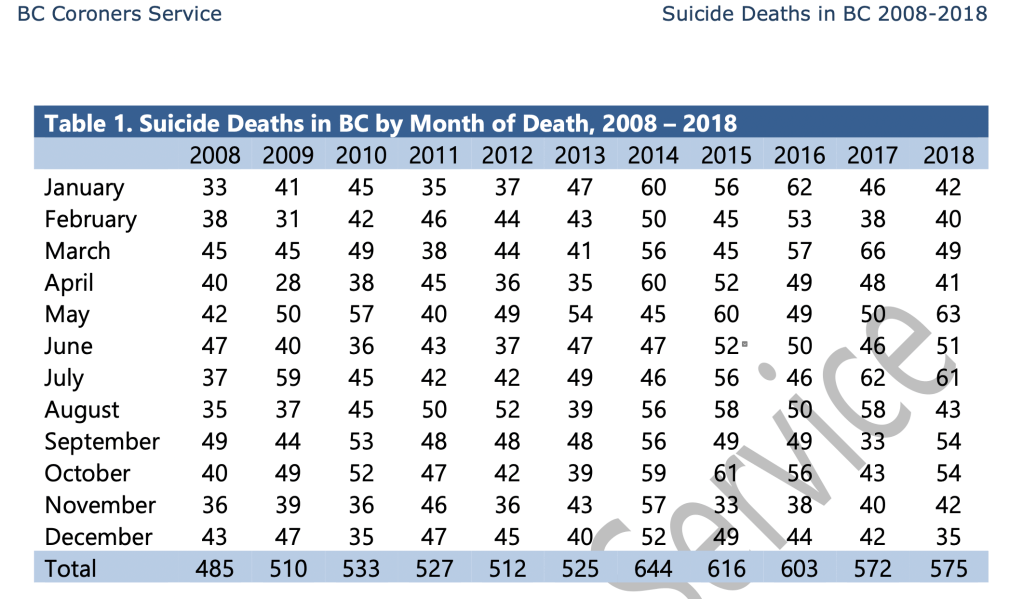
How many suicides are there every year? This table is from the BC Coroner’s service.

6,102 people successfully committed suicide in the ten year period starting in 2008. I don’t remember hearing a single news story about these people, do you? Society again thinks that by not talking about suicide that suicide will just simply disappear.

What are the common methods of suicide?

When was the last time you heard of a suicide on the Skytrain? Next time, pay attention to the “Medical Emergency” announcement. Yet between 2008 and 2018 there were 32 successful suicides on the Skytrain. The most prevalent method of suicide is the rather barbaric method of hanging. Let’s be honest, self hanging is NOT the same as hanging used as execution. There is very little chance that the person using hanging as a method will know how to do the proper calculations to ensure a quick death.

And it should go without saying, but committing suicide by Skytrain or railway is not a guaranteed way to go. More often than not you will survive with horrific injuries that will haunt you for the rest of your life.

What is often not discussed is the number of suicide attempts per year. The only stats I can find say that in Canada on any given day 275 people attempt suicide. That’s over 100,000 people per year.

I am not a neurologist, but it’s safe to say that the human brain is fragile and can easily be damaged and not just by physical trauma. The human brain can easily be damaged by traumatic experiences. Because the human brain relies on chemicals to transmit and receive signals any disruptions to these chemicals can cause long term effects. The longer a person suffers from untreated major depression and severe anxiety the more profound the damage becomes.

No amount of telling a depressed person to not be sad or instead to think happy thoughts will fix brain damage caused by trauma. And in the end, no amount of medication of therapy will reverse the psychological damage caused by trauma.

However, the events leading up to suicide tend to be very short term problems that could possibly be dealt with if the person committing suicide believed that they had someone to listen to them.

Physician Assisted Suicide.

Physician assisted suicide is a term that fell out of favour just as quickly as it entered the national vocabulary. When a person with an incurable medical condition wishes to end their life so as not to prolong their needless suffering, they are not committing suicide. And as such, the physician supplying the medication is not assisting in a suicide.

Euthanasia.

Euthanasia is a term for when a person, typically a doctor, uses medications to end the life of a patient typically without the consent of the patient. Euthanasia is pretty well illegal just about everywhere in the world. The only place that anything close to Euthanasia is practiced in on death row when prisoners are executed.

As much as I am in favour of any mentally competent adult, and children in very strictly controlled circumstances, ending their life for any medical or psychological issue, I don’t think that physicians should be able to decide on their own, or the next of kin for that matter, should be allowed to end the life of another person without very careful consideration from the courts.

Medical Assistance in Dying.

M.A.i.D. is the term for when a person applies to use medications prescribed for the sole purpose of dying. As I’ve said before, M.A.i.D. is something that has to be applied for, and it has to be planned for. When I apply for M.A.i.D. I can promise you that there will be a battery of tests that I will have to go through. It will not be as simple as me just going to my doctor and asking for a note.

Unlike suicide, almost every detail of M.A.i.D. is planned out from start to finish.

And unlike suicide, the medications used will ensure a proper death and not just an attempt.

If the proper drugs are used in the proper dosages the person undergoing the procedure will not feel pain and will not even be aware of their death.

And because M.A.i.D. is always undertaken with a sound, rational, and lucid mind, the person undergoing the procedure can stop the procedure at any time right up until the loss of consciousness. For obvious reasons you can’t withdraw your consent once the Propofol hits your brain.

And yes, during the entire M.A.i.D. process from application to the final day, the person electing to undergo the procedure will be frequently asked if they wish to continue forth or if they want to abandon the procedure.

The where, when, and how will be scheduled like clockwork. There will be no corpse for an unsuspecting landlord or relative to discover. Arrangements are typically made for the disposal of the body after the procedure. There will be no curious absence from work. People who need to be informed will be informed. And the answers as to why will be available to anyone who asks.

Why? Why do you want to kill yourself.

I prefer the term “going to sleep”. Kill implies violence. I’m just going to sleep. A sleep like the 18,250 sleeps that I’ve gone through in my life. Just that this is a sleep that I will never rouse from.

For 42 years now I’ve had to deal with the fallout from CFB Namao. What happened on that base is not something that one can simply get over and forget about. Then there’s the after effects of being swept up in the desire of the Department of National Defence and the Canadian Armed Forces to keep the actions of P.S. and Captain McRae under wraps least the Canadian public discover what happened.

The Canadian Forces determined that my mental health and my mental wellbeing were sacrificial to the greater cause. Whether or not you like to admit it, the Canadian Forces chain of command sentenced me to death in 1980.

For 42 years I lived with and internalized major depression, severe anxiety, gender and orientation confusion, the inability to form friendships, the inability to form intimate relationships, the inability to enjoy life.

I’m 50 years old now. Seriously, I’m now fifty as I type this out. I honestly never thought that I would live to see this milestone.

I am very tired. I’ve fought the depression and the anxiety for as long as I could. I’ve hidden the depression and anxiety with every fibre in my body. I’ve tried my hardest to appear normal. But I am damaged. To say that I am not damaged is to minimize what occurred on Canadian Forces Base Namao when I was 7 to 8-1/2. To say that I am not damaged is to minimize my mistreatment at the hands of Captain Terry Totzke from age 9 to 11-1/2. To say that I am not damaged is to overlook the fact that I was supposed to have been institutionalized due to how bad my mental health had deteriorated by the time I was 11 years old.

I am damaged due to the wilful neglect of others. I am damaged due to the fact that others kept me from receiving timely counselling, therapy, and medication.

The damage was allowed to fester untreated and unmanaged for almost 42 years now.

There is no fixing this damage.

Just because I no longer cry myself to sleep at night doesn’t mean that this damage doesn’t affect me anymore. It just means that I’ve run out of tears to cry and I am almost completely dead on the inside.

The time for “fixing” me was in 1980. Not 2021.

My entire life was wasted because DND and the CF had a secret to hide.

I am actually at peace with myself now.

The more I think about how close I am to the end and how peaceful the transition from living to dead will be I become filled with a feeling of serenity. It’s actually a beautiful peaceful feeling.

I have a lot of unwanted people living in my skull, and they won’t voluntarily leave. They need to be forcefully evicted.
P.S.;
Captain Father Angus McRae;
The man in the sauna;
Captain Terry Totzke;
My father, Mcpl Richard Wayne Gill;
The other victims of P.S. that I keep seeing him abuse over and over;
Earl Ray Stevens;
And many others.

When I go to sleep they’ll never bother me again.

When I go to sleep my major depression and my severe anxiety will never trouble me again.

When I go to sleep I will never wake up in the middle of the night due to horrific dreams.

When I go to sleep I will never again grind my teeth down to nothing.

When I go to sleep I will never be crushed under the weight of a severe anxiety attack.

When I go to sleep my gender and orientation issues will never bother me again.

When I go to sleep all I will ever know is silence.

And after the life that I’ve been through never ending silence is fine by me.