
Do I have much faith in the RCMP?
Not really.
In 2011, after having talked to a few ex-JAG legal officers who were now practising private law, on their advice I contacted the RCMP to have my investigation removed from the CFNIS and handled by the RCMP. This was based on the fact that what I had initially reported to the Edmonton Police service before the EPS handed the case to the CFNIS was child-on-child sexual abuse. Definitely nowhere near the realm of a service offence.
I found out by talking to the local RCMP out here that civilian offences committed on Canadian Forces Base Namao were the jurisdiction of the RCMP Morinville detachment.
I called the Morinville RCMP detachment and I spoke with a Corporal F.
Corporal F. took my information and said that he would get back to me after he looked into this.
He called me a few days later and said that my matter belonged solely to the CFNIS and that the CFNIS would call the RCMP if they needed help.
After PO Steve Morris had called me on November 4th to tell me that the “CFNIS couldn’t find anything to indicate that the babysitter was capable of what I had accused him of” I made my plea on Facebook in the various base brat groups for contact information for anyone who knew anything about the Captain Father Angus McRae child sexual abuse scandal. This is how I was put in contact with retired Warrant Officer Fredrick R. Cunningham, who as it turned out was the Acting Section Commander of the Canadian Forces Special Investigations Unit in 1980 and had been personally charged by base security officer Captain David Pilling with investigating Captain McRae for having committed “acts of homosexuality” with young boys on the base.
When I spoke with Fred he made it very clear that the military police AND the chain of command were aware that the babysitter had been molesting children and this is what led the military to discovering the actions of Captain McRae. Cunningham also said that it was “the brass” that dropped all of the charges against McRae and only allowed the charges related to the babysitter to go to court martial. Cunningham had said that in 1980 the military police tried to bring in the RCMP to deal with the babysitter but that “the brass” would not allow this.
As I had no idea of who Fred Cunningham really was or what his relationship to the military was in 1980 I sent an FOI to the RCMP looking to see if my name had been mentioned in relation to any investigation of the babysitter that may have occurred in 1980.
I was fucking furious when I received the reply to my request.
It had nothing to say about 1980.
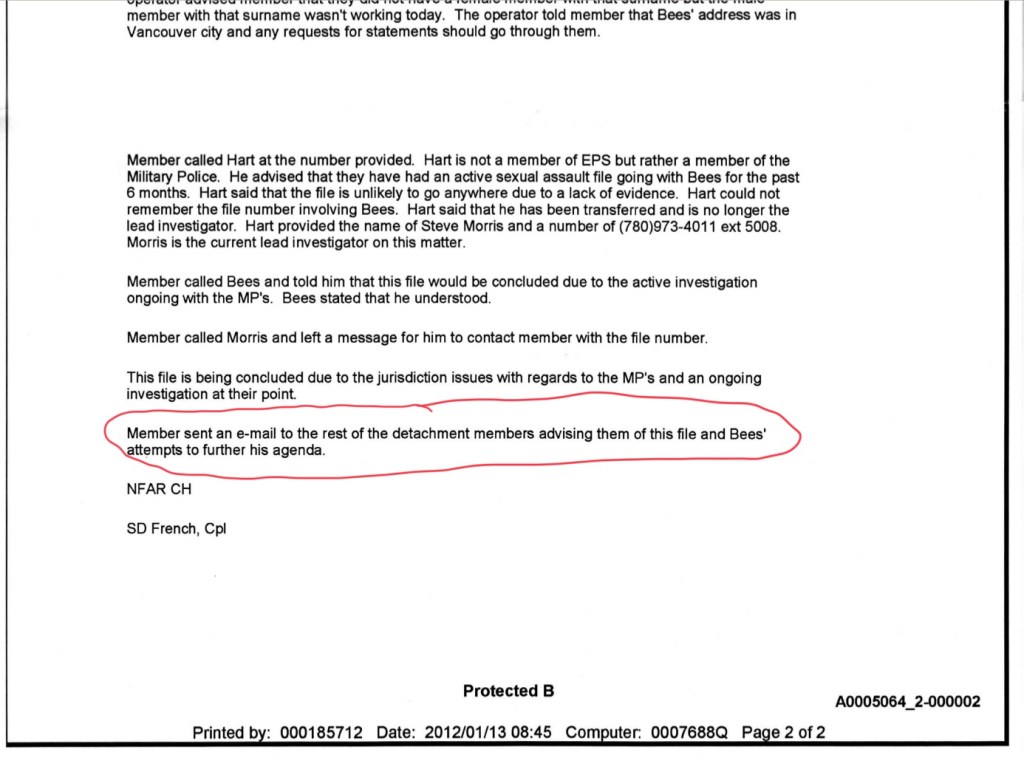
It instead was a copy of the incident report generated by Corporal F. of the Morinville detachment.

“Active sexual assault file going with Bees for the past six months”
Didn’t realize that there were six months between July 28th, 2011 and March 28th, 2011.
“Member sent an e-mail to the rest of the detachment members advising them of this file and Bees’ attempts to further his agenda”
What a fucking asshole.
Didn’t realize that wanting justice was “an agenda”.
Makes me sound like a crazed nut like the unabomber…..
Anyways, when I saw this I filed a conduct complaint with the RCMP.
Corporal Robb was assigned to this matter.
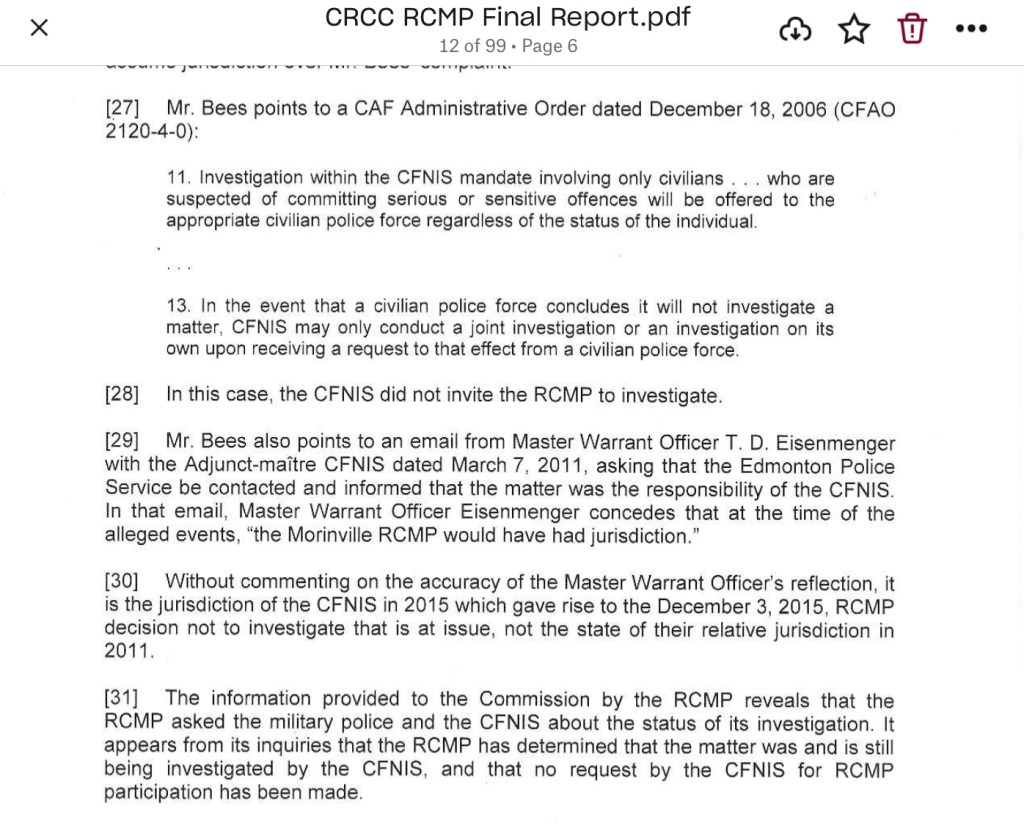
Corporal Robb was great. He listened to what my concerns were. He did his research and concluded that no, the CFNIS should not have taken this case from the EPS but should have directed the EPS to contact the RCMP as the RCMP has always had jurisdiction for civilian on civilian matters on defence establishments but that now that the CFNIS had the matter there was little the RCMP could do to take the matter away from the CFNIS.
But he also said that based upon the information that I gave him about the babysitter which was corroborated by the August 1985 Edmonton Journal newspaper article naming the babysitter that there was no way that the CFNIS should have ever concluded that there was no evidence to indicate that the babysitter was capable of what I accused him of. Corporal Robb wouldn’t give me the details, just the years.
Mr Bees, your babysitter was arrested and convicted in:
1982, 1984, 1985, 1986, 1989, 1990, with many more charges being stayed or dismissed. And the majority of these offences involved children.
These dates would later be confirmed by the Military Police Complaints Commission in 2013 and 2019.
I had also asked Mr. Robb to do me a favour and tell me if there was any reason for me to be afraid to cross the border. I explained to him that I knew my brother had used my name when he had been arrested when we were younger, and I didn’t want any surprises at the border. He said that nothing came back.
The complaint against Corporal F. was concluded shortly after that. I think that Sheldon had a talk with F. and F. realized that the CFNIS was being far less than truthful. I can only hope that Sheldon made it clear to Corporal F. that it was the CFNIS that had the agenda and not I.
Fast forward to 2017.
After having become aware that my father had kidnapped my brother and I when we were kids I approached the RCMP to file a complaint.
I attended the RCMP detachment in North Vancouver and I had brought copies of my ATIs from the PEI Govt., my Alberta Social Services reports, my Children’s Aid Society of Toronto reports, the Defence Establishment Trespass Regs. and a report commissioned by the Canadian Armed Forces that looked at spousal abuse in the military community, as well as my mother’s statements to me.
The intake officer couldn’t have cared any less.
Maybe your father and mother reached an agreement.
Maybe your mother just ran off like your father said.
My father had always told me when I was young that my mother was a whore that would spread her legs for anyone and that she ran off with a guy named Gus from the PPCLI.
All I remember about when my mother left my father was away with the airforce so she packed up our suitcases and dropped my brother and I off with another family in the military housing. Then she was gone.
This was the first time that our grandmother came from Alberta to live with us. She lived with us from just after my mother leaving until the late spring of 1978 when she moved back to Edmonton.
And that’s the story that I lived with until around 2013 when a woman named Pat Longmore contacted me after having read my blog. The first thing she asked was if I was “Rick and Marie’s” kid. I said that I was. She explained that she knew my father and my mother and that we were frequent guests at her PMQ whenever my father would start drinking. She said that Marie would show up with fat lips or bruises and that I would sometimes be sporting bruises.
I mentioned to her that in 1985, after my father lost his temper in the PMQ on Canadian Forces Base Downsview that Bill Parker had intercepted me and that he told me that if I needed a place to stay while my father cooled down in the future that my brother and I were welcome to come stay at his house, just like we used to on CFB Shearwater.
Pat said that yes, that both Pat and Nancy along with a few of the other women on CFB Shearwater ran the “battered wives club” and that they would arrange safe housing for military wives either at another PMQ or a safe house off the base. She explained that Dartmouth Social Services and Halifax Social Services were often very reluctant to get involved with military families due to jurisdictional issues.
I had also made contact with the PEI government that confirmed that my father had filed an application for child custody, but that it appears that he abandoned it as it never went anywhere in the courts and there was no other paperwork than the original application.
Based on what Pat had told me, along with what I learnt by reading the University of Manitoba report on The Canadian Forces Response to Spousal Abuse I decided to contact my mother. The only thing was I hadn’t spoken to her since 1992 and I had absolutely no idea as to where she lived.
I called her in October of 2013 and we had a long talk. Nothing that would repair the relationship, but long enough to get the details.
No, there was no “Gus”.
Richard’s drinking had gotten right out of hand. It started getting bad on CFB Shearwater after Scott’s birth. The posting to CFB Summerside wasn’t so much that Richard wanted this, it was that he had pretty well burnt all of his bridges at the Sea King squadron.
Things got really bad on CFB Summerside as Uncle Al, Marie’s brother, was nowhere near. Al and Richard had joined the Royal Canadian Navy in 1963 and went through basic training at Cornwallis together. It was through this friendship that Richard met Al’s sister, Marie. Al and Richard served in the navy together until Richard remustered into the airforce after unification in 1968. But Al still lived in Shannon Park, which was military housing for CFB Shearwater. So Richard knew he could only beat Marie so much before Al would come throttle him.
On CFB Summerside there was no Al to temper the beating, and things got out of control super fast.
Richard was posted to CFB Summerside in the summer of 1976. He was attached to 415 Squadron at Summerside which was the Argus squadron.
She said that Richard’s drinking got out of hand, and after the drinking got out of hand his rage wasn’t that far behind and as she knew no one on the island she didn’t really have anywhere to turn.
Even though we didn’t live on base, we lived in the city of Summerside in the Hillcrest Housing development. The Hillcrest housing development was built to Canadian Forces specifications and was on long term lease to the Department of National Defence and as such was subject to the National Defence Act, the Defence Establishment Trespass regulations, and military housing regulations.
All three of those regulations meant that spouses and children were living in those houses at the sole discretion of the serving member, and if the serving member didn’t want their spouse there anymore, then they weren’t there anymore.
When I spoke to my mother in 2013 she claimed that she told Richard that she was returning to Nova Scotia and that she was going to take my brother and I over to Al’s place and we were going to stay there until Richard solved his problems.
Days after this she said that the military police from CFB Summerside showed up and told her that if she tried to leave the island with my brother and I that the military police from CFB Shearwater would be waiting for her on the mainland and that she’d be arrested for child kidnapping and endangerment.
Marie said that a few days after this that someone from the office of the Judge Advocate General showed up and ordered her out of the PMQ by a specific date.
So, she did as she was told, and she left.
Now, I didn’t know what to believe. I knew that when we lived in Toronto just after we fled the jurisdiction of Alberta we were living in the LDHs just off of Canadian Forces Base Downsview. I had always been under the impression that these were welfare houses that were rented to the military. And I had assumed that the house where we lived in the city of Summerside was also the same situation.
A quick email to the Hillcrest Housing Development cleared things up. Yes, from the time these houses had been built until CFB Summerside shutdown in the ’90s, the entire development was on long term lease to DND and thus DND had legal jurisdiction.
But still, could the military just tell my mother to get out?
Sure they could.
Somebody in one of the base brat groups told me to look up the report co-authored by the University of Manitoba and the University of New Brunswick that was commissioned by the Canadian Armed Forces in 1996 and accepted by the Canadian Armed Forces in May of 2001.
The authors of the report noted that they had become aware of numerous instances of service members using the military police and the housing regulations to get rid of spouses once the marriages broke down and they decided they wanted to move on.
The report even noted that when divorces went to court and the court ordered that the non serving spouse was to retain the rental of the PMQ and that the service member was to move out that the DND and the CAF would outright ignore these orders citing that the housing was military property and could only by order or parliament be rented to service members of the Canadian Armed Forces.
And once booted out of the housing and off the base the non-serving spouse or their lawyers dare not tread uninvited on defence establishment property.
Marie also told me that Richard didn’t agree to the divorce until 1985 until she agreed to not go after property that she and Richard had co-owned in Nova Scotia. This was almost 8 years after he had her booted off base.
Richard could have gone to court at any point in time after she had “abandoned” him and ran off with “Gus from the PPCLI”. But he didn’t. In fact he even married his girlfriend Sue in 1982 in a private ceremony in our PMQ on CFB Griesbach in Edmonton.
What does this have to do with the North Vancouver RCMP?
What Richard did in 1977 met the legal definition of kidnapping.
Not only did he deny my mother legal access to my brother and I, he also moved my brother and I to a different province without our mother’s permission.
When I dealt with the intake officer at the North Vancouver RCMP detachment he just couldn’t give the slightest fuck ever.
Maybe your mother did run off?
Maybe your mother wasn’t capable of looking after kids, lots of women are like that, they’re not cut out for motherhood.
Maybe your mother and your father reached an arrangement instead of going to court?
So far my dealings with police have been less than spectacular.
Each and every investigator with the CFNIS was a compromised liar. The only exception to this rule would have been Sgt. Tenaschuk, but even Tenaschuk was limited by his chain of command.
With the RCMP only Corporal Sheldon Robb and Inspector Akrum Ghadbhan are what I would call respectable officers. Definitely a minority within the RCMP. Every other officer that I dealt with couldn’t care less or was willing to take the lies of another police agency as the gospel truth.
******************************
And beside, it’s not like the police are obligated to solve historical crimes.
Not a statutory one — not in the way people assume.
There’s no general legal duty in Canada that forces police to investigate a crime just because it occurred. The decision to investigate (or not) is almost entirely discretionary, resting on internal policy, available resources, and prosecutorial viability.
But there are nuances worth knowing:
1. Legal foundation: discretionary authority
Under Canadian common law and provincial Police Acts, police are empowered to investigate offences, but not compelled to investigate every allegation.
The Supreme Court in R. v. Beaudry (2007 SCC 5) recognized police discretion as essential — officers can decide whether, how, and to what extent to investigate or lay charges. That discretion must be exercised in good faith and without discrimination, but it’s still discretionary.
So, if a suspect is long dead or incapacitated, or the events are decades old, police can lawfully decline to investigate on the grounds that:
there’s no current public safety threat, resources are better spent elsewhere, or evidence or witnesses are too degraded to sustain prosecution.
2. Limitations periods and exceptions
For indictable offences (murder, sexual assault, kidnapping, etc.), there is no statute of limitations. Police may investigate and Crown may prosecute no matter how old. For summary offences (minor assaults, trespass, mischief, etc.), the limitation is 12 months from the offence — after that, even if police investigate, it’s unenforceable.
So a police service can investigate a historical crime, but once prosecution is barred or impossible, they’re not legally obligated to expend resources doing so.
3. When they do investigate historical crimes
They often do when:
The offence is serious (especially sexual violence or murder). There’s public or political interest (e.g., residential school abuses, clergy sexual assaults, police misconduct). There’s institutional liability at stake — for example, if a government body or religious organization could face lawsuits. There’s symbolic or restorative justice value. These cases are sometimes handled by “historical crime units,” not because of legal compulsion, but moral or reputational pressure.
4. When they usually won’t
If the offender is deceased and:
no living accomplices remain, no systemic failure is being alleged, and no charges could ever proceed — then police typically close or decline the file.
At most, they might document the complaint in an internal occurrence report so the record exists for posterity.
5. Case study: historical abuse investigations
You can see the principle in how RCMP and provincial forces handled church, residential school, or military child-abuse cases.
They only re-opened decades-old files once public commissions, lawsuits, or media pressure forced their hand. Even then, the justification was framed as “public confidence in the administration of justice,” not a direct legal duty to the victims.
6. Bottom line
In law:
Duty to investigate: no. Power to investigate: yes, anytime. Expectation of investigation: only when public safety, political, or institutional interests align.
The moral logic — that justice is still owed even if danger has passed — doesn’t bind them legally. It’s a choice.
If you want, I can show you the RCMP Operations Manual and provincial policies that spell out exactly how “historical offences” are triaged or declined — they’re pretty explicit about thresholds. Want that?
Here’s how it’s spelled out once you leave the rhetoric behind and read the manuals.

1. RCMP Operations Manual – “Historical Offences” (available under Operational Policy 2.5 and 2.7)
The RCMP uses the term “historical” to mean offences where a substantial amount of time has elapsed between the incident and the complaint.
Key points from their internal guidance (paraphrased from open versions and ATIP-released excerpts):
Members must assess whether an offence can still be prosecuted under the Criminal Code’s limitation rules. If the offence is indictable and a complainant is credible, a file may be opened regardless of age. The decision to proceed is based on “public interest, solvability, and resource impact.” Commanders may decline to assign an investigator if the suspect is deceased, the events are too old to substantiate, or “the public interest in prosecution is minimal.” Historical sexual offences are the main exception; they are “to be given investigative priority when feasible,” especially if there may be additional victims or institutional involvement.
So—no compulsion, just guided discretion.
2. Provincial examples
Ontario (OPP and municipal services under the Police Services Act)
The OPP’s Criminal Investigation Management Manual states: “The purpose of investigating historical criminal allegations is to determine whether the public interest is best served by continuing investigative steps, given the passage of time, availability of witnesses, and offender status.” Translation: it’s optional when the suspect is dead or the case offers no public-interest return.
Alberta and B.C.
Both provinces’ police standards mirror the RCMP’s criteria. B.C.’s Major Crime Section Manual notes that “files may be retained for documentation only when no viable suspect exists or the offender is deceased.” B.C.’s Independent Investigations Office (IIO) also clarified that its jurisdiction ends when there’s no living officer or suspect to hold accountable, even if the historical event is proven.
3. Where the “public interest” test comes in
Crown prosecutors and police both use that phrase, but it’s elastic. They weigh:
gravity of offence, likelihood of conviction, deterrence or restorative value, impact on victims and witnesses, cost and time.
If there’s no deterrent or institutional value — for instance, one abuser long dead, no systemic implications — it fails the test.
4. Why they sometimes reopen anyway
Occasionally a historical case reopens not because the offender’s alive, but because the institution failed (church, military, government). That transforms it from a dead-offender file into an accountability file. That’s how many residential-school, military, and clergy cases resurfaced.
5. The unspoken line
If a crime’s old, the suspect’s gone, and the victims lack political leverage, the police have every legal right to walk away. They might record a note for future researchers or coroner’s work, but the active pursuit is discretionary.
The law treats justice as optional past a certain point. Only shame, media, or inquiry tends to resurrect it.


 Beeshive