Okay, so I don’t know what’s going to happen next, but the justice reviewing the certification portion of my class action against the Canadian Armed Forces has agreed that the class action has merit to proceed.
The justice has also stated that I am okay to be the representative plaintiff.
I don’t know if the Department of Justice and the Canadian Armed Forces will try to appeal these decisions. I don’t know if they will be allowed to appeal. So I’ll have to wait and see.
If there’s one thing that I’ve learnt in my life it’s that nothing usually goes as planned.
Maybe it’s the eternal pessimist in me, but I have a very good reason to expect things to fail.
I come from a very long line of systemic failures.
It’s like my life has been falling through each and every crack imaginable.
My grandmother going through residential school
My father joining the Royal Canadian Navy.
The HMCS Kootenay incident.
The military’s lack of acknowledgment of PTSD and stigma to mental illness
The military’s culture of self medicating with alcohol and other substances
The military’s rules and regulations that put non-serving spouses at great disadvantage on the bases, especially in matters of child custody.
The military’s defective by design justice system.
The flaws in the National Defence Act
The “blame the victim” culture that existed on the bases.
The rampant homophobia that existed on the bases and which was condoned by Canadian Forces Administrative Order 19-20 which really made it almost impossible for male victims of sexual assault to be taken seriously.
The ability for dysfunctional military parents to use the transfer system to skip out on social services.
The fact that civilians such as civilian law enforcement and civilian social services needed permission to enter defence establishments.
So, will I continue to fall through more cracks?
Or will long overdue acknowledgements be forthcoming?
If there’s one thing that the public misunderstands about base brats it’s that as kids we moved around a lot. And not only were we moving, but the other kids on base would move as well.
Kids from dysfunctional families were pretty well segregated and ignored on base.
The Canadian Forces and the Department of National Defence will bray endlessly that your serving parent’s rank had no influence in the PMQ patch and that your serving parent would drop their military mindset at the front door of the PMQ.
That was absolute bullshit.
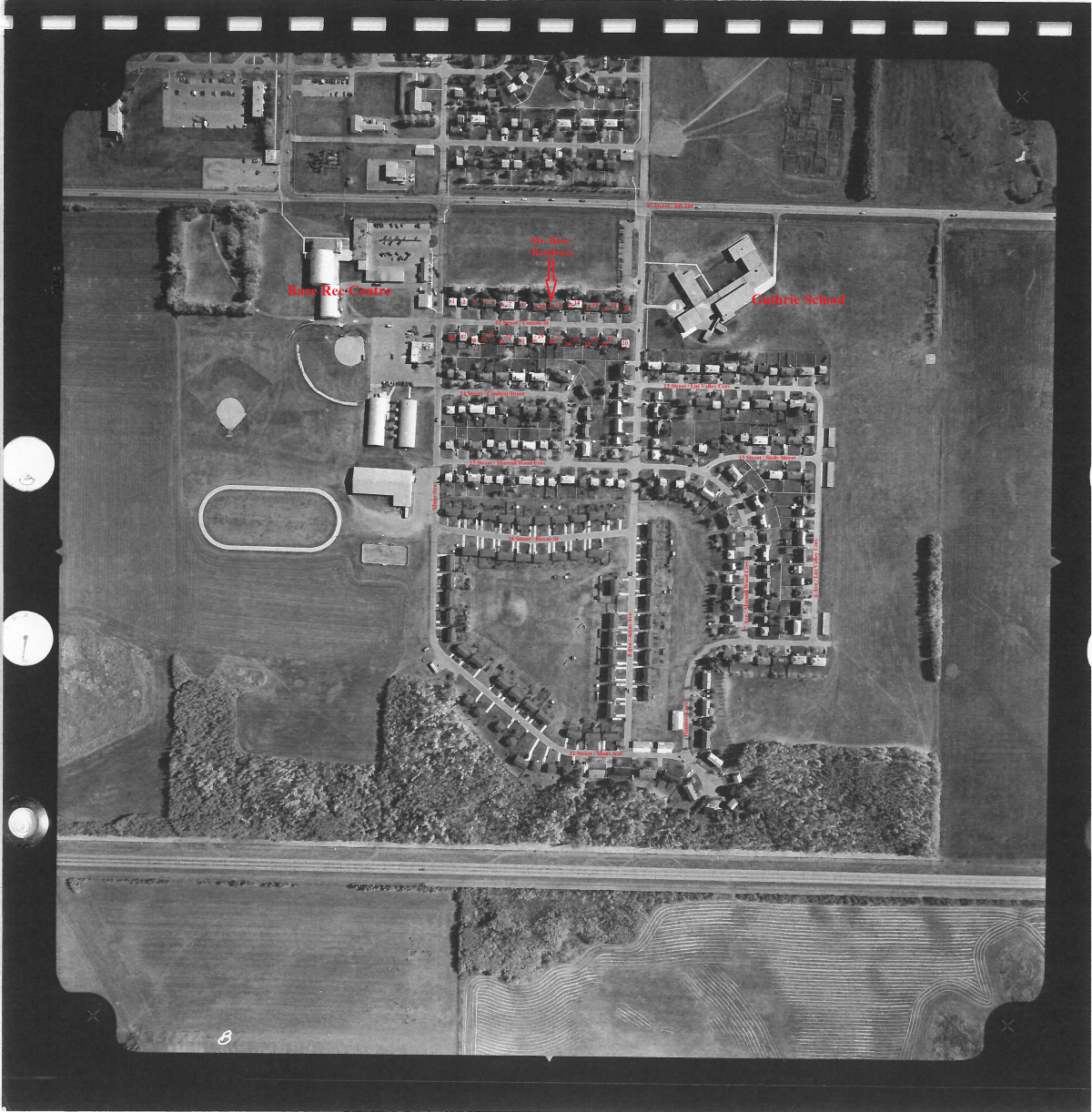
The PMQ patches were in all sense of the word the ultimate company town.
And as such children from dysfunctional homes were pretty well isolated from the others.
Sexually abused children, especially males, were seen to be willing participants in their own abuse and as such they were seen to be a risk to the other kids on base.
In the days after the CFB Namao child sexual abuse sex scandal my family, like others, were posted off CFB Namao. The babysitter’s family was the first to move. This more than likely had to do with rumblings on base that some of the junior ranks wanted to lynch the babysitter.
My family was punted off CFB Namao and down to CFB Griesbach in October of 1980. This was a total trip distance of 10 km, paid for by the Canadian tax payers.
So, how am I supposed to know who the other kids are or how to find them.
The DND, the CAF, and the DOJ all have access to the listings of military families that resided on the base from the summer of 1978 until the summer of 1980, but this is “protected” as personal information.
The CFSIU investigation paperwork and the courts martial transcripts contain the names of the other potential victims, but again this is “personal information” and can’t be released to protect the victims.
There was a crime stoppers appeal for victims of sexual assault on the base between 1978 to 1980 that was released in 2018. According to the MPCC paperwork this provided “hits”, but nothing that could be directly tied to me. This could be used to find other victims. But the DOJ, the DND, and the CAF would fight this tooth and nail.
Why don’t I go on line to the facebook groups? or Xitter, or Bluesky, or Threads?
The one problem with that is there is a certain contingent of former military dependent that will not acknowledge that bad things happened to children on the bases because if they did then they would have to face the fact that they were often the ones shunning, teasing, taunting, and isolating the hurt kids.
So, here we are in 2024.
My clock is quickly winding down.
And the DOJ knows full well well that they have nothing to fear as the organization that I am squaring off against controls all of the information required for my claim to be successful.
Unlike the kids who got diddled by sports players, priests, police officers, school teachers, etc., I have to contend with an agency that can legally silence potential witnesses that were part of the military back in the day. The security of information act / the official secrets act is so extremely vague when it comes to persons who were subject to the code of service discipline when they learnt about “information” on a defence establishment.
The section of the official secrets act / security of information act that deals with members of the Canadian Armed Forces on base isn’t limited to “secret” or “classified” documents, plans, sketches, etc. These acts cover “all information” which could include “police investigations”, “reasons for chain of command decisions”, “orders to subordinates”, etc.
Also, the 3-year-time-bar legally protects anyone who was subjected to the code of service discipline in 1980 from any modern day legal action, and I would also interpret that to also protect these people from any civil liabilities.
Even if the RCMP wanted to go have a chit-chat with retired Canadian Armed Forces officer Brigadier General Daniel Edward Munro, the National Defence Act protects Munro from any criminal investigation.
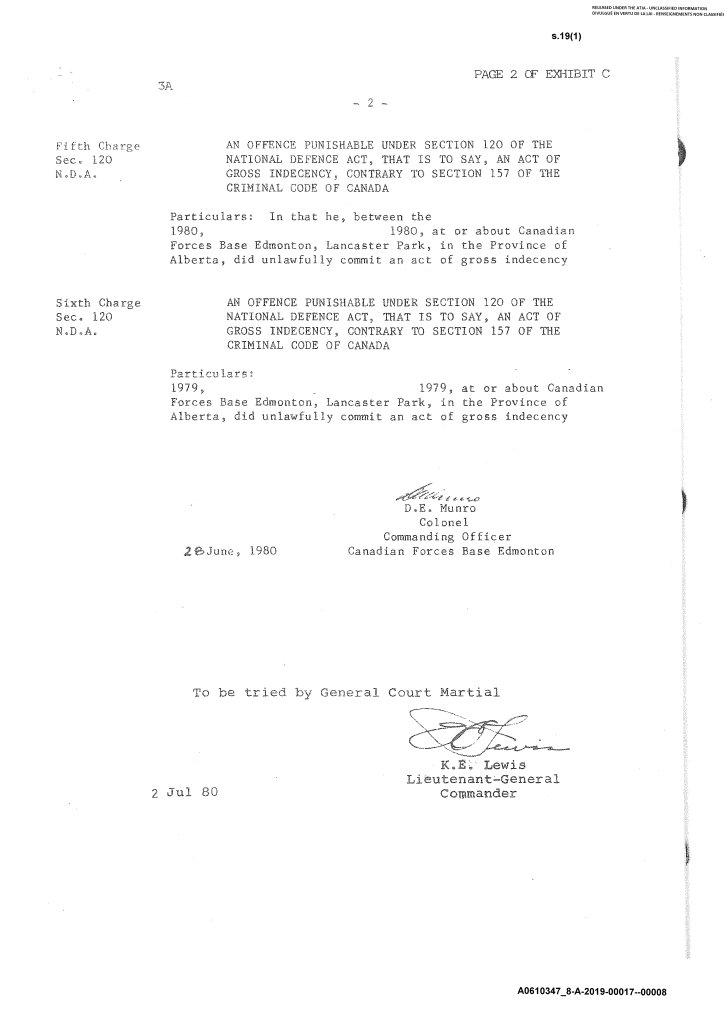
Charges against McRae pg1Charges Against McRae pg2
The above two pages are from the 1980 courts martial of Captain McRae. They are what are known as the “charge sheets”.
Yes, the Canadian Forces have ALWAYS had the authority to try service members on Code of Service Discipline matters, and that the National Defence Act allowed the military to try Criminal Code offences as Service Offences.
This also meant that the crimes of Gross Indecency, Indecent Assault, Buggery, and just about every other charge related to sexual offences against children were subject to the 3-year-time-bar that stipulated that no person that committed a service offence could be prosecuted for that offence if the tribunal for said offence commenced more that 3 years after the date of the offence.
The fact that the Canadian Forces could try sexual assaults against children as service offences meant that the summary investigation flaw would also apply. The Summary Investigation Flaw required that the commanding officer of the accused review the charges that had been brought against their subordinate. If the charges would result in a sentence of less than 2 years and not dismissal from the Canadian Forces , the commanding officer could conduct a summary trial where the commanding officer would be the judge.
If there was the risk that the charges would in charges of more than two years or dismissal from the Canadian Forces the commanding officer would cause the charges to proceed to courts martial or the civilian justice system.
However, the commanding officer could also chose to simply dismiss any or all of the charges brought against their subordinate. And once dismissed, those charges or similar charges arising out of the same or similar facts could never be brought against the subordinate at a later date by either a military or civilian tribunal.
When I asked the CFNIS in 2018 if they could talk to Daniel Edward Munro, whom was residing in the vicinity of the CFNIS detachment at CFB Esquimalt, this was the response the CFNIS investigator received from Ottawa.
3 year time bar pg13 year time bar pg2
So, not only is Munro immune from explaining to the military or civilian police what he did in 1980 and who may have possibly ordered him to do what he did, but he would also be silenced by the Security of Information Act as anything that he did on CFB Namao related to the investigation and prosecution of Captain McRae would be considered “information”.
As I mentioned in other blog postings, I had become acquainted with Fredrick R. Cunningham on November 27th, 2011. He filled me in on numerous details of the Captain McRae fiasco. He wouldn’t name names, but he would state that the military police were prevented by the “brass” from calling in the RCMP to deal with the babysitter, and that the military police had many more charges against Captain McRae but that the “brass” reduced that number of charges to those only related to the babysitter, all other charges related to other children had been dropped. Cunningham also noted that the military police at the time wanted to move this case into the civilian justice system but that the “brass” refused their requests. Cunningham wouldn’t say what his rank was or what unit that he was involved with, but he also begged me not to tell anyone that he had told me anything about the babysitter and Captain McRae.
I mentioned the contents of my conversation with Cunningham in a letter to the Provost Marshal. Weeks later Gilles Sansterre, the commander of the CFNIS telephoned me to say that the CFNIS couldn’t find any evidence to substantiate what this “Cunningham” guy said. Sansterre said he doubted that Cunningham could have known anything about the 1980 investigation and that Cunningham probably heard about this information 2nd or 3rd hand.
In 2020 with the release of the CFSIU investigation paperwork I would learn that Cunningham was in fact the Acting Section Commander of the CFSIU on CFB Namao and that he had been personally tasked by the base security officer, Captain David Pilling, with investigating Captain McRae for having committed “Acts of Homosexuality” with young boys on the base.
Everything that Cunningham had told me had been backed up by the CFSIU paperwork.
How powerful are the Canadian Armed Forces and the Department of National Defence at keeping secrets?
In 2016, during part 2 of the CFNIS investigation into my complaint against the babysitter, the CFNIS tried to talk to Fred Cunningham. Fred outright refused to go for an interview at the CFNIS detachment located on Canadian Forces Garrison Steele Barracks (formerly CFB Namao). He would only talk to the CFNIS as long as no audio or video recordings were made. That’s an odd thing for the lead investigator of a major child sexual abuse scandal involving more than 25 children to say.
What was Fred afraid of?
Well, I think that Fred was afraid that if what he told the CFNIS in 2016 came anywhere near close to what he told me in 2011, then that meant that we would have run afoul of the security of information act / official secrets act. The actual penalties aren’t anything too serious under the acts.
BUT……..
What if the Canadian Forces were to retroactively dishonourably discharge Fred from the Canadian Forces effective the time period of the Captain McRae fiasco. I don’t know when Fred retired, but that would be a hell of a lot of pension money, wages, and housing allowances to have to pay back to the government.
Do I think it would have resulted in that? No. But who the hell would want to go against a government agency governed by intentionally vague and overreaching acts and regulations and spend all sorts of retirement money and retirement time fighting the government?
And this is the problem facing any lawyer dealing with matters against the Department of National Defence and the Canadian Armed Forces. You’re not dealing with acts and regulations that are set in concrete. You’re dealing with acts and regulations that are so vague that they can be whatever the DND and the CAF want them to be from one day to the next.
The catholic church or even the scouts can be required to hand over the names of members of their organizations to police investigators, prosecutors, and even civil litigants. The DND and the CAF don’t have to meet those obligations as any information they have is considered “personal information” as the abusers and the serving parents of the victims were members of the Canadian Armed Forces and as such were “employees” and as such they would need to seek the permission of the involved parties to release said information.
So back to the topic at the start of this post, “why don’t I simply find other brats”? The secrecy surrounding the CAF and the military communities guards the military community with a large impenetrable wall of secrecy.
Throw into this the number of frequent relocations across the country, and then the children moving off and on their own when they “age off” the bases, and you have former brats scatted all over the country.
In the day and age that I lived on the bases children could only live in the PMQs on base until the 19th birthday. There were exceptions for children going to college or university. They had until 24 to get out of the military housing. The only other exception was for handicapped children.
I lived in 7 different PMQs, on 5 different bases, in four different provinces by the time I was 12. Might not be a lot of moves in and of itself, but when the other kids are also moving around this creates a lot of churn.
As I said, dysfunctional families on base were a dime a dozen. I spoke to my father only a handful of times between 1990 when I moved out of the house for the second time and 2006. I never spoke to my father again between 2006 and when he died in 2017. I suspect that there were a lot of other brats like this.
I know of another department manager at work that was a base brat as a child. They absolutely refuse to talk about their childhood as they’re ashamed of what they went through and they’re afraid of others finding out.
And this is why I don’t think that the Canadian Armed Forces or the Department of National Defence will ever have to own up to the full extent of child sexual abuse on Canadian Forces Base Namao nor any other defence establishment across Canada.
The impenetrable walls of secrecy, and the online army of flying monkey base brats ensure that the Canadian Armed Forces and the Department of National Defence never have to worry their pretty little heads off. When the tools of secrecy can’t conceal the child sexual abuse, the legion of flying monkey base brats will attack the abused brats.
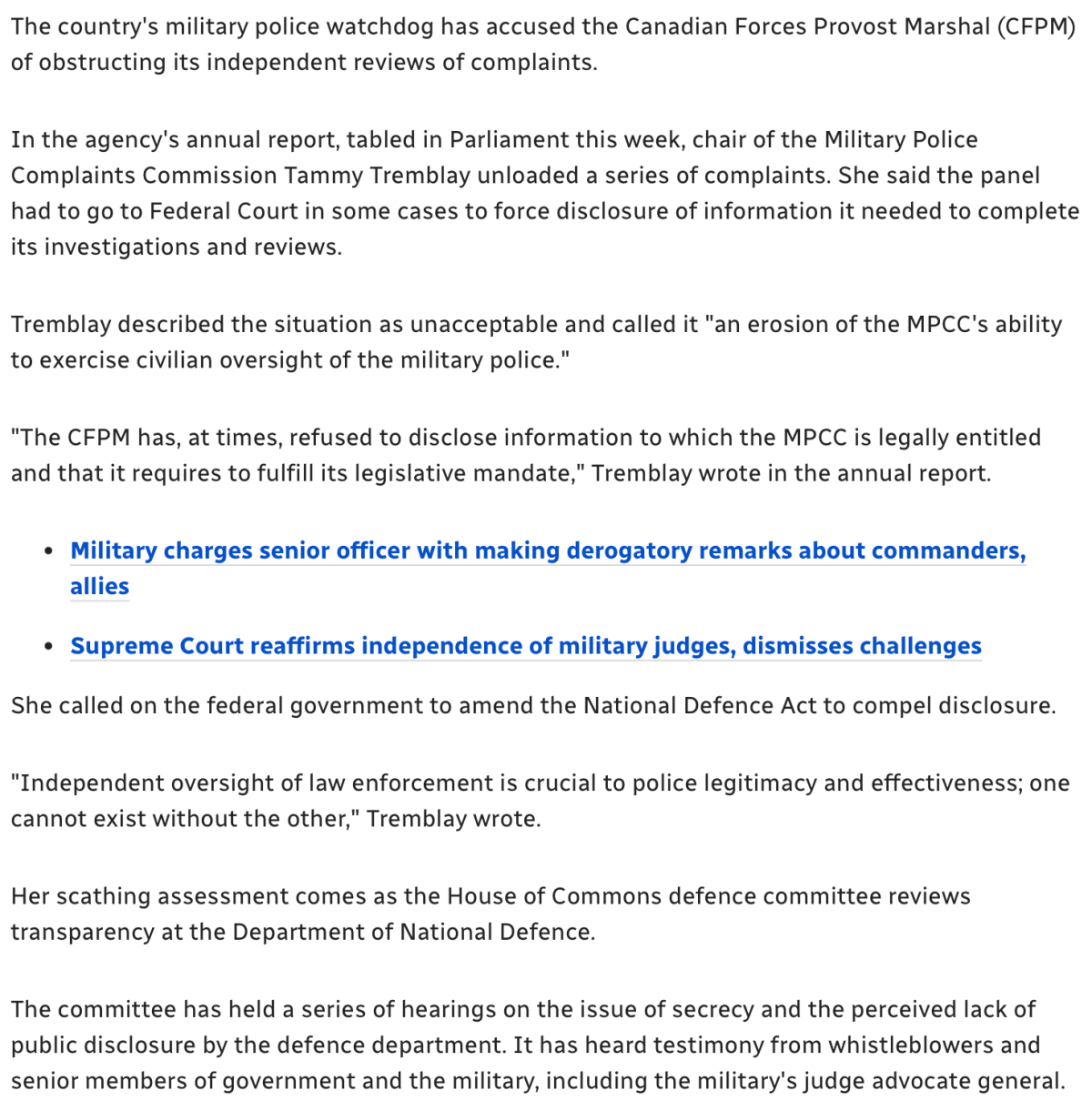
From the report: “Our most significant challenge this year was the erosion of the MPCC’s ability to exercise civilian oversight of the military police. The MPCC used a great deal of resources and effort to obtain relevant documents from the CFPM to enable it to conduct fair and fulsome investigations. In too many instances, we have seen resistance or refusal to disclose information the MPCC needs to investigate complaints; a reduction in the number of recommendations accepted by the CFPM; a refusal to respond to recommendations; a refusal to provide updates on files currently being reviewed by the Office of Professional Standards of the CFPM; and restrictive and unilateral interpretation of the MPCC’s jurisdiction. The MPCC has been forced to turn to the Federal Court to obtain the documents it is legally entitled to review as part of its mandate. These unfortunate barriers dilute the will of Parliament in setting up a strong oversight system for the police and must be addressed.”
The MPCC was created in 1998 as part of the passing of Bill C-25 in 1998 and the restructuring of the military police in the aftermath of the fallout from the failures of the military police to conduct proper criminal investigations in Bosnia and Somalia when the Canadian Forces were on “peace keeping” missions there but ended up with members of the CAF conducting illegal activities.
The Military Police Complaints Commission was created with input from the Canadian Armed Forces and the Department of National Defence, meaning that the CAF and the DND knew how they wanted their new police forces to operate and that through careful consideration the MPCC would be relegated to the status of toothless hound dog.
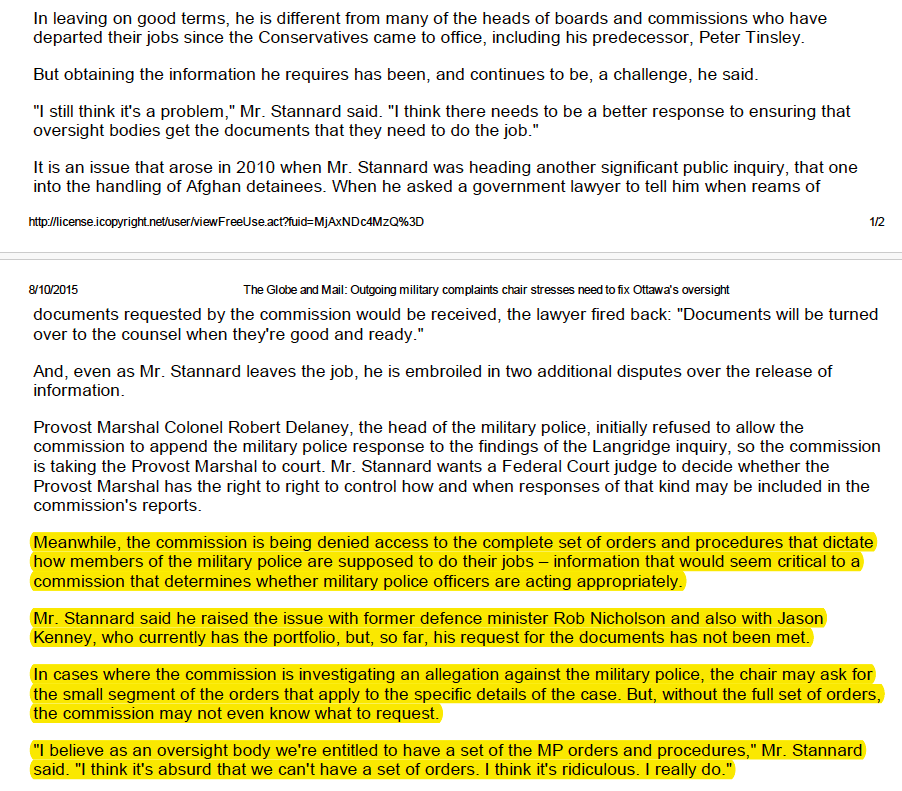
The issues that Madame Tammy Tremblay raised above are nothing new. In 2015 then outgoing MPCC chairman Glenn Stannard has this to say in his interview with Gloria Galloway of The Globe and Mail.
The Canadian Forces Provost Marshal has the ability to control the findings of the Military Police Complaints Commission.
During a review, the MPCC cannot subpoena documents or witnesses. The MPCC also cannot administer oaths.
Without the ability to administer oaths the members of the CFNIS subject to the complaint can utter falsehoods all day long and there will be absolutely no repercussions.
If a person such as myself wishes to make a complaint against the base military police or the Canadian Forces Special Investigations Unit we have to first submit our complaint to the Provost Marshal. The Provost Marshal then knows what the complaint is about and can then tailor the documents released to the MPCC to paint the narrative that the Provost Marshal or the Vice Chief of Defence Staff which for the MPCC to see.
Even if the MPCC suspects that something is off and not right, there’s nothing the MPCC can do as the MPCC cannot demand the release of documents from the Provost Marshal. Sure, they can go to Federal Court to ask the court to instruct the Provost Marshal to hand over the records, but that would mean that the MPCC would have to know what documents to request.
As I learnt during the 2012 review of my complaint against the 2011 CFNIS investigation, the complainant cannot simply supply the MPCC with all the documents in their possession. The MPCC can only consider documents that are relevant to the documents supplied to the MPCC by the Provost Marshal.
And as the Provost Marshal is under no obligation to tell the complainant what they’ve supplied and what they’ve withheld from the Military Police Complaints Commission, following through with a MPCC review is almost 100% a waste of time.
This is why when I was interviewed by Claude Bergeron and Peter Cicalo of the MPCC in July of 2012 they were practically popping the champagne and cheering for the CFNIS.
I’m on the left….. the MPCC is on the right.
Peter and Claude were very impressed with the CFNIS investigation even though the Provost Marshal had actually withheld all of my email communications between myself and Master Corporal Christian Cyr detailing the 5 visits to the chapel.
After my interview with Peter and Claude I was so fucking nauseated that I just wandered around the city aimlessly until about 03:00 in the morning trying to work up the courage to jump off the Granville Street bridge.
The Provost Marshal withheld the fact that the CFNIS had in its possession the 1980 CFSIU investigation paperwork and the 1980 courts martial transcripts from the MPCC.
Both of these sets of documents indicated that in 1980 the military police and the CFSIU were very well aware of the babysitter’s abuse of young children on the base and the fact that it was the investigation of the babysitter that exposed the actions of Canadian Armed Forces officer Captain Father Angus McRae.
This of course ran counter to was I was told by Petty Officer Steve Morris on November 4th, 2011 when he stated that the CFNIS could find absolutely no evidence that the babysitter was capable of what I accused him of.
Well, if you don’t like the findings of the MPCC, file an application for Judicial Review.
Don’t think that the Federal Court will be of any relief. The Federal Court can only render judgements based upon the documents that the Provost Marshal submitted to the MPCC. Anything else is considered “New Evidence” and the Department of Justice will fight tooth and nail to have all “new evidence” dismissed.
When I entered all of my emails between myself and Master Corporal Christian Cyr detailing the visits to the chapel the DOJ demanded that these be struck from the proceedings as they were “new evidence”. Because the Provost Marshal failed to notify the MPCC about these emails, I couldn’t introduce these emails at Federal Court level.
And it gets goofier than this.
In 1998, the Provost Marshal issued CFPM 2120-4-0 to the commanding officers of the new CFNIS, and all of the detachments across Canada. This document was further reissued in 2006. This document stated that matters involving civilian victim are to be handed over to the outside civilian authorities having jurisdiction. This document further stipulated that the CFNIS could only conduct an investigation of offences involving civilian victims if the outside civilian authorities outright refused to conduct the investigation.
I introduced this document into my applicant’s records for my application for judicial review.
The Department of Justice requested this document be struck from my hearing as this was also “New Evidence”. New evidence even though this was a standing operating procedure of the Canadian Forces Military Police. But it appears that the Military Police Complaints Commission was never given a copy of this document even though this document has guided military police and CFNIS operations since 1998.
I can’t help but wonder if the Provost Marshal’s new found energy to fight the MPCC over documents has to do with the fact that the MPCC went around the firewall that the CFNIS and the Provost Marshal had constructed around the investigation into my complaint of sexual abuse on Canadian Forces Base Namao and accesses a parallel investigation being conducted into the sexual assaults on CFB Namao and discovered the CFSIU investigation paperwork and the 1980 courts martial transcripts in the possession of the CFNIS.
Militaries like the Canadian Armed Forces really don’t like outside civilian agencies and do-gooders sticking their noses into the military’s business. Militaries view themselves as being the saviours of their respective country, and therefore they should never be questioned.
The Catholic church did the exact same thing that the Canadian Armed Forces are doing. And that’s using their immense power and prestige to place themselves above examination by pesky civilians.
The only difference between the Catholic church and the Canadian Armed Forces is that the Catholic church is subject to civilian laws and the civilian courts. The Canadian Armed Forces are a law unto themselves.
Is there any chance that I will pass up on Medical Assistance in Dying?
No.
But Bobbie, aren’t you on hormones?
Yes, yes I am.
And aren’t you on anti-depressants?
Yes, yes I am.
Well then, you should be feeling much better, you should be happy.
No. No I’m not, and it’s nothing to do with being happy.
My brain is burnt out.
I can’t escape the ghosts of so many years ago.
40 years of untreated mental illness has taken its toll.
40 years of living with the fallout of Captain Totzke.
A dysfunctional childhood spent hopping from one Canadian Forces base to another being raised by a rage fuelled alcoholic and his cruel alcoholic mother.
I’m going through with the hormones because this is something that I always wanted to do. This was something that I would not have been able to undertake when I was younger. But the hormones won’t fix a damaged brain nor will the hormones erase 40 years of horrific memories.
I get the feeling that society believes that I owe it to society to fix myself and to live so that I continue to be a benefit to society.
I owe nothing to society.
Society in fact owed it to me to allow me to enjoy a normal childhood and a normal adulthood. Society instead said that it valued the image and prestige of the Canadian Armed Forces over my well-being. And as such society really has lost its “right” to tell me that I have live because I owe it to society.
Well, why don’t you commit suicide?
I’ve known for a very long time that if I were to commit suicide that the babysitter and my father would win and their version of reality would become my truth.
Since learning the whole entire truth about the events that occurred on Canadian Forces Base Namao and how the modern day Canadian Armed Forces are so very hellbent on keeping the secrets of child sexual abuse on Canadian Forces hidden from the public consciousness, committing suicide would be giving the Canadian Forces an easy way out. And you can bet your bottom dollar that the Canadian Forces would pull out all of the stops to tar and feather my name.
So, you’re not really going to take your own life, you’re just doing this for theatrics, right?
Nope. Just waiting to see if the Department of Justice or the Canadian Armed Forces are willing to do the right thing or if they’re going to do everything in their power to keep this matter hidden and buried from the public eye.
The hospital where I work is in the process of moving. The new facility is supposed to be opened by 2027. The acute portion of the hospital is expected to transfer from the old site to the new site in a couple of weeks. The old hospital will stay in operation for a little while longer as it will have to support the various research programs on site until the new research building is constructed. I’ve already made it very clear that I have no interest in going to the new site, that I’m more than content to stay at the old site and run it until I either decide to pull the plug or the site shuts down.
Management for the most part doesn’t know why I have no interest in going to the new site, but there are a few managers that do. Some co-workers know of my plans, but most don’t.
My plan for when I decide the time is right to die is to simply announce that I’ve received an excellent job offer in the maritimes and that I want to take it as I want to return to Nova Scotia to retire there.
Just spent the last three days sleeping in for the most part.
I know that it’s so very hard for you the reader to understand just how fucking hard it is to keep staying alive.
About the only thing that keeps me going is the minuscule possibility that I might be able to clear my name before I die.
My childhood was a disaster, not just because of a child predator named Angus McRae who was a member of the regular forces as a Captain, and not just because of the teens that he groomed to molest children and trained those teens to bring young children over to the base chapel.
No, my life was ruined by mostly men in the Canadian Armed Forces and the Department of National Defence who decided that my mental health and the mental health of the other children molested on various Canadian Armed Forces Bases was worth far less than the prestige, honour, and reputation of the military.
Master Corporal Richard Wayne Gill
Warrant Officer Fredrick R. Cunningham
Captain David Pilling
Captain Terry Totzke
Colonel Daniel Edward Munro
Minister of National Defence Gilles Lamontagne
And many other useful idiots “just following commands”
The Canadian Armed Forces and the Department of National Defence know how to manipulate public opinion. DND and the CAF have an extensive “Public Relations” department that knows how to manipulate useful idiots into projecting the image of the Canadian Armed Forces as being infallible and beyond reproach.
And no, this isn’t just a distant event. In the modern day the Canadian Armed Forces and the Department of National Defence have sections that engage in social media. The MPCC noted in their 2020 report that the DND and the CAF are well aware of my blog postings and my social media presence.
And yes, the Department of Justice is actually following along with my blog.
In May of 2011 the Canadian Forces National Investigation Service told the Royal Canadian Mounted Police that my case was likely to go no where due to a complete lack of evidence. This was two months before the CFNIS would talk to other victims or try to track down the perpetrator.
Of course we’d learn in 2020 that the Canadian Forces National Investigation Service had in its possession since the beginning of the investigation in March of 2011 the 1980 Canadian Forces Special Investigations Unit paperwork and the July 1980 courts martial transcripts, both of which heavily implicated the babysitter as it was his abuse of young children on the base that brought him to the attention of the base military police.
When the CFNIS submitted their brief to the Alberta Crown in October of 1980 they forgot to tell the crown about the dysfunctional household I was living in, the fact that the babysitter was investigated for molesting children in 1980, and that the babysitter was receiving psychological counselling for his attraction to young children. The CFNIS also forgot to mention to the Alberta Crown that I had tried to report the babysitter twice before to the military police but that the military police took no action.
More alarming is that the CFNIS submitted to the Alberta Crown an absolute fabrication. And no doubt that the Department of Justice has latched on to this fabrication. The fabrication? On May 3rd, 2011 I was contacted by Mcpl Christian Cyr of the CFNIS. Cyr tried and tried and tried to get me to believe that the babysitter was only 12 or 13 years old in the spring of 1980. The babysitter was born on June 20th, 1965.
More damning than that was the fact that Cyr literally dropped a bombshell on me. He asked me point blank if I remembered anything about the base chaplain having been charged with molesting children during the time that I was accusing the babysitter of abusing me and he implied that maybe I was confusing things insinuating that maybe I was making this story up for easy money.
When I regained my composure I told Cyr about the 5 visits to the chapel in which the babysitter escorted me over. I told him I remembered the activities we’d do in the living quarters, and that the visits always ended with me being given a “sickly sweet grape juice”.
I would learn later that the CFNIS would imply to other victims that I was a “societal malcontent with an axe to grind against the Canadian Armed Forces” and that I couldn’t hold jobs and that I frequently bounced around in my employment.
When I made my application to Federal Court in 2013 and I was given a copy of the certified tribunal records I was gob smacked to discover that “Cyr” had made an entry into the Security and Military Police Information System database (SAMPIS) that indicated that I remembered various visits in which the babysitter escorted me over to the base chapel “but that nothing sexual ever occurred”. “Cyr” removed any mention of an intoxicating substance as the CFSIU investigation paperwork and the courts martial transcripts would indicate that McRae was known to be giving the children alcohol. I use “Cyr” in this instance in quotes because at the time in 2011 the SAMPIS database had one massively horrific flaw. Superiors could make any edits to any entry that existed in SAMPIS. Sure, SAMPIS would log who made the changes, but SAMPIS would not retain the previous version of the edited item, nor would SAMPIS log the changes made.
In the modern day the Canadian Forces National Investigation Service and the Department of Justice will strive to portray me as an out of control lunatic just looking for quick bucks. The rational for this opinion will be the findings of the 2012 and 2018 MPCC reviews of the 2011 and 2015 investigations. The Department of Justice will go out of its way to downplay the fact that the Canadian Forces Provost Marshal determines what evidence will and will not be presented to the Military Police Complaints Commission and that the MPCC cannot subpoena documents from the CFNIS nor the MPCC.
The Canadian Armed Forces, with the assistance of the Department of Justice are very adept at keeping the truth hidden from the outside world.
I still like to think that in 2019 the Military Police Complaints Commission realized just how fucking badly the Canadian Forces Provost Marshal lied to MPCC . I think this is why the MPCC went out of their way to verify that the CFNIS knew the truth about the babysitter and the extent of Captain McRae’s abuse of children on the base.
Harjit Sajjan was more than happy to fight me to deny me access to the 1980 records. Sajjan only relented once the MPCC confirmed that the CFNIS and the Provost Marshal both knew about the truth from 1980 and actively hid the truth from me and from the Alberta Crown prosecutor.
And no, this shit hasn’t changed to this day. The Canadian Forces Provost Marshal is still actively denying and hiding documents from the Military Police Complaints Commission.
And the really aggravating matter is the fact that the Department of Justice actually wants to rely on the 1980 CFSIU investigation paperwork, the 2011 CFNIS investigation, and the 2015 CFNIS investigation to determine who was a victim and who wasn’t.
In 1980 it was Colonel Daniel Edward Munro, the base commander of Canadian Forces Base Namao that would determine to not call the RCMP in to deal with the babysitter and would not allow charges to proceed that involved children under the age of 14 so that the military could retain jurisdiction for this matter.
Remember, under the pre-1998 NDA Summary Investigation Flaw, it was the commanding officer of the accused that determined which charges their subordinate would face and which charges would be dropped. The provincial crown prosecutor would only become involved AFTER the commanding officer approved the charges and then allowed them to flow into the civilian justice system.
Both the 2011 and 2015 investigations had the 1980 CFSIU investigation paperwork and the 1980 courts martial transcripts in their possession. The 2011 CFNIS investigation ignored my social service records, and various information that I sent to the CFNIS related to the visits to the chapel.
So yeah, this is why I’m fucking tired.
And no, there is no recovering from this.
My father is long dead, he’ll never apologize for the living hell that he subjected my brother and I to in the silence of the military housing on base.
My brother will never get to hear anyone from the Canadian Armed Forces apologize, and my brother will never see that I wasn’t lying about what the babysitter did and that I didn’t “let” or “allow” the babysitter to do what he did.
Daniel Edward Munro will never explain why he did what he did.
The DOJ will go to bat for the babysitter in their portrayal of him as an innocent little angel.
The DOJ will never apologize for learning the entire truth about Captain McRae and his teenage accomplice in 2014 but instead using the absurd and byzantine laws crafted by the Government of Canada that allow agencies like the Canadian Forces to hide and bury the truth.
And no one from the Canadian Forces National Investigation Service will ever have to apologize for lying to me, lying to others about me, lying to the RCMP about me, and making false accusations against me.
In late August of 1985 my brother and I flew back from Edmonton after having spent the entire summer staying with our grandmother in Edmonton.
Upon our return to Canadian Forces Base Downsview in Ontario our father had to alert the base military police to our arrival back home.
The military police came to talk to my brother and I about a rage-out that our father had in the PMQ that had contributed a significant amount of damage to the PMQ and required 3 military police officers to bring him under control.
Richard’s rage-outs were nothing new, but during this one he had completely lost control and smashed out all of the ground floor windows and damaged a lot of the furniture.
Richard used to self medicate by getting himself pickled drunk. But since Sue moved in with us in the summer of 1980, she tried to get Richard to sober up.
Richard also had a thing for prescription pain meds. Beyond that I can’t say if he was ever into hard drugs or not. But yes, he was an alcoholic.
And by not self medicating, Richard’s physical rage and temper would often peak at boiling over.
The military police implored my brother and I to NOT call 9-1-1 but to instead call the base military police as the Toronto cops couldn’t just come on to the base.
The two military police officers told us that we shouldn’t call for help unless we got out of the PMQ first, and that we should be prepared to jump from the second story of the PMQ if we had to get away from Richard.
Looking back I now realize that the base military police didn’t want us calling 9-1-1 as the civilian police were duty bound to report domestic violence to civilian social services where as the military police and the Canadian Armed Forcesliked to keep things in house an out from under the noses of those nosey civilians.
The MPs gave my brother and I business cards with the direct phone number for the MPs so that we didn’t have to go through base switchboard.
I was going to go show one of my friends the business card and tell him how the military police promised me that they would protect me from Richard and his anger outbursts as the MPs had heard things from the neighbours about the way Richard treated my brother and I.
Bill Parker intercepted me as I walked across the common lawn that the PMQs surrounded.
Bob! Bob, come here, I need to talk to you.
Bill promised me that if my father ever got angry again that I could come stay with his family, just like my mother and I had done on Canadian Forces Base Shearwater. I would find out about the CFB Sheawater “Battered wives club” in the 2010’s.
I showed Bill the business card and told Bill that if the fucker ever hit me again that I’d call the military police and they’d come take care of Richard. Bill told me that I had to take it easy on my father, that I simply didn’t understand what my father had been through and how the Canadian Forces had abandoned him.
Bill went on to explain something about my father having sailed to England with the Sea Kings in 1969 and that there had been an explosion in the engine room on one of the ships and that my father lost three of his drinking buddies from when he had been in the Navy.
“Bob, I wish you knew your father before that. He was a completely different man. He would have been nice.”
Bill implored me to never ask my father about this, that I was supposed to keep this a secret and just understand and accept my father’s anger and temper.
August of 1985 was long before the advent of Netscape Navigator and Google.
I was in Sea Cadets at the time, so I devised a way in which I’d ask my father about this “engine room explosion” without asking him directly about it.
I came home one night after cadets and told him that as part of studying naval history in the Canadian Navy that I was supposed to write a report on ship explosions that would have occurred in 1969.
The blood drained from his face, his cigarette hung from his lower lip, and his fists clenched up. All he said was that if I ever asked him a question like that again that I wouldn’t have to worry about ship explosions because of my broken neck.
It was the early 2000’s when I discovered the HMCS Kootenay incident that occurred in October of 1969 when the ships from CFB Halifax and the Sea Kings from CFB Shearwater were returning from exercises to the UK. It wasn’t an engine that exploded. It was oil vapour in a high-speed gear box that ignited due to an overheated main bearing. 11 members of the navy died. The explosion had been swift and hot. It was so hot that it melted all of the aluminum ladders that lead out of the engine room / gear box room.
My father had been on the Kootenay in his navy days before unification gave him the opportunity to get out of the Navy and into the Air Force. His name won’t show up on any of the ship’s registers as he was with the Sea Kings in the Air Force and not the Navy.
When I met my mother, Marie, in 2013 she confirmed Richard’s involvement with the Kootenay incident saying that Richard became a different man in the days and weeks after. His drinking had increased, his violence increased, he started to exhibit a hair trigger temper.
When Richard was posted to CFB Summerside his temper and his drinking became even worse, hence why she tried to take my bother and I back to Nova Scotia to stay with our uncle Al, but why she ended up being ejected from the PMQ by the base military police.
I met a gentleman by the name of Chris Legerre in the summer of 2014 when I went to Halifax to see the city that I had been born in 42 years previously. Chris had been on the HMCS Kootenay on the day of the gearbox explosion.
Yep, the Canadian Armed Forces literally and figuratively fucked everyone over that had been involved in the incident. A complete lack of compassion. No mental health treatment, nada, zip, zilch. Drug use became rampant amongst the survivors. Families of the deceased were booted out of the military housing with absolutely no compassion shown to the kids.
And you’d think that things would have changed in the last 55 years, but you’d be sadly fucking mistaken.
The Canadian Armed Forces and the Department of National Defence don’t give one sliver of a flying fuck about the mental health of the members of the Canadian Forces . And from my personal experience the Canadian Armed Forces care even less about the family members of mentally ill service members that have to experience the untreated mental illness of the serving member.
See, in my day of living on the bases in Canada military dependents were of absolutely no concern to the Canadian Armed Forces and the Department of National Defence. We were referred to as D.F.&E., Dependents, furniture, and effects. It took lobbying by the Ombudsman to get the Canadian Armed Forces to change this and to stop lumping dependents in as the personal belonging of the serving member.
But that really didn’t change things.
David Pugliese of the Ottawa Citizen posted a link to a story by Morgan Lowrie of National News Watch that was about two member of the Canadian Armed Forces that committed suicide. They were brothers. Both had served in Afghanistan. The article talks about how the Canadian Armed Forces are going to give the mother of the two soldiers a silver star. The article however mentions nothing about the spouses of the deceased members, nor the children of the deceased members.
Children of service members that die in action or die as a result of committing suicide due to mental stress endured during service should automatically receive guaranteed scholarships to college or university or support through trade school.
Spouses should receive compensation up until the retirement age of the service member.
The Canadian Armed Forces asks a lot from its service members, and by extension it asks a lot from the families of the service members.
It should then have to look after the families of service members, and stop treating military dependents like an afterthought.
Just thought that I would make a post about the imaginary independence of the Canadian Forces Military Police and the Canadian Forces National Investigation Service from the Chain of Command.
The base MPs and the CFNIS along with its predecessor, the CFSIU, have never been free of the chain of command. The investigators with these agencies are at all times soldiers first and police officers second. These soldiers, just as all other soldiers, are bound by the National Defence Act to obey the lawful commands of their superiors.
And yes, there is a difference between legal and lawful. Member of the Canadian Armed Forces generally don’t have the time and the ability to consult with a legal officer to determine if a lawful command is in fact a legal command.
And this poses a massive problem for persons such as myself who have actions against the Department of National Defence and the Canadian Armed Forces for abuse and neglect that we endured at the hands of members of the Canadian Armed Forces.
In the spring of 1980 the military police commenced an investigation of my babysitter due to the numerous complaints of inappropriate sexual touching of other children living on the base. The investigation quickly exposed the fact that Canadian Armed Forces officer Captain Father Angus McRae was running a child sexual abuse ring on the base.
There were three boys involved with escorting children over to the living quarters attached to the chapel. One of these boys was my babysitter.
You would think that the military police would have wanted to string Captain McRae up with as many charges possible. But that’s not the way that the military justice system worked then.
In May of 1980, after the base military police investigated the babysitter for molesting children, base security officer Captain David Pilling instructed CFSIU Acting Section Commander Warrant Officer Fredrick R. Cunningham to investigate Captain Father Angus McRae for having committed acts of “homosexuality” with young boys on the base. The use of the term “acts of homosexuality” indicated that the Canadian Armed Forces already viewed McRae’s victims not as victims, but as homosexuals participating in homosexual activities.
Now, this is where things become very bad for the victims of Captain McRae that were under the age of 14.
The Canadian Armed Forces could only prosecute for the crimes of Gross Indecency, Indecent Assault, and Buggery so long as consent was a possibility. This fact was raised in the Court Martial Appeal Court finding of Regina vs. Corporal Donald Joseph Sullivan which was held in 1985.
Captain McRae’s commanding officer was Colonel Daniel Edward Munro, the base commander of Canadian Forces Base Namao. In 2017 as a result of me asking a CFNIS investigator if they could talk with retired Brigadier General Daniel Edward Munro to find out what transpired of CFB Namao in 1980 the office of the JAG replied that due to the 3-year-time-bar that existed in 1980, no charges could ever be brought against Munro so the CFNIS declined to talk to him.
In 1980 it would have been the commanding officer of the accused that would have decided what type of investigation McRae would be subjected to and how in-depth the investigation would be.
Colonel Daniel Edward Munro along with his chain of command would have known that the Captain McRae couldn’t be subjected to a courts martial for any crime committed against a child under the age of 14. Munro and his superiors would have known that to prosecute McRae for abusing any child under the age of 14 the Morinville RCMP would have had to be called in. And this would mean that McRae would be prosecuted in the civilian justice system where the military would not have been able to place a “veil of secrecy” around the whole affair.
This is why it was either Colonel Daniel Edward Munro or his superiors that wouldn’t allow the Base MPs to contact the Morinville RCMP to deal with the babysitter. They weren’t trying to protect the babysitter. They were trying to keep this whole mess from getting out into the public eye. Once the RCMP started investigating the babysitter, and once the babysitter mentioned the other boys and that they were bringing children as young as 4 over to the chapel the military would have lost control of the whole matter
Once the CFSIU completed its investigation of Captain McRae for sexually abusing children, the charges weren’t referred to the Alberta Crown Prosecutor for review. McRae was being charged with sections of the Criminal Code of Canada that were enumerated into the National Defence Act as Service Offences. Service offences were not in the purview of the provincial crowns. The charges were instead reviewed by the commanding officer of the accused. Which again in this case was Colonel Daniel Edward Munro, the base commander of Canadian Forces Base Namao.
An interesting thing about Colonel Daniel Edward Munro is that EVERY member of the regular force and the reserves located on Canadian Forces Base Namao was Munro’s subordinate. There is no requirement for an officer with the Chain of Command to follow the command structure when issuing commands to subordinate.
At work, if a manager from a department makes an unrealistic request of me or my subordinates, I can ask that manager to address my department manager. And I have the union to back me up on that. In the Canadian Forces you don’t have that ability.
In the Canadian Forces, if you don’t do as your superiors tell you to, you run the risk of being charged with insubordination. Basically you do as you’re told and you can only ignore the order you were given if someone else superior to you instructs you to ignore that order.
Members of the Canadian Forces subject to orders from and decisions by Colonel Munro included, but were not limited to:
my father
the father of the babysitter
the serving parents of the other two boys suspected of bringing kids to McRae
the serving parents of the other abused children
the investigators within the CFSIU
the investigators within the Base MPs
military social workers like Captain Lynda Tyrell and Captain Terry Totzke.
Once the Chain of Command decided that the Captain Father Angus McRae matter was going to be dealt with through the military justice system, that was it. This is not to be questioned.
When I talked to Claude Adams of Global News in 2014 about the Captain McRae sex scandal from CFB Namao, Claude assured me that if he was in the Canadian Forces and if the military didn’t want to charge McRae with abusing his children that he’d just go marching down to the city police and lay charges himself.
That’s not how this works. If Claude did that, that would have been an immediate courts martial.
Yes, the ignorance by the Canadian public of how the military works is quite alarming.
Why would the Canadian Armed Forces go through all of this just to keep the McRae matter out of the media? Wouldn’t this have shown the Canadian Public that the Canadian Armed Forces does not tolerate child sexual abuse under any circumstance?
No. That’s not the way the Canadian Forces operated, especially not during the Cold War. The Canadian Armed Forces, much like many other “western” militaries had waged a war against homosexuality as it was seen as a weakness that the Soviets could exploit via entrapment and blackmail to recruit spies.
During the period of the Captain McRae child abuse sex scandal the Government of Canada employed the “fruit machine” to weed out homosexuals. The Canadian Forces had CFAO 19-20.
So imagine the military’s reluctance to prosecute Canadian Armed Forces OFFICER Captain Father Angus McRae for sexually abusing over 25 children on Canadian Forces Base Namao in direct view of the Base MP detachment.
Imagine if the Canadian public had discovered via a public trial that McRae had inappropriate sexual relations with children on other Canadian Forces Base and Canadian Forces Stations that Captain McRae had been moved to by the Canadian Armed Forces.
Can you imagine Colonel Daniel Edward Munro’s fear of having his command ability called into question as it was his Base MPs that failed to detect Munro’s direct subordinate molesting the children of enlisted personnel on the base that Munro was ultimately responsible for the security of?
To top it off, Captain McRae had been investigated at the Royal Military College at Canadian Forces Base Kingston for “Acts of homosexuality” in 1974. It’s not like CFB Kingston and CFB Namao are separate entities. They’re both Canadian Forces Bases under the same command chain and policed by the same police force. So it’s not like anyone in the chain of command on CFB Namao could plead ignorance to Captain McRae’s previous investigation for “acts of homosexuality” in 1974?
Why wasn’t McRae tossed out of the military in 1974? Was it because the military police or the CFSIU couldn’t find enough evidence? No. It doesn’t matter what the Base MPs or the CFSIU found. McRae’s commanding officer would have had the ultimate authority to dismiss the charges that had been brought against Captain McRae.
Even in 2011, the CFNIS had the 1980 CFSIU paperwork and the 1980 courts martial transcripts in their hand, but there was no way that the Canadian Armed Forces were going to allow charges to be brought against the babysitter.
Why?
Angus McRae didn’t die until May 20th, 2011. 3-1/2 months after the start of the investigation. And this posed a massive problem for the CFNIS.
While the CFNIS would have been free to bring charges against the babysitter, the CFNIS would never have been able to charge Angus McRae for ANY service offence that he had committed while subjected to the Code of Service Discipline.
Two flaws that existed in the National Defence Act prior to December of 1998 ensure that child molesters who abused children on Canadian Armed Forces bases in Canada ensure that these abusers nor their victims will ever receive justice.
See, even though the flaws were removed, there was no legislation enacted that retroactively allowed the crown prosecutor to become involved with reviewing charges laid by the base military police or the CFSIU prior to the commanding officer of the accused conducting their Summary Investigation as required under the National Defence Act.
In 1980, after the laying of charges by the military police or the CFSIU, all charges were required to be reviewed by the commanding officer of the accused. This included not only charges of a purely military nature, but ALL criminal code charges enumerated into the National Defence Act. The commanding officer had the full authority to dismiss any and all charges, including criminal code offences.
When Bill C-25 passed in 1998 the 3-year-time-bar flaw and the summary investigation flaw were removed, but there was no language added that allowed the base military police or the CFSIU / CFNIS to bypass the language that existed prior to 1998 and to refer service offence charges to a provincial prosecutor. More alarmingly, there was no language added to either the National Defence Act or the Criminal Code of Canada that nullified the 3-year-time-bar prior to 1998.
Why is this important?
Well without a police investigation showing evidence that I was molested directly by Captain McRae it is being hinted that I have no legal claim against the Canadian Armed Forces and the Department of National Defence. But don’t forget, the investigations being relied upon are investigations conducted by the police of the agency that I am claiming compensation from.
In it’s 10 year report to Parliament that was published in 2010, the Military Police Complaints Commission that allowing the military police and the CFNIS to investigate matters that may subject the DND and the CAF to civil actions is inappropriate as indicated by decisions by the Supreme Court of Canada.
These decisions are why police forces in Canada generally will not investigate matters that could be expected to lead to civil actions against the city they work for. This is why when there is a police shooting in Canada or an allegation of police brutality police from another jurisdiction are brought in to investigate. This is also why when civilian employees of a city are suspected of wrongdoing other police agencies are usually brought in to at least review and offer oversight of the investigation.
As the Military Police Complaints Commission pointed out in 2011, the Supreme Court of Canada has decided that when a peace officer is conducting a criminal investigation, that peace officer is to answer to no-one except to the law itself. This is an outright impossibility in the Canadian Armed Forces. Every member of the Canadian Armed Forces is at ALL times subjected to the Code of Service Discipline. There are no exceptions for the base military police, the CFNIS, nor the Provost Marshal.
In fact things are far worse for the base military police and the CFNIS as the National Defence Act allows the Vice Chief of Defence Staff to offer instructions and orders to any MP or CFNIS investigation. As indicated by the Military Police Complaints Commission the Vice Chief of Defence Staff is NOT a peace officer and has no law enforcement training.
Another oddity with the structure of the military police is that the head of the military police, the Canadian Forces Provost Marshal, directly reports to the Vice Chief of Defence Staff.
Currently the Vice Chief of Defence Staff is a Lieutenant General. The Provost Marshal is a Brigadier General.






 Beeshive