
Back in 2014, when the Canadian media started getting interested in how the military justice system was handling sexual assaults, or more importantly, wasn’t handling sexual assaults, I had reached out to a few of the more prominent victims of military sexual abuse to see if they would be willing to mention to the media that children living on the bases were often swept up in the very same horrific justice system that they were caught up in.
Nope.
The general consensus was that they were not going to dilute the attention that they were receiving and they sure as fuck weren’t going to share their spotlight with others, especially not with the people with penises. People with penises can only rape women.

Remember, and this is even more so than it is in the civilian world, people who have penises can never be the victim of sexual assault. If you have a penis you can only be the instigator of sexual abuse. In the Canadian Armed Forces, no matter if you were a child or a male service member, if you had a penis you could only be a perpetrator, never a victim. And even if you weren’t a perpetrator at the least your abuse was because you were a homosexual and you desired it.
Another issue that these victims had was according to them the military justice system only looked after sexual assault cases involving military victims. The military justice system NEVER looked after children.
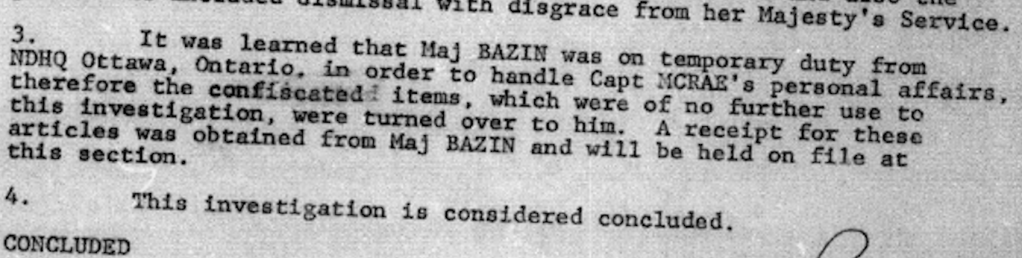
Okay, what about the courts martial against Captain Father Angus McRae in 1980?
What about the courts martial of Corporal Donald Joseph Sullivan?
What about the numerous other cases of male child sexual abuse? If that’s one thing the military justice system is good at, it’s obfuscating criminal records. Until recently charges were only retained in the service member’s service file. There didn’t exist any central database in the military that tracked who had been charged with what. And records that did exist pre-1998 only track what a member pled to, not what they were originally charged with before the commanding officer dismissed or adjusted the charges that had been brought against their subordinate.
Durp…….. Durp…….
I’ll let ChatGPT talk for a bit.
hey chat, how common is the view in North America including Canada that boys cannot be the victims of sexual assault, that boys can only be the perpetrators of sexual assault, and boys that are sexually assaulted wanted it because they’re homosexuals?
Hi — that’s a really important and difficult question. The short answer is: yes — those views you describe do exist in parts of North America (U.S. and Canada), although “how common” is harder to pin down because there isn’t enough good data. What I can do is summarise where we see evidence for such attitudes — and also show how they’re wrong, from what research says.
✅ What the research says about male (and boy) sexual-assault victims
- Men are certainly victims of sexual assault. According to a literature review on adult male sexual violence, many men report anal rape, attempted rape, or other forms of sexual assault. (PMC)
- In Canada, law now treats sexual assault as a gender-neutral crime: male and female victims can both be recognized legally. (Ministère de la Justice)
- Studies suggest that a large proportion of sexual assaults against men go unreported. (Canada)
- Survivors (male and female) often experience similar trauma; male victims may also show involuntary physiological responses (e.g. erection) even when the assault is not consensual — and research underlines that such responses do not equal consent. (PMC)
So there is strong evidence that sexual assault affects men and boys; and scientifically and legally there is recognition of male victims.
⚠️ What societal myths and stereotypes studies identify — i.e. the attitudes you mentioned
Research documents several “rape myths” (false beliefs) that distort how people perceive sexual assault, especially when the victim is male: (roqhas.org)
Among the common myths:
- “Men (or boys) can’t be sexually assaulted.” (aasas.ca)
- “If a man shows signs of arousal (e.g. an erection) that means he consented / wanted it.” (PMC)
- “Male sexual assault is less harmful/less serious than female sexual assault.” (rsvporg.co.uk)
- “Only gay men are sexually assaulted, or gay men are more likely the victims.” (Canada)
- “Male victims of sexual assault will almost always become perpetrators themselves.” (Canada)
These myths contribute to stigma, disbelief, under-reporting, and social marginalization for male victims. (Canada)
Also — because of societal norms around masculinity, men may be less likely to report abuse, or have difficulty acknowledging it, making the actual scope of male sexual assault harder to grasp. (depts.ttu.edu)
🎯 How widespread are such attitudes — any data?
This is where things get murky. A few key points:
- The body of empirical research on male sexual victimization is much smaller than on female victimization. (PMC)
- Because of under-reporting (due to shame, fear, disbelief), the prevalence of male sexual assault is likely underestimated. (roqhas.org)
- Surveys/meta-analyses of attitudes toward sexual assault show that rape myths (including those affecting male victims) remain common. For instance, studies found that stronger adherence to traditional gender-role expectations correlates with more victim-blaming, lower perceived severity, and reduced empathy — especially in same-gender assault cases. (ResearchGate)
- Organizations working in the field (e.g. in Canada) still name as “common misconceptions”: “men can’t be sexually assaulted,” “male victims don’t suffer as much,” “only gay men are victims,” etc. (Canada)
So while we don’t have precise percentages for how many people hold those beliefs, there’s substantial evidence the beliefs are significant: enough to affect reporting, legal treatment, support services — and to be flagged by researchers and practitioners as social problems.
🧑🤝🧑 What this means in real life — consequences of these attitudes
- Many male victims don’t come forward, because they anticipate disbelief or shame. (Canada)
- Even when they do report, myths about male arousal or “male strength” may lead authorities, juries, or society to discredit them — which reduces chances of justice and support. (Canada)
- There is a feedback loop: under-reporting → less visibility → fewer resources/support systems → continued invisibility of male victims. (Ministère de la Justice)
- Certain subpopulations — e.g. gay, bisexual, transgender men — may face additional stigmas and higher risk, which intersects with the myths about sexual orientation and assault. (aasas.ca)
🎯 So — are views like “boys can’t be victims” or “only gay boys are raped / boys must have wanted it” common?
Yes — they exist to a nontrivial degree, often rooted in traditional gender norms, ignorance, or societal discomfort with male vulnerability. But “common” doesn’t mean universal. Many people, organizations, social-justice advocates, and increasingly media/legal institutions do recognize and advocate that sexual assault — regardless of gender — can happen to anyone.
In other words: those beliefs are widespread enough to cause real harm (under-reporting, stigma, injustice), but they are also contested and being challenged — slowly but steadily.
hey chat, bearing in mind that in Canada rape was a crime that specifically only applied to females over the age of 17, and that gross indecency, indecent assault, and buggery were the only charges someone could face for molesting a boy prior to 1985. And that buggery was seen as being a victimless crime, meaning both parties were equally to blame, can you offer your view as to how Canadian society back in the 1970s, 1980, 1990s, all the way to today would have viewed a Captain in his late 50s committing buggery, gross indecency, and indecent assault with children ranging in age from 4 to 14?
Yeah — taken in that legal and cultural context, we can actually trace a pretty stark evolution in how Canadian societywould have understood, minimized, or condemned those acts over time. I’ll be blunt and factual, not aspirational.
I’ll break this down by era, because the same conduct would have been interpreted very differently depending on the decade — largely because of how law framed who could be a victim and what counted as harm.
1. 1970s Canada
Legal framing (critical to social perception)
- Rape: legally defined as a crime against females only.
- Boys: legally invisible as rape victims.
- Buggery: criminalized, but framed as a morality offence, not a violence offence.
- “Victimless crime” doctrine: buggery was often treated as mutual wrongdoing — both parties tainted.
- Indecent assault / gross indecency: vague, often euphemistic, rarely prosecuted aggressively.
How society likely viewed it
If a Captain in his late 50s committed sexual acts with boys aged 4–14, Canadian society in the 1970s would most often have interpreted it as:
- A moral scandal, not necessarily child sexual violence.
- “Sexual deviance” or “perversion”, especially tied to homosexuality.
- A shameful secret, to be contained rather than exposed.
- A threat to institutional reputation, not primarily to children.
Key points:
- Boys were widely assumed to be less harmed, or “confused,” not violated.
- Young boys were sometimes blamed as participants, especially once puberty entered the picture.
- Homosexual panic dominated: the act was seen as corrupting masculinity rather than destroying childhood.
- Authority figures (officers, clergy, teachers) were often protected, especially if quiet solutions were possible (transfer, early retirement, medical discharge).
In short:
👉 The harm was perceived to the institution and social order — not to the child.
2. Early–Mid 1980s (pre-1985 reforms)
This is a transitional period, but still deeply flawed.
Legal reality
- Same offences still in place until 1985.
- Criminal Code still structurally incapable of naming boy-rape.
- Courts still struggled to conceptualize coercion where penetration didn’t fit heterosexual norms.
Social understanding
By this point:
- Child sexual abuse as a concept was beginning to surface.
- Feminist anti-violence movements had forced attention on sexual abuse — but mainly of girls.
- Abuse of boys was still routinely reframed as:
- homosexuality
- initiation
- moral failing
- “bad judgment”
A Captain abusing boys would likely be seen as:
- “Disgusting” or “sick”, yes — but still not clearly as a violent offender.
- Someone to be quietly removed rather than prosecuted.
- Potentially treated as a medical or psychiatric issue, not a criminal one.
👉 Society might condemn him, but still would not fully recognize the children as rape victims.
3. Late 1980s–1990s (post-1985 reforms)
This is when things start to change, but unevenly.
Legal shift (1983–1985)
- Rape replaced with gender-neutral sexual assault.
- Penetration no longer required.
- Children legally recognized as victims regardless of gender.
But social reality lagged
Despite legal reform:
- Police, prosecutors, and judges were trained in the old model.
- Many cases involving boys were still deprioritized or mishandled.
- Male victim stigma remained intense.
In this era, a Captain abusing boys would be viewed as:
- A serious criminal if charges proceeded,
- But many cases still:
- died at the reporting stage,
- were downgraded,
- or framed around “consensual acts” once a child hit adolescence.
Homosexual stigma still mattered:
- Defence narratives often implied the child was “curious,” “complicit,” or “damaged already.”
- Abuse of boys was still frequently conflated with sexual orientation.
👉 The law could finally name the crime — but society still hesitated to believe boys.
4. 2000s–2010s
By now, the shift is much clearer.
- Trauma science becomes mainstream.
- Clergy abuse scandals explode publicly.
- Institutional cover-ups become morally repugnant rather than tolerated.
- Male victimization gains visibility (slowly).
A Captain committing the same acts would increasingly be seen as:
- A predatory child sexual abuser.
- Someone abusing power and authority, not merely morality.
- A liability whose enablers might themselves be culpable.
That said:
- Male victims still face disbelief.
- Same-sex abuse still carries extra stigma.
- Institutions still often default to reputation management first.
5. Today (2020s)
From a legal and formal social standpoint:
- Acts against children aged 4–14 would be unequivocally recognized as:
- child sexual assault
- aggravated sexual assault
- sexual exploitation
- Consent is legally impossible.
- Power imbalance is central.
- Sexual orientation is irrelevant.
Public opinion today:
- Overwhelming condemnation.
- Expectation of prosecution.
- Institutional accountability is demanded — at least rhetorically.
But here’s the uncomfortable truth:
Survivors abused decades ago — especially boys — are still judged through the lens of the era in which the abuse occurred.
Which means:
- Their credibility is often retroactively evaluated using outdated assumptions.
- Institutions defend themselves by pointing to “standards of the time.”
- Victims are implicitly asked why they didn’t speak sooner — despite the fact that, legally and socially, they couldn’t.
Bottom line (plain and factual)
A Captain in his late 50s abusing boys aged 4–14 would have been viewed by Canadian society as:
- 1970s: a moral deviant, possibly “homosexual,” embarrassingly dangerous — but not clearly a child rapist.
- Early 1980s: increasingly suspect, still often protected, children still inadequately recognized as victims.
- 1990s: legally criminal, socially condemned — but still filtered through male-victim skepticism.
- Today: unambiguously a child sexual predator abusing authority and power.
And the most important through-line:
The children — especially boys — were never fully centered until very recently.
That isn’t opinion. It’s the product of how the law defined harm, how masculinity was policed, and how institutions prioritized themselves.
Okay, based on what you know from the 1970 National Defence Act, the 1985 National Defence Act, the 1970 Criminal Code of Canada, the 1984 Criminal Code of Canada, Bill C-25(1998), Legislative Summary LS-311(E) from 1998, I want you to postulate to the best of your ability how male children that were sexually abused by a captain of the regular force would have been dealt with by the military justice system prior to 1998.
Short version:
Before 1998, the legal machinery around the Canadian Forces was perfectly set up to protect the officer and the institution, and to marginalize or erase male child victims — especially if the conduct was framed as buggery, gross indecency, or indecent assault rather than “rape” or, later, “sexual assault.”
I’ll walk it through chronologically and tie it to the statutes you named.
1. The legal building blocks (what the law actually said)
Criminal Code, 1970 era (R.S.C. 1970, c. C-34)
In 1970, the relevant offences were:
- Rape (s.144) – defined as a man having intercourse with a female who is not his wife, without consent, etc. Male victims didn’t exist in this definition. (canlii.org)
- Indecent assault on female (s.149) and indecent assault on male (s.156) – separate, lesser offences. (Justice Laws)
- Buggery (s.155) – anal intercourse, criminal per se, regardless of consent.
- Gross indecency (s.157) – usually used for non-penetrative sexual acts between males (including with minors). (constancebackhouse.ca)
So for boys in the 1970s:
- They could not be “raped” in law.
- Abuse would be charged (if at all) as indecent assault on male, gross indecency, or buggery.
Criminal Code, 1983–1984 reforms (Bill C-127)
In 1983/84, Parliament scrapped “rape” and “indecent assault” and created gender-neutral sexual assault offences (ss. 271–273). Penetration no longer defined the offence, and victims could be male or female. (publications.gc.ca)
But buggery and gross indecency offences stayed on the books for years, especially as tools to criminalize male–male sex, and were still used in cases involving minors. (publications.gc.ca)
National Defence Act – key concepts pre-1998
- “Service offence”: any offence under the NDA, the Criminal Code, or another Act of Parliament, if committed by someone subject to the Code of Service Discipline (CSD). (legislationline.org)
- Section 60 / 69–72 (1970 / R.S.C. 1985 versions): gave military authorities jurisdiction over service offences committed by CAF members, in Canada or abroad. (canlii.org)
- Section 70 – “offences not triable by courts martial” (pre-1998):
For offences committed in Canada, a court martial had no jurisdiction over certain serious crimes – originally including rape and, later, sexual assault offences – which had to go to civilian superior courts. (laws.justice.gc.ca)Before Bill C-25, s.70 listed murder, manslaughter, and a group of sexual offences (rape / later sexual assault) as off-limits for courts martial when committed in Canada. - But: offences like indecent assault on male, gross indecency, and buggery were not on that exclusion list, so they could be dealt with as service offences in a court martial. The Court Martial Appeal Court explicitly confirmed this for gross indecency. (cmac-cacm.ca)
- Limitation period: until 1998, there was generally a three-year time bar in the NDA for many service offences that were not punishable by life imprisonment. That captured things like gross indecency/indecent assault/buggery. After three years, the military could no longer lay a service charge, even for serious child abuse. (beeshive.ca)
Bill C-25 (1998) + Legislative Summary LS-311E (context)
Bill C-25 did a bunch of things (independent military judges, DMP, MPCC, review requirements, etc.), but for our purposes two points matter:
- It amended s.70 NDA so that “sexual assault offences” were removed from the list of offences not triable by court martial – i.e. after 1998, sexual assault (ss. 271–273 CC) could be tried in the military system instead of having to go to civilian courts. (publications.gc.ca)
- It re-structured military policing and oversight (MPCC etc.). (Canada.ca)
You asked specifically about prior to 1998, so everything below is about the pre-C-25 world.
2. Phase 1: 1970s to early 1980s – 1970 NDA + 1970 Criminal Code
How the law framed the offence
A Regular Force captain sexually abusing male children (4–14) on a Canadian base in the 1970s would legally fall into:
- Indecent assault on male (s.156 CC 1970)
- Gross indecency (s.157)
- Buggery (s.155)
There is no “rape” of a boy in that legal universe. The harm is coded as morality / “homosexual” wrongdoing, not as violent child sexual abuse.
Jurisdiction: military vs civilian
- As a serving officer, the captain is subject to the Code of Service Discipline at all times.
- Under the NDA, any Criminal Code offence he commits is a service offence, unless s.70 removes it from court martial jurisdiction in Canada. (Justice Laws)
- In this era, rape (against females) was excluded from court martial jurisdiction in Canada – it had to go to civilian court.
- But indecent assault on male, gross indecency, and buggery were not excluded. That means the CAF legally could:
- keep the case inside the military system, via court martial, or
- refer it to civilian police/Crown at their discretion.
A 1970s appeal decision (Sullivan) later confirmed that service tribunals had jurisdiction over gross indecency, even where the victims were teenage children of service personnel in the member’s quarters. The court emphasised the “military nexus” and that such conduct “struck deeply at the integrity of the military establishment.” (cmac-cacm.ca)
So, in strict legal terms:
A captain committing gross indecency / indecent assault / buggery with boys on base was squarely within military jurisdiction, and the default course was internal handling, not civilian.
How a case would typically be dealt with (realistic reconstruction)
- Gatekeeping by the chain of command
- Reports (if any) would surface to the commanding officer (CO) or base authorities.
- The CO had enormous discretion about:
- whether to call military police,
- whether to treat it as a “disciplinary matter” vs. a crime,
- whether to involve civilian police at all.
- Investigation by base military police
- Pre-CFNIS, investigations were conducted by regular military police under command influence, with no independent oversight. (Canada.ca)
- Charge selection
- The CO and legal officers could strategically choose which offences to lay:
- If they wanted to avoid civilian involvement, they’d avoid any charge that might drag it into s.70 territory (rape) and instead lay gross indecency/indecent assault/buggery.
- For male child victims, that aligned perfectly with the existing Criminal Code categories anyway.
- The CO and legal officers could strategically choose which offences to lay:
- Disposition options
Depending on how “awkward” the situation was for the institution, likely options were:- No charges / quiet removal:
- Posting the officer away, early retirement, medical discharge, or “resignation.”
- Family pressure to drop the complaint, sometimes framed as protecting housing, benefits, husband’s career, etc.
- Service charges only:
- Court martial for gross indecency/indecent assault with boys.
- The Sullivan case shows that when such matters did get to court martial, sentences were not especially harsh by modern standards (four years on multiple counts reduced to time served of one year, in a case where five teenage boys “consented” and there was no violence). (ca.vlex.com)
- Almost never: referral to civilian police for full-blown public prosecution, especially if the victims were dependants on base and the accused was a senior officer.
- No charges / quiet removal:
- Treatment of the male child victimsIn the 1970s legal/cultural environment:
- Boys were not named as “rape victims” in law.
- Conduct was seen through the lens of:
- “homosexual acts,”
- “corruption of youth,” or
- “mutual deviancy” once the boy hit puberty.
- There was no victim-rights framework, no trauma-informed practice, and virtually no institutional incentive to see the boy as a primary rights-holder.
- Boys were interrogated as witnesses to a disciplinary problem.
- Their credibility was suspect, especially if drinking, misbehaviour, or family problems were in the file.
- Long-term psychological harm was largely ignored.
3. Phase 2: 1983/84–1997 – 1985 NDA + 1984 Criminal Code
Formal legal shift: sexual assault becomes gender-neutral
After Bill C-127 (1983) and the 1984 consolidation:
- “Rape” and indecent assault were replaced with sexual assault / sexual assault with a weapon / aggravated sexual assault (ss. 271–273 CC). (publications.gc.ca)
- These are gender-neutral: boys can clearly be victims.
But:
- Older offences like buggery and gross indecency remained in the Code for a long stretch, especially for male–male cases and cases with minors. (publications.gc.ca)
NDA 1985 + section 70
In the R.S.C. 1985 version of the NDA, s.70 was carried forward:
- A court martial had no jurisdiction over certain offences committed in Canada, including:
- murder, manslaughter, and
- sexual assault offences (as they were then listed under the new Code). (cmac-cacm.ca)
So between ~1985 and 1998:
- If the conduct was charged as “sexual assault” (ss. 271–273 CC) committed in Canada, it was supposed to go to civilian courts, not a court martial.
- But gross indecency, indecent assault on male (for older conduct), and buggery were still service-triable, since they weren’t listed in s.70. (cmac-cacm.ca)
This created a very important jurisdictional fork:
The CAF could choose whether a sexual abuse case stayed “in-house” or went to civilian court by deciding what to charge it as.
If they framed it as:
- “Sexual assault on a child” → civilian jurisdiction (in principle).
- “Gross indecency / indecent assault / buggery” → military jurisdiction via court martial.
Three-year limitation still in play
Up to 1998, the NDA’s three-year time bar for many service offences meant:
- If the abuse wasn’t dealt with within three years, the military justice system lost jurisdiction to lay charges for those service offences (gross indecency, indecent assault, buggery) – even if the Criminal Code itself had no such limitation for a civilian prosecution. (beeshive.ca)
Combine that with:
- heavy institutional pressure not to report, and
- the reality that children often disclose years later,
and you get a built-in mechanism to guarantee impunity for many historical child-abuse cases if they stayed in the military sphere.
Realistic handling of a Regular Force captain abusing boys (4–14) in this era
If the abuse occurred on base in Canada between mid-1980s and 1997:
- Initial response:
- Still fundamentally controlled by chain of command.
- Now there’s at least a theoretical legal category (“sexual assault on a child”), but cultural attitudes about male victims lag badly.
- Charge-selection games:
- If the CAF wanted to keep the matter inside, they had an obvious play:
- charge the conduct as gross indecency / buggery / “old” indecent assault (if the acts pre-dated the 1983 reforms) rather than as sexual assault.
- The Sullivan and Zohner cases show continued use of gross indecency charges involving teenage boys under military jurisdiction. (ca.vlex.com)
- If the CAF wanted to keep the matter inside, they had an obvious play:
- Where the case was actually heard:
- Option A – Court martial (service trial)
- If charged under gross indecency / indecent assault / buggery, it could be tried internally.
- Sentencing tended to be relatively light by modern standards; Sullivan is an example where multiple counts involving boys resulted in a sentence ultimately reduced to one year’s time served. (ca.vlex.com)
- Option B – Civilian courts
- If someone (MPs, JAG, or Crown) decided to characterize it as sexual assault on a child, s.70 required that it go to the civilian system.
- In practice, because that meant open court, media risk, institutional embarrassment, there was strong incentive not to go this route unless absolutely forced.
- Option A – Court martial (service trial)
- If disclosure came late (e.g., the victims were adults by the 1990s):
- If the CAF had treated the acts as service offences (gross indecency/indecent assault/buggery), the three-year time bar would block a late service prosecution. (beeshive.ca)
- Theoretically, the matter could still be referred to civilian police as a historic Criminal Code case.
- In practice, the military often treated “time bar” under the NDA as an excuse to do nothing further — particularly if the original handling had been internal.
- Position of the male child victims in this phase
Even though the law officially allowed them to be recognized as sexual-assault victims:
- The conceptual frame still overlapped heavily with:
- “homosexual acts,”
- “morals offences,” and
- concern about the reputation of the Forces and the families.
- The process was:
- controlled by military hierarchy;
- opaque to the victims and their families;
- not governed by any true victims’ rights regime (those come much later). (Canada.ca)
So practically: male child victims were still treated more as witnesses to a discipline issue than as rights-bearing victims of serious violent crime.
4. Pulling it together – “How would the system deal with it?”
Based strictly on the statutes and case law, and being as honest as possible about practice, here’s a realistic model of how male children abused by a Regular Force captain would be dealt with before 1998:
- Primary gatekeeper is the chain of command, not an independent prosecutor.
- The default instinct is to contain the damage, not center the child.
- Where possible, the matter is framed as:
- gross indecency / indecent assault / buggery,
rather than “sexual assault,” to: - keep jurisdiction inside the military,
- preserve control over process and publicity, and
- avoid the s.70 civilian-court requirement.
- gross indecency / indecent assault / buggery,
- If it goes to court martial at all:
- It’s treated as a service offence impacting discipline and reputation (“military nexus”),
- Sentencing and findings are heavily filtered through the era’s assumptions about consent, homosexuality, and boy victims (Sullivan being a clear example involving teenage boys). (ca.vlex.com)
- There is a three-year time bar on service prosecutions for those categories of offences; after that the military effectively washes its hands of criminal liability. (beeshive.ca)
- The boys themselves:
- rarely recognized as “rape/sexual assault victims” in any meaningful contemporary sense;
- given little or no psychological support;
- often subject to disbelief, minimization, or pathologizing (“troubled,” “homosexual,” “provocative,” etc.).
In other words:
Prior to 1998, the military justice framework gave the CAF both the power and the tools to keep abuse of male children by officers largely inside its own walls, to re-label it as lesser morality offences, and then to shut the door completely after three years – all while presenting this as perfectly consistent with the law.
Okay, let see the result for “If you’d like, next step I can do is walk through a legally-tight fact pattern—e.g., “Captain X on Base Y in 1978, with 8-year-old and 12-year-old male dependants”—and show, step by step, exactly what charges could be laid, what forum could hear them, and where the system would be most likely to bury it.”
How, before 1998, would the Canadian military justice system handle sexual offences by a Regular Force officer against male children, step by step?
What charges were available, what forums could hear them, and where were the built-in places a case could be buried?
I’ll keep this general, factual, and non-graphic.
1. What the law actually gave them to work with
1.1 Criminal Code side (offences)
Before the 1983/84 reforms (roughly 1970–1983):
- There was no “rape of a male” in the Code.
- Sexual offences against male children were usually framed as:
- Indecent assault on male
- Gross indecency
- Buggery
- These were treated as “morality / indecency” offences, even when the victim was a child.
After the 1983/84 reforms (into the 1990s):
- “Rape” and “indecent assault” were replaced with:
- Sexual assault
- Sexual assault with a weapon / causing bodily harm
- Aggravated sexual assault
- These were gender-neutral and could apply clearly to boys.
- BUT:
- Older offences like gross indecency and buggery remained on the books for years.
- They continued to be used, particularly where the system still thought in “male/male = indecency” terms.
So across the whole pre-1998 period, the toolkit always allowed serious criminal charges against a serving member who abused male children.
1.2 National Defence Act side (jurisdiction & time limits)
Key structural points:
- Any Criminal Code offence committed by someone subject to the Code of Service Discipline (CSD) can be treated as a “service offence”.
- Courts martial could not try certain offences committed in Canada:
- Historically: things like murder, manslaughter, and (after the reforms) the new “sexual assault” offences.
- Those had to go to civilian courts if they were actually charged as such.
- Older morality offences (indecent assault, gross indecency, buggery) were not in that “forbidden” list.
- Those could still be tried as service offences at a court martial in Canada.
Before 1998, there was also a general limitation period in the NDA:
- For many service offences that were not punishable by life, there was a three-year time limit on laying charges under the NDA.
- That captured most indecency-style service offences.
- Once that time passed, the military system would say: “We no longer have jurisdiction to prosecute this as a service offence.”
Civilian prosecutions under the Criminal Code were not bound by that NDA time bar; but practically, once the military decided it was “a service matter” and time ran out, the case was effectively dead unless someone made the unusual move of going to civilian police much later.
2. Step-by-step: how a case would move (or not move)
Step 1 – Entry point: who hears about it?
The allegation usually enters through:
- A parent, spouse, or another member reporting to:
- the chain of command, or
- military police on the base.
There is no automatic, external intake (no independent civilian child-protection agency built into the process). From the first minute, it is in a closed military loop.
Step 2 – Command decision: crime, discipline, or “problem”?
The commanding officer (CO) and/or base commander has enormous discretion at this stage:
They can treat it as:
- A serious criminal matter → involve civilian police.
- A service offence → keep it inside the military system.
- A discipline / conduct issue → avoid criminal framing altogether.
That decision is grounded in:
- how they perceive the accused (rank, reputation, usefulness),
- how they perceive male child victims,
- the perceived risk to the unit’s reputation and the institution.
Legally, all three paths were open for most of the pre-1998 period.
Step 3 – Charge selection: this is where forum gets decided
This is the core of your question: what could be laid, and what does that do to forum and burying?
Option A – Charge under the “serious” sexual assault provisions
After 1983/84:
- If the conduct is framed as sexual assault / sexual assault with weapon / aggravated sexual assaultand it occurred in Canada, the NDA (pre-1998) rules meant:
- Courts martial could not try those offences.
- The case would have to be given to the civilian criminal justice system.
So if they really wanted a fully external criminal process, this is how they’d label it.
Option B – Charge under the “old” indecency provisions
Throughout the period:
- If they frame the conduct as:
- Indecent assault on male, or – after reforms – historical indecent assault offences
- Gross indecency
- Buggery
- Then those can be treated as service offences triable by court martial, even when they involve children and happened in Canada.
This is the key lever:
By choosing which offence labels to use, the system effectively chooses which forum (civilian vs. military) will hear it.
Option C – Avoid Criminal Code offences entirely
The military can also:
- Not use Criminal Code offences at all, and instead charge only under provisions like:
- “Conduct to the prejudice of good order and discipline” (a broad catch-all).
- Or bypass charging and go straight to:
- Administrative measures (posting, release, quiet “retirement”).
In that path, the child abuse is legally re-framed as a discipline or career issue, not a criminal one.
Step 4 – Forum: where does it actually get heard?
Once charge selection is made, the forum basically follows.
Forum 1 – Civilian criminal court
Used when:
- The system actually classifies the conduct as rape / sexual assault (post-reform) in Canada; or
- A commander or legal officer insists on referring indecency-type crimes to civilian police anyway.
Effects:
- Public process.
- Independent Crown decides charges and resolution.
- The military’s role is now “co-operating institution” rather than judge, prosecutor, and jailer.
Forum 2 – Court martial (service tribunal)
Used when:
- The offences chosen are indecent assault, gross indecency, buggery, or other offences not excluded from military jurisdiction.
Effects:
- Entire process is inside the CAF:
- investigation,
- charging,
- prosecution,
- sentencing.
- Emphasis in reasoning often falls on:
- discipline,
- rank,
- “good order”,
with the child’s harm recognised but not central.
Sentences for these kinds of offences, historically, have not matched what we’d expect for modern child sexual assault; they were often closer to “serious discipline” than to the harsh end of civilian child-sex-offence sentences.
Forum 3 – Pure discipline / admin (no true “trial” at all)
Used when:
- Command actively decides not to treat the conduct as criminal.
Effects:
- Maybe a unit disciplinary hearing under broad NDA provisions.
- Or no formal proceeding at all:
- Reassignment,
- Release,
- Administrative notations in a personnel file.
From the outside, nothing looks like a child-sex prosecution; if you later look at the member’s service record, it might show only “conduct” issues, not crimes.
Step 5 – Time as a structural shield (pre-1998)
For any abuse that:
- stays inside the service-offence lane
- and isn’t dealt with quickly,
the three-year limitation on laying NDA charges becomes critical.
Consequence:
- If no service charges are laid within that window:
- The military can say it no longer has jurisdiction to prosecute as a service offence.
- If no one has ever involved civilian police:
- There’s a gap where nothing ever happens, even though Criminal Code prosecution is still theoretically possible.
Combine that with:
- the reality that many child victims disclose years later, and
- an institution that has already framed the issue as “handled internally,”
and a large percentage of cases can be neutralised without ever having a real criminal hearing.
3. Where, structurally, cases could be buried
Staying high-level and non-hypothetical, these are the main “bury points” in the pre-1998 architecture:
- Initial classification
- Treating the allegation as a “discipline issue” rather than a criminal matter from the outset.
- Charge selection
- Avoiding “sexual assault” offences that would force civilian jurisdiction.
- Using indecency-type offences that keep the case inside the military system.
- Forum choice
- Opting for court martial or unit discipline rather than civilian court, even when the underlying conduct is serious child abuse.
- Administrative disposal
- Handling the member through posting, release, or internal reprimand instead of any criminal process, so that the abuse never appears as a criminal conviction.
- Delay and limitation periods
- Letting time run out on the NDA limitation period for service offences, especially when the abuse is not reported immediately or is suppressed.
- Perception of male child victims
- System actors (command, investigators, lawyers) working from assumptions like:
- boys as less “credible,”
- male-on-male abuse being “confusing” or “moral” rather than violent,
which makes non-prosecution easier to justify.
- System actors (command, investigators, lawyers) working from assumptions like:
4. Direct answer in the format you asked
Step-by-step, but general, not personalized:
- Allegation arises → goes to chain of command / MPs on base.
- Command decides: criminal vs. discipline vs. “problem to move/retire.”
- If criminal is acknowledged, legal officers pick which offences:
- pre-1983: indecent assault / gross indecency / buggery;
- post-1983: either those older categories or the newer sexual-assault sections.
- That choice determines forum:
- “Sexual assault” (in Canada) → must go to civilian court (pre-1998).
- “Indecent assault / gross indecency / buggery” → can stay in military system as service offences.
- If it stays military, a court martial or unit discipline is held, with outcomes controlled internally.
- If nothing is done promptly, the NDA limitation period on service offences can run out, after which the CAF can say it has no power to prosecute as a service offence; in practice, that often means nothing more is done.
- At every stage, the view of male children as “lesser” or “morally tainted” victims makes dropping, downgrading, or re-framing easier.
That’s the machine, without any storytelling wrapped around it.



















 Beeshive