
If that’s one thing that people have trouble wrapping their heads around is how did I have a military social worker.
But Bobbie, you weren’t a soldier. You weren’t in the military. How could you have a military social worker?
Back in my day, we couldn’t get medical care at the base infirmary. We couldn’t get dental care at the military dentist unless the base we lived on was far away from the nearest civilian dentist.
But when it came to social workers, especially in “sticky situations”, the Canadian Armed Forces had no problem with unleashing their employees onto the children of military service members.
I didn’t pay much attention to Totzke’s career after I was no longer involved with him in 1983.
I should have though.
He joined the Royal Canadian Navy in 1966. Seems to have been involved with the naval band when he first joined.
Sometime after 1983 the good captain became a lieutenant colonel.
By 1984 he was the Area Social Worker for Pacific Command.
He was involved with the Sea Cadet program on the west coast.
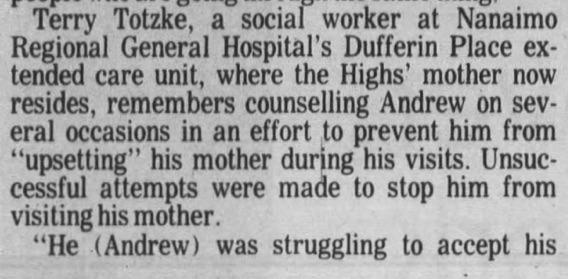
He didn’t seem to stay in the Canadian Forces for much longer as by 1989 he was working at Nanaimo Regional General Hospital’s Dufferin Place extended care unit as a social worker.
Nothing much more out of the ordinary with Terry Totzke. He seemed to have retired from social work in the ’90s and went on to play drums in a band.
The band had some religious connections.
The one thing that does stick out though as interesting is that one person that Totzke had direct involvement with committed suicide with a crossbow.

Not too much was publicized about the suicide other than it appears that the man who committed suicide was suffering from a mental illness and Totzke had been involved with denying this man the ability to see his mother in a nursing home as Totzke was concerned that the man’s mental illness would be upsetting to the mother.

Really, none of this is surprising.
The counselling that I received from Totzke from October of 1980 until April of 1983 had driven me to attempt suicide two times in that period of time.
Social work and military didn’t really work back then.
Social work in the military was more about control and contain.
Blame the victim.
Make sure the victim understood that they were just as guilty as the abuser.
I wasn’t a 7 or 8 year-old victim of the babysitter and captain McRae for a year-and-a-half.
No, I was a budding homosexual pervert that enjoyed being abused and enjoyed watching my brother be abused.
During our meetings or the school visits, Terry would often remind me that he had the base military police watching me to see if I ever tried to kiss or touch another boy.
Terry was the reason that I wasn’t allowed to play team sports anymore. Might be naked boys in the change room. I might lose control of myself and start having sex with these boys.
And don’t forget, as Captain Totzke’s affair, it was his responsibility to get me the treatment required for my major depression, my severe anxiety, and my haphephobia.
In fact, he just seemed to stand by and watch me deteriorate to the point that I was supposed to have been institutionalized.
Even when Alberta Social Services finally began to put the pieces together and realized that I was in danger the longer I stayed in my father’s house, Totzke appears to have been very instrumental in helping my father obtain a posting out of the jurisdiction of Alberta to avoid my apprehension.
And even at our new posting, the new military social worker, Captain Linda Tyrell, offered absolutely no assistance to the Children’s Aid Society of Toronto when CAST tried to contact my father.
 Beeshive