Slipping through the cracks.

Looking back on my life it has become readily apparent that the one thing that I am extremely accomplished at is slipping through the cracks.

And this has made me realize that there are actually a lot of people on this planet that have slipped through the cracks for all of their lives.

In 2011, in an attempt to bolster my complaint against P.S. after the case manger with the CFNIS told me that they couldn’t find any evidence against P.S. I started tracking down all of my personal information from any place that my father had been stationed.

The first crack that I seemed to have slipped through was in Halifax.

CFB Shearwater – Nova Scotia.

I had sent off a request to the Nova Scotia government for any medical or social service records that the government had from my childhood when my father was stationed at Canadian Forces Base Shearwater.

I was surprised that they had the detailed records that they did. They had my birth records that included my mother’s admission records. They also had all of my admission records from just after I was born all the way up until we moved from CFB Shearwater to CFB Summerside on PEI.

The records were notable for a few things.

First, the records identified an issue that I had with anything that contained beef fats like dairy.

The records also indicated that my mother was an extremely anxious person.

The records also indicate that my father had to be returned to port by the Canadian Forces due to “emotional issues”.

I had been admitted to the hospital on a couple of occasions as a “boarder”.

The longest I spent in hospital was 31 days.

Just before my father’s posting to CFB Summerside in Prince Edward Island the doctors at the IWK Children’s hospital had reached the opinion that my frequent admissions to the hospital were due to “societal problems” in the household and that social services should be notified.

Around 2015 I would make the acquaintance of Pat Longmore. She had been in the Canadian Forces along with her husband Bob back in the 1970s at CFB Shearwater. Pat knew both Richard and Marie. Pat was the first person ever to have confirmed the existence of a “battered wives club” on CFB Shearwater and that my mother had used it a couple of time when she needed to get us away from Richard when Richard was in the midsts of a meltdown.

  • How would things have turned out if Richard had not been able to escape the involvement of our family with Nova Scotia Social Services by obtaining a posting to CFB Summerside.
  • What would life had been like had Richard faced any real serious consequences for his alcoholism and his violent outbursts.
  • What would life had been like had the Canadian Forces offered Richard treatment for his PTSD and his Depression instead of encouraging him to self medicate his problems away with alcohol.

CFB Summerside – Prince Edward Island

I remember being in a bicycle accident while we were stationed at CFB Summerside. I didn’t remember too much about the accident, but I figured that I would submit a request anyways.

Turns out that someone had found me laying face down in the middle of the road unconscious with no description of what had happened.

The person who admitted to hospital was not my grandmother. To this day I still don’t recognize the name. When I tracked down my mother in 2013 and showed her the paperwork she said that she didn’t recognize the name. At the top of the admission paper it says “Father in Iceland with airforce, will return this evening”.

In 2013 I had to examine my father for a Federal Court application for judicial review. One of the questions I asked my father was what provinces other than Alberta were we involved with social services. His response was PEI for child custody.

I filed a request from the PEI Govt for these records. All the government would confirm is that my father had applied for custody, but that the matter was never settled by the court, the government had never granted Richard sole custody.

In 2013 I tracked my mother down to ask her about this. She said that the Canadian Forces Judge Advocate General had granted Richard sole custody of my brother and I and that she had been ordered to leave the PMQ by the Canadian Forces.

Behaviours such as this were confirmed in a report that was commissioned by the Canadian Armed Forces in 1996 and released in May of 2000. The report stated that because of the existence of the Defence Establishment Trespass Regulations military dependents such as spouses and children had no legal right to live on military bases. Military dependents are there at the pleasure of the serving member. If there was a breakdown in the marital home the serving member could have the military police eject the spouse from the base. This would prevent the ejected spouse from serving court papers on the serving spouse. Also, the serving spouse enjoyed free transportation provided by the Canadian Forces which would often cause the ejected spouse to be disadvantaged by travel distance from seeing her children.

  • How would things have turned out in the long run if Richard wasn’t able to have Marie ejected from the PMQ?
  • What would have happened had social services become involved when I was admitted to hospital with no next of kin.

CFB Namao / CFB Griesbach – Edmonton, AB

The most egregious cracks that I slipped through here were related to my mental health.

As I’ve said in other posts, I fully believe that my long term mental health was willingly sacrificed to allow the Canadian Armed Forces to keep their damn secrets about the Captain Father Angus McRae child sexual abuse sex scandal under wraps and out of the public eye.

I had no idea of how bad things were until I received my foster care records from the Alberta Government. The fact that I had foster care records was the most stunning aspect of this.

In October of 1980 my family arrived at CFB Griesbach. This was 6 months after the events on CFB Namao. My teacher and my brother’s teacher brought us to the attention of military social worker Captain Terry Totzke. A psychiatrist hired by the Canadian Armed Forces to evaluate my family and I found that I was well past the point of despair and depression and that I was extremely anxious and fearful of men. I was also found to hate being touched. Oh, and I was terrified of my father and I was convinced that he was going to drown me in a toilet. It’s obvious that by this point in time Richard had been informed of what had transpired on CFB Namao.

For an added bonus my results from the Wechsler IQ test that I had been administered showed that I had an IQ of 136 +/- 6.

This same psychiatrist found that my father accepted no responsibility for his family, he expected others to solve his problems for him, he blamed his mother for the problems my brother and I were exhibiting.

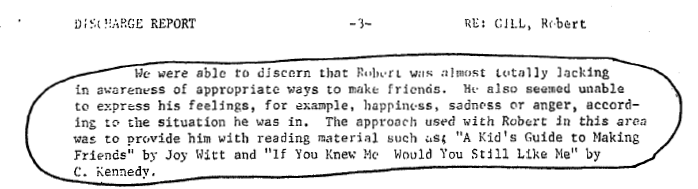
I remember this time of my life as being full of confusion. I couldn’t make friends. The other kids on base were constantly beating the daylights out of me. I also started to be able to run my hands through my hair and pull clumps of hair out of my head. My father was angry with me no matter what I did. My stepmother started echoing my father’s anger towards me. No matter what I did I was a complete fuck-up. There was no pleasing anyone. I started frequently wetting the bed. To teach me a lesson and to get me to stop wetting the bed I was often sent to school without a shower which just amplified the attacks at school. The kids would often call me “onion head”. As a foot note, I didn’t stop wetting the bed until just after I had turned 16 and had moved out of the house.

Various follow-ups between October 1980 and November 1981 didn’t go anywhere. No matter what Captain Totzke was being told I was never medicated nor was I ever sent for therapy.

In November of 1981 my teacher, my brother’s teacher, and our principal contacted Alberta Social Services as Captain Totzke didn’t seem to be able to get my brother’s and my “odd and strange behaviours” under control. It wasn’t that Totzke couldn’t get our behaviours under control. It’s more than likely that the Canadian Forces didn’t want to risk either me or my brother talking to civilian therapists because there was the obvious risk that we’d start talking about the babysitter from CFB Namao which in turn would lead to the discovery of the true extent of what Captain Father Angus McRae had done on CFB Namao from 1978 until 1980.

Alberta Social Services sent me for testing and found that I was so emotionally disturbed that I would never be able to function properly in any school unless I received treatment. By the time I was supposed to be placed in a “special school” I had devolved so bad that I was supposed to be institutionalized. As Captain Totzke was my primary caregiver he would have to agree to this. Which he never seemed to. So a compromise was reached, I would attend a school program for emotionally disturbed children until further arrangements could be made.

Being in this program required two things. First my father had to sign my foster care admission paperwork. Second, me father was supposed to attend family counselling.

In December of 1982 a letter was sent to Captain Totzke and my father inviting them to a conference with my civilian social workers on January 26th, 1983.

The meeting occurred on January 26th, 1983. Captain Totzke was there but my father wasn’t. Captain Totzke said that my father was happy with my improvement from being in the Westfield program. My father was so happy that Captain Totzke said that he recently helped my father turn down a posting to Nova Scotia because my father wanted me to stay in the program.

My civilian counsellors informed Captain Totzke that my father was not attending family counselling and that unless my father attended family counselling that my behaviour and my emotional state would continue to deteriorate. My civilian case worker told Captain Totzke that in order to apply duress to Richard to make him comply that I would be removed from the home and placed into foster care or residential care. Remember the part about my father signing the foster care admission paperwork? My civilian counsellors told Captain Totzke to inform my father and my father’s commanding officer forthwith that Richard was to attend every scheduled family counselling session that was upcoming or Alberta Social Services would take action.

On January 28th, 1983 my civilian case worker called Captain Totzke for an update. Apparently my father lost his shit. He didn’t understand what the program was all about. He claimed that my counsellors were harassing Richard and Sue. Totzke also informed my civilian case worker that my father has just received a posting to Ontario. Remember Totzke claiming he helped my father turn down a posting? I wonder what changed in the span of two days, don’t you?

In closing the file Alberta Social Services noted that my father often changed his story from one meeting to the next, and that my father often told people in positions of authority what he thought they wanted to hear. Basically Richard was a pathological liar who could manipulate people to get what he wanted.

It destroys me to know that the Canadian Armed Forces and my father knew that I was experiencing severe psychological trauma brought on no doubt by the sexual abuse from CFB Namao, but also from my father’s issues, and they chose to do nothing.

What type of life would I have been able to enjoy had I received proper therapy and treatments back then?

What would have happened if my father had to prove that he had sole custody of my brother and I and that it turned out that he didn’t.

How would life have been for me had I been removed from both Richard and Marie and placed with a normal family.

If I had remained in Alberta after my father fled to Ontario and had I remained in the foster care program what type of assistance would I have received with obtaining higher education?

I slipped through far too many cracks to count here.

  • How would my life have turned out had I received therapy for my major depression?
  • How would my life have turned out had I received therapy for my severe anxiety?
  • How would things have turned out for me if Captain Terry Totzke was less concerned about my apparent homosexuality and had been more concerned about my mental health and wellbeing.?
  • How would things have turned out for me had I been institutionalized and received the proper care?
  • How would things have turned out for me if I had been placed into foster care or residential care and then felt safe enough to talk about what had happened on Canadian Forces Base Namao?
  • If I had been removed from the home and placed with a family that cared, would I have finished grade 12? Would I have gone on to college? University? Would I have been able to take proper trades training?
  • If I was removed from Richard’s house and placed into either residential care or foster care, would I have been free to develop a proper sexual identity?
  • Given a chance, what would I have parlayed my IQ of 136 +/- 6 into?

CFB Downsview

I obtained my social service paperwork from the Children’s Aid Society of Toronto as they were mentioned in my Alberta Social Services paperwork.

CAST tried to locate the contact information for my family from the Canadian Armed Forces, but the Canadian Forces wouldn’t comply.

CAST ended up tracking down my brother and I through the North York Board of Education.

CAST wasn’t able to get too involved with my family as my father didn’t want to participate and CAST was facing budget cuts. CAST said that they would keep the file open none the less and that if they received any complaints from the neighbours they wouldn’t hesitate to get involved.

I don’t ever remember being involved with CAST. Is this why Richard and Sue always insisted that my brother and I get out of the house in the morning and not come back until supper time? That way we’d never be home when CAST showed up for a house visit?

  • If I had been placed at the Sick Kids Hospital in Toronto for psychiatric treatment, instead of being forced to grow up with major depression, severe anxiety, and gender confusion, what would my future have been like?
  • What would have happened if the Canadian Forces Military Police on CFB Downsview had reported Richard’s violent domestic fight to CAST in the summer of 1985? Is this why when the military police came to talk to my brother and I about Richard’s violent breakdown that they told us to never call 9-1-1, that we were to call base switchboard and summon the military police?
  • When I moved out of the house in the winter of 1988 the CAST file on my family was still open. I didn’t have to go to work or rent a room in a house. Had I known that my family was involved with CAST I could have asked CAST for emergency shelter and emergency funding to allow me to attend school without having to work.
  • In 1989 when I attempted to finish off my schooling at A.I.S.P., I could have also received emergency funding and emergency shelter had I applied for it after Richard blew a gasket because he didn’t understand what the name “Alternative and Independent School Program” meant.
  • If I had known about my family’s involvement with CAST, would CAST have assisted me with extracurricular music lessons?
  • Would CAST have assisted me with getting into the National Science Fair if they had learnt about my father’s refusal because I was “showing off”?

CFNIS 2011

If I had known the truth about the period from October of 1980 until January 1988, would I have been better able to prevent the CFNIS, the Provost Marshal, the VCDS, and the Minister of National Defence from concocting a wildly inaccurate story about the period of August 1978 though to July of 1980.

  • The CFNIS in 2011 had access to the Canadian Forces court martial records relating to Captain Father Angus McRae. The CFNIS knew that P.S. had been molesting numerous children on the base and it was this abusive behaviour that attracted the attention of the base military police which eventually led to the CFSIU investigating Captain McRae for having committed “acts of homosexuality” with young boys on the base.
  • Alberta Social Services was of the opinion that my father was a liar and often told people he perceived to be in positions of authority what he thought they wanted to hear. Would the CFNIS had been able to place much emphasis on Richard’s statement in which he said that there was never a babysitter in our house?
  • If I had my social service records during my initial interview with the CFNIS in March of 2011, would I have been able to introduce enough evidence to show the CFNIS that my father was fully aware of what had occurred on CFB Namao but that due to his own issues he was refusing to allow me to receive treatment for the various mental illnesses that I was suffering through as a result of the abuse on CFB Namao?

So many cracks.

I’ve slipped through so many cracks that it’s not funny. It’s actually quite maddening.

To see that I was so close to receiving help with my issues, but that my father and the Canadian Forces were so hell bent on keeping a lid on the Captain McRae fiasco that I was kept from receiving the help that I so rightfully deserved.

You might say to yourself that maybe it would have been better if I had never found these records and documents. You’d be very wrong.

Prior to obtaining these records I had always viewed myself as a worthless fuckup who had screwed up his own life because as my father would often say that I was fucking insane like my mother and that I was a selfish crybaby who fucked with his military career.

The records allowed me to see that I wasn’t a fuck-up. That I was just a kid being crushed by forces far more powerful than I could have ever imagined.

I had been sacrificed in order to keep a secret.

The Canadian Armed Forces sacrificed me to keep the lid on a horrific secret.

My father, having his own demons and lacking his own backbone was more than willing to go along with this.

My father was obviously an unfit parent, so was my mother but I didn’t grow up with her, how would my life had turned out if I hadn’t grown up in an environment where secrets needed to be kept?

People keep telling me “Bobbie, you’re so smart, what are you wasting your life for”, or “Bobbie, you’re so smart, why didn’t you get into such-n-such a trade”, or my favourite “Bobbie, the guys in the shop are afraid of you because you know too much”.

The last point I’m not kidding about. When I took on the position of Chief Engineer at St. Paul’s I got brought into the plant manager’s office for a little one-on-one. Seems that there was a little mutiny of sorts brewing in the power engineering section. I was too smart and the other engineers were feeling intimidated. And this isn’t the first employer that has brought this up.

And it’s true. I love to read. I love reading service manuals. I love to understand. If I didn’t then I wouldn’t have made so many changes at St. Paul’s. And this is something that I am sick and tired of apologizing for. Yes, I should be in more technical employment. But that wasn’t in the cards for me. And I’m not about to play stupid. Why should I? I didn’t ask to have my potential pulled out from under me.

I really despise it when people accuse me of having been lazy or having wasted all the opportunities that a person like me should have had. When I was younger this used to anger me quite a bit. “Bobbie, you must have partied too hard instead of going to trade school”, or “Maybe home life was too good and you just never learnt the value of hard work”.

Where would I have gone in life had I not had to drag along the diagnosed but untreated depression, anxiety, and other issues that were gifted to me?

No, the discovery of all of these records tells me that short of a fucking miracle I ended up exactly where the trajectory of my early life aimed me for. I think I did pretty good for a grade 9 dropout with a grade 12 G.E.D..

No drug dependency, no criminal record, a pretty solid employment history.

Sure, going to college, or university, or even trade school would have probably opened up a world of opportunity for me, but those things were never to be.

So I’m not upset and saddened by the opportunities that were taken away from me.

I’m just disgusted at the people and organizations that took those opportunities away from me.

You seem so normal……..

One of my curses if you will is that I seem “so normal”. Facial piercings and tattoos aside. This was especially truer back in my teens and twenties when I really had to appear “normal” in order to gain and keep employment.

I have never once in my life stuck a needle in my arm nor have I ever snorted anything up my nose. I don’t even like weed.

I can honestly remember the handful of times that I did drink. And not surprising these events often went way out of control. I honestly believe that alcoholism is genetic. My grandmother was an alcoholic. My father was an alcoholic. And I more than like was destined to be an alcoholic.

Outside of the wine that I had been given in the rectory of the chapel on Canadian Forces Base Namao, and outside of the occasional sips of Baby Duck or my father’s rum & coke mixes, the first time I had alcohol as a kid was in the summer of 1984 when I was staying with my grandmother over the summer. Grandma and her friend Hazel were drinking. Grandma asked me to get her and Hazel another beer each out of the fridge. I took two beers out and popped the caps off. I sucked the foam off the top like I would always do when getting grandma a beer. This time though she told me to get her another beer out of the fridge, and this time I wasn’t to drink any of it. So I got her the beer, I popped the cap off, and I let the foam run down the side of the bottle. I put the bottle on the table in front of grandma. Grandma slid the other bottle over towards an empty chair and told me to sit down and drink my beer. This was cool I thought. I’m drinking beer with my grandmother. What twelve year old boy doesn’t want to hang out with his sixty-one-year-old grandmother and get drunk with her. I finished two bottles and then it was time for me to go pass out in the bedroom.

I didn’t drink again until I was about 15.
I know “drink again” isn’t something you want to hear somebody brag about when discussing their childhood, but in my household, the fact that I wasn’t a raging alcoholic by the time I was 18 was a miracle.

Bob Becker, a man that I was working for on the weekends at the time, had given me a small bottle of Johnny Walker Red Label to give to my father as a present. When I got home my father took one look at the bottle and said that he wouldn’t drink that horrid piss. Richard was a Lamb’s Navy and a Pilsner kind of guy. Anyways, Richard told me to put the bottle on a shelf in my bedroom and that he didn’t want to see me drink it until I was 19.

A friend from cadets happened to be over at my house for lunch one school day. We went downstairs to my bedroom. He spied the bottle. He saw my father’s shot glasses over by my father’s computer desk. Peter grabbed a pair of shot glasses and challenged me to drink more shots than he did before we returned to school. After about four shots each I grabbed the bottle from Peter’s hand and chugged it until it was empty. I don’t remember how long I stayed upright for. But I woke up the next day on the floor of my bedroom laying in a copious puddle of vomit.

My bedroom in the basement didn’t have a door. Richard said that military housing rules didn’t allow bedrooms in the basement and the military housing authority agreed that as long as there was no door on the bedroom that it wouldn’t be considered a bedroom. But I don’t think this was the housing rules were the true reason. My bedroom door was off for most of the time on CFB Griesbach, and the door was off for most of the time that I lived in the upstairs bedroom on CFB Downsview before giving my bedroom over to Sue’s son in early 1986.

Richard’s computer workstation where he played with his computers, sometimes until 02:30, had a view right into my bedroom. So there was absolutely no way that Richard didn’t see me laying on the floor with all that vomit and the bottle of Johnny Walker laying beside me.

All I got from Richard was a warning that he was going to start locking up his rum in his desk and that if his rum ever went missing that he was going to make sure that I knew there was a price to be paid.

The next time I had a drink of alcohol was in the spring of 1990 when I was on the road with Canshare Cabling. Michael and I had stopped at a hotel in Gagetown, New Brunswick. This was the first time that I had ever joined Michael for dinner. We had both stopped at the bank earlier in the day and I had pulled out about $300.00 for the week. Mike invited me to the bar at the hotel after. He encouraged me to keep up with him. I was 18 at the time but no one asked me for I.D. as I honestly looked like I was in my early 30s with my moustache and the grey hair that was peppered though my hair. I remember making it back to the hotel room that we were sharing. As soon as I laid down on the bed to room started spinning. No matter how tightly I gripped the mattress the room would just start spinning. And once it started spinning it wouldn’t stop. I spent the night going between the bed and the bathroom throwing up. I vowed to never drink again after that.

The next time I would ever go drinking was in August of 2005. I had just gotten my new job at St. Paul’s. And to reward me for the previous 5 years of employment, the Board of Directors with Equitable agreed to allow me to celebrate at the Lion’s Pub with some coworkers from Equitable and some other workers that I had previously worked with at a previous employer. We ran up a tab of about $3k for I think 8 people, most of it was for steaks and other foods. I’m also sure that other engineers from other buildings started showing up too. I didn’t get pissed drunk this time, but still I knew that something was wrong as the depression started to get out of control. I spent most of the evening crying to Harry about what had happened on CFB Namao. This was the first time that I had ever, and I mean ever, talked to anyone about this. This was supposed to be a happy day for me and it turned into a disaster.

I wouldn’t drink again until I took a short leave in 2010 from work to go to a job in Surrey. At my going away party a bunch of the boys from the plant took me out for drinks. I only had a glass or two. No problem this time.

On July 18th, 2011 I had gone downtown to pick up a MIDI cable for my new Yamaha keyboard that I had at the time. I figured that with the CFNIS finally going to hold P.S. responsible for what he had done all those years ago, I was going to start trying to learn some of the things my father had denied to me as punishment for my involvement with P.S.. I missed the Tom Lee store by about 20 minutes. On my way home I stopped at a bar. This was a bar that I had gone to a couple of times recently with the chief engineer and the steam fitter from work. They’d have beer and I’d drink Ice Tea. So, I was gonna grab an ice tea and maybe an order of fish and chips before heading home. As I was sitting there I started to realize that I hadn’t heard any case updates from the CFNIS lately and I was curious. So I called the case manager. We had a couple of back and forth calls. Basically his response to me was that he had been transferred and wasn’t really involved with my case anyways anymore. But he also said that the CFNIS couldn’t find anything about P.S. that would indicate that P.S. had ever been suspected of abusing children. (Remember, at this point in time the Canadian Forces had the court martial transcripts which indicated that P.S. was the star witness against Captain McRae and that Captain McRae’s defence counsel was trying to discredit P.S. because the military police knew in 1980 that P.S. had been sexually assaulting younger children on the base).

I ordered a beer to calm my nerves. But here’s the thing. When you suffer from major depression and severe anxiety, and alcoholism runs in your family, alcohol doesn’t calm you down. It just drives you further down into maddening depression.

I had a few more drinks. And because I didn’t really drink at the time, 3 or 4 beers would hit me a lot harder than let’s say someone who had been drinking a beer a day for 10 years. I think I had about 6 beers, each one driving me down deeper into despair.

I called the CFNIS case manager back and asked him what the point of living was if assholes like P.S. don’t get held responsible for what they’ve done in life. Again he started off with the “Mr. Bees, we can’t find any evidence against P.S.”. So I said fine, fuck it, I was going to go home and kill myself. How he asked. I said either jump out the window or slice my femoral arteries. After I got off the phone with him I realized that I was too drunk, and that I was now very depressed and angry. I also realized that I was probably going to hurt myself if I went home. I decided to go get checked out at a safe place. Work. I went in and started talking to the staff in the Emergency Dept at St. Paul’s. As I was in there, the CFNIS case manager called me back and asked me where I was. I told him I was at St. Paul’s and that I was going to get myself checked out. Fine, sure, okay. So I got admitted to the psych unit for observation.

I had a talk with a psychiatrist the next morning. I explained to him what had transpired between me and the CFNIS case manager. I explained to him what had happened on CFB Namao almost 30 years previous. He said that it was understandable that I had the reaction that I did. He asked me if I had ever wanted to harm myself previously, I told him that I had, but that I was never able to act upon it. He asked me if I still wanted to harm myself. I looked at him and said no.

So he released me that morning. Basically told me that with what had transpired 30 years previously and the previous evening that my reaction was to be expected. His discharge summary said “Adjustment Disorder with depressed mood”. It also listed “Alcohol Intoxication” as the pre-admission diagnoses. In his summary the psychiatrist mentioned that the police showed up after I had self-admitted. This is important as the CFNIS case manager in his account of the evening indicated that he literally saved my life by putting out an alert to the VPD and that the VPD had picked me up and brought me in to the hospital.

When I was released from the Comox unit I was setting in the waiting area. One of the porters came over and sat down beside me. He said ” So I see you spent the night”. I replied “Yep”. He said ” Don’t worry, you’d be surprised at how many staff members have actually spent a day or two in the psychiatric units”.

I haven’t touched a drop of alcohol since then. That’s ten years and two months. Unlike my grandmother, I didn’t require a stint in A-A to quit. I think the fact that I drank so infrequently had a lot to do with this. Wasn’t hooked on the stuff so quitting something that I wasn’t addicted to was very easy.

Which brings me to the million dollar question.

WHY?

WHY AM I NOT AN ADDICT?

A counsellor that I was seeing in 2011 agreed with me that it was very surprising that I wasn’t an addict pushing a shopping cart up and down the alleys collecting cans to feed my drug habits considering my history of neglect, abuse, sexual abuse, and the fact that alcoholism is so prominent in my family.

As mentioned at the start of this entry I’ve never done heroin, I’ve never done coke, crack, meth, crystal meth, LSD, Special K, or any of the other multitude of drugs. I don’t smoke weed, I don’t eat mushrooms. I can’t stand prescription pain killers. And I can remember each and every time that I’ve had alcohol.

My childhood, all of the physical, mental, and sexual abuse, my untreated mental illnesses, these all should have put me on the streets.

When I first arrived in Vancouver back in 1992 I spent time living at some of the rooming houses in the DTES. I spent time staying at the Catholic Charities Hostel for Men on Cambie Street. I was in the prime habitat for starting a drug infused spiral into oblivion.

But I didn’t.

Even when my anxiety and my depression would keep me from sleeping and I’d wake up with horrific night terrors, I never once felt the need to self medicate.

And let’s face it. Not being an addict is a double edge sword.

On one hand I’ve had a clean life.

But on the other hand medical and psychiatric professionals are very doubtful of my stories when I tell them about my past because research shows that a high percentage of drug addicts were sexually abused as children and came from dysfunctional homes as children and had substance abuse problems in their genetic lineage.

And yet here I am, the only needle marks I have are from my tattoos or piercings.

So, did I really suffer that abuse?

And that’s when the self doubt sets in.

Maybe I wasn’t sexually abused for 1-1/2 years by P.S.

Maybe I was given wine in the rectory at the chapel because Captain McRae was a really nice guy and he just wanted me to enjoy a cup of wine.

Maybe I misunderstood Captain Totzke when he told me that I was a homosexual.

Maybe Richard really wasn’t that abusive, maybe he was a fun loving parent that spent every waking moment doting on his children, and maybe social services in three different provinces were really just good for nothing do-gooders that liked to stick their noses into other people’s business.

And you can see how the self doubt can start to be just as bad as the major depression and the severe anxiety.

Is there something special in my brain that makes me resilient to drug addiction or even the desire to try drugs?

That I don’t know.

Was it my exposure to my father’s alcoholism and my grandmother’s alcoholism that made me generally steer away from alcohol and illicit drugs?

I don’t know.

Was it my father’s abusive behaviour and rage anger that scared me away from ever taking drugs?

I don’t know. I really don’t.

But what I do know is that if anyone wants to study my brain to see what’s up, it’s available. At the moment it’s attached to a set of vocal cords and a pair of lungs and it can answer any questions you have. You’re even welcome to do fMRIs on it.

And if I do proceed with M.A.i.D. it’s yours to pop out of my skull and slice up and pickle with formalin and study to your little heart’s content.

Maybe my brain will help understand why some people from traumatic backgrounds never go on to have drug dependencies and why others who have had less traumatic experiences turn to drugs without a second thought.

A Societal Malcontent with an Axe to grind against the Canadian Armed Forces

People often wonder why I don’t simply go see a counsellor for my issues. Or in the alternative they often suggest that my issues can’t be that serious as I’ve never sought help.
Welcome to the twisted life of a military dependent.

That is one of the questions that an investigator from the Canadian Forces National Investigation Service asked my brother in 2011 after I had made my complaint to the CFNIS in 2011 about the actions of the babysitter from 1978 until 1980.

The other thing the investigator asked my brother was if I had trouble holding down secure employment suggesting that maybe I had made my complaint against the babysitter as a way of making money.

I know of the existence of these two questions as I have certified copies of the 2011 investigation.

The point of this post is not to go over the 2011 investigation.

The point of this post is to illustrate how the Canadian Armed Forces have always blamed the victim.

Blaming the victim is nothing new for the Canadian Forces. You need to only look at the various reports commissioned by the Canadian Armed Forces over the years to understand that the Canadian Armed Forces have a significant issue with blaming the victim and that the Canadian Forces are very cognizant of the existence of this predisposition within the military community to blame the victim.

When a family member of P.S. found P.S. buggering me in the bedroom of his family’s military housing unit on base in late April early May I became a victim of sexual assault.

I would then also become a victim of the military’s attitude towards not only victims in general, but also the military’s attitude towards victims of male on male sexual abuse.

After being found in P.S.’s bedroom, I was told to go home. I lived right across the street from the P.S. family house. I lived in PMQ #11 – 12th street, he lived at PMQ #26 – 12th street.

I didn’t make it across the street before getting the shit beat out of me by a bunch of kids who were between 12 to 18. Remember, I would have been 8. P.S. was just weeks shy of his 15th birthday.

According to military records, the base military were coincidentally conducting an investigation into P.S. around the same time due to the numerous complaints that the military police had received about P.S. behaving improperly around young children. I don’t have the start date of this investigation, but I have no doubt that it was P.S. being found with me that started the ball rolling.

P.S. and I would have two very different tangents in life.

P.S. would go on to be convicted in civilian courts between 1982 and 1985 for molesting children.

When I spoke with the father of P.S. in July of 2015, P.S. was living in his father’s home. J.S. is the father of P.S.. J.S. had just had a leg amputated due to diabetes and he needed P.S. to be at home to help him with his care. P.S. at the time was facing trial for two counts of sexual assault and one count of forcible confinement.

J.S. had apparently supported his son from 1980 onwards as he view his son as the true victim of Captain McRae.

In 1980 the Canadian Armed Forces needed ONE victim and one victim only. And that was P.S.

The rest of us kids, which according to J.S. was known to be over 25 children molested by both McRae and P.S., were not allowed to be victims.

My father wasn’t around at the time I was found in P.S.’s bedroom in late April or early May of 1980. My father did move back in with us in August of 1980. He brought his girlfriend Sue to live with us.

The start of the school year was an absolute disaster. Not a day would go by that I wasn’t taunted or teased or beat up for being a fag, a queer, a fucking homo, for doing what I had done with P.S..

“Robert and P____ up in a tree, k-i-s-s-i-n-g. First comes love, then comes marriage, then comes Robert with a baby carriage”

In October of 1980 my family was moved from Canadian Forces Base Namao 10km down the road to Canadian Forces Base Griesbach. Looking back now I have no doubt that it was the Canadian Forces that relocated my family, probably in an attempt to get me away from the kids on Namao. I’m also pretty certain that the reason we didn’t get moved off to bases in other provinces like the families of other victims is due to the amount of money the Canadian Forces had just spent training my father on CH-147 Maintenance Management.

There really was no reason for us to move from CFB Namao to CFB Griesbach. My grandmother moved out not too long after our arrival at CFB Griesbach. So the 3 bedroom house that we lived in on CFB Namao would have been more than large enough for us.

This move also coincides with my father getting angry with me for what I had allowed P.S. to do to my younger brother. Richard had been living off base with Sue up to that point in time. He probably didn’t know about P.S. having been found buggering me in his bedroom, or the arrest and subsequent court martial of Captain McRae. But then again, my father had problems remember things as well. For example he “forgot” that in June of 1982 that he signed the paperwork placing me in the foster care system in Alberta.

When it was decided by military brass to get me off Namao, that’s more than likely when Richard was told what had happened and that I had been discovered with an older boy’s penis inside of me. After all, the Canadian Forces would have had to explain why they wanted us to move. Moving wouldn’t have been in Richard’s best interest as he could easily get pissed drunk at the mess on base and walk back home or be escorted back home by his drinking buddies and thus not risk losing his licence again. Living down on CFB Griesbach meant that he had to drive, and that meant that he couldn’t go to the mess on Namao to go drinking with his buddies.

This was also around the immediate time that I started engaging with a man name Terry. Terry would come to see me at the school on base for military children. Sometimes I would have to go see Terry over at a building near base head quarters.

I would have just turned 9 when I started seeing Terry in October of 1980.

I would learn in the summer of 2011 that Terry was Captain Terry Totzke, a social worker with the Canadian Armed Forces.

Terry seemed to know a great deal of my involvement with P.S.

I remember being told by Terry that I had a mental illness that was exhibited by me frequently having sex with P.S.. Terry would state that this mental illness was called homosexuality.

Terry would claim that because the encounters had happened so often, and that I never told anyone about them that I was just as ill as P.S. was.

Terry would tell me that boys do not have sex with other boys, that boys do not kiss other boys, and that boys do not touch other boys penises.

Terry would tell me that he had the base military police watching me and that if I ever tried to kiss or touch another boy again that I would be sent off to the Alberta Hospital for psychiatric treatments.

My father would sometimes come to these meetings and he was obviously taking what Terry had to say very much to heart. I don’t think this was only due to Terry being a captain and my father being a master corporal. Homosexuality was viewed in a very contemptible fashion within the Canadian Forces back in the ’50s through to the ’90s.

So here I am, the eldest son of Richard, a man dealing with his own demons of depression, PTSD, and alcoholism , being told by a captain of the Canadian Forces that his son is very quite possible a homosexual.

I wasn’t a victim of Captain McRae and McRae’s 14 year old altar boy P.S..

Nope, I was a homosexual who through his own homosexual depravity had allowed his younger brother to be victimized by P.S..

There was one time when Richard and Terry had taken me off base to see a psychologist. On the drive back on base we drove past the military prison on CFB Griesbach. I can’t for the life of me remember if it was Terry or if it was Richard, but one of the two pointed at the brig and said to me that “if I didn’t smarten up and stop trying to kiss and touch other boys that I was going to end up in there just like the priest from Namao”

The major depression and severe anxiety that I was beginning to exhibit around the just made Richard and Sue much more angry. Even Terry didn’t seem to have much sympathy for my battles with depression and anxiety.

I remember getting the strap from Mr. Little, the principal of the school on base for military children. The Canadian Armed Forces ran these schools until 1994 when the Canadian Forces handed the schools over to the local school boards and got out of the business of educating military dependents. Because the military ran these schools, corporal punishment was allowed right up until 1994. I still remember getting the strap from Mrs. Potter on CFB Namao. But yeah, I got the strap quite frequently. And my father wanted to know when I got the strap so that I could get a spanking when I got home.

I don’t talk about Sue very often in my blogs. I don’t think she really knew what was going on back then. I don’t think Richard was honest with her as to all of the issues the Gill family had. And she did apologize to me in 2003 for the way things had been back then.

When you have major untreated depression and severe anxiety everything can induce tears. And when you’re only around 9 years old and you start developing these mental health issues, you have meltdowns and temper tantrums, which to a man with his own depression, PTSD, and alcoholism may come across as nothing more than an insubordinate child in need of a good belting or back hand.

Richards spankings were always the pants down kind and he had a thick leather belt.

And he’d often lose control, so much so that either Grandma or Sue would have to step in to stop him. I think that the reason he’d lose control is that the sound of crying would drive him bonkers. It would trigger something inside him.

The funny thing about grandma stopping Richard is that she could dish out corporal punishment pretty good herself. Which makes me wonder if Richard was just reacting to inter-generational violence. After all, grandma had been through Indian Residential School as a child. Grandma was an alcoholic by the time Richard was born when grandma was 23. Richard was already a good drinker by the time my mother met him in 1965. Which makes me wonder. Did Richard get his drinking from his mother? Was Richard born with Fetal Alcohol Syndrome?

The Canadian Forces and my father never allowed to be the victim of P.S. nor Captain McRae.

I was just a selfish crybaby who was fucking with his father’s military career.

The Canadian Forces had determined that I was never the victim of P.S., the abuse had gone on far too long for me to be a victim.

I was never allowed to be a child with mental illness, I was just a fucking selfish little asshole doing anything to get my way.

One of the ways that I learnt to avoid the wrath of Richard was to hide my emotions and to hide my wants and needs.

When I started seeing Pat and Wayne I wasn’t allowed to talk to them.

I was told periodically by my father and Terry that I had to be very careful what I told Pat and Wayne because if they found out that I liked boys that I’d be sent to a hospital.

When we’d start going to go see Pat and Wayne at the facility that had a one way mirror with a room behind the mirror, I was told by both my father and Terry that I had to watch what I said to Pat and Wayne and anyone else in the room as they would “twist my words” and make me say things that I didn’t want to say and that quite possibly that they would take me away from my father. To be on the safe side I should run my answer by my father first.

I honestly don’t think Pat and Wayne had any idea of what was going on, or what I had suffered through on CFB Namao from 1978 to 1980.

But to me they were the enemy. Both Terry and my father assured me that these people were not my friends nor were they there to help me.

I think this is one of the reasons I have never been able to interact with counsellors. My whole childhood was a lie. A lie to keep the public from discovering what had occurred on CFB Namao.

In 2011 I would discover that Pat and Wayne were social service workers with Alberta Social Services. Alberta Social Services had been called in by my teacher and my brother’s teacher in November of 1981 as the school though that Captain Totzke wasn’t having any success in helping my brother and I with the behaviour issues we were exhibiting.

I talked to Pat recently. She remembered me. She said that she knew there was something going on but that I was too afraid to say anything. She also said that once Alberta Social Services handed the case back to Captain Terry Totzke they had doubts that anything was going to improve for me.

Which brings me back to the heading at the top of this post.

The Canadian Armed Forces have always viewed victims as the cause of their own misfortunes. This is nothing new. It’s the way the military hierarchy functions. If you were sexually assaulted, or if you were physically assaulted, or if you were psychologically abused, you must have done something to deserve it. Or in the alternate, if you didn’t do anything to fend off the assaults, you must have either enjoyed the assaults or you were a willing participant in the assaults.

This attitude still prevails.

In 2016 during a meeting with the Minister of Parliament for Vancouver South, Harjit Sajjan, Mr. Sajjan asked me “what my game was” and “what angle was I playing”. To this day Mr. Sajjan refuses to meet with me as the Minister of National Defence. Something about having to legally act upon my concerns if I make my concerns known to him.

But, if you talk to anyone that I’ve worked for over the years or have worked with I’m definitely not a “Societal Malcontent with an axe to grind against the Canadian Armed Forces” nor do I “frequently jump from job to job frequently changing jobs”. I honestly don’t think that anyone at St. Paul’s knows of my troubled past or my unfortunate adventures as a military dependent.

As I’ve said elsewhere, I started working when I was young. Not because a 10 year old can make a fortune cleaning aquariums and rodent cages at pet shops, or because an 11 year old can make a killing washing pizza pans and fetching supplies at a pizza shop in a shopping mall. I started working because I could get validation. I could get everything from these strangers that I couldn’t get from home. Looking back I’m more than certain that everyone I worked for knew that I came from a troubled home and that I needed help.

Sure, St. Paul’s is finally closing down. But we didn’t know that until 2019.
During my time at St. Paul’s I’ve done the following:
1-Initiated the cooling tower replacement on Phase 1 / Phase 2.
2-Repaired a design flaw with the steam regulator system that would starve the facility for steam heating during the winter months.
3-Replaced old reciprocating compressors with newer more efficient screw compressors.
4-Initiated the replacement of the main Diesel fuel tanks once I had discovered that the original main tanks were leaking and couldn’t hold pressure.
5-Repaired a long standing flaw in the secondary chilled water loop that would starve Phase II for cooling water on warm days.
6-Upgraded all cooling and heating valves in Phase II to electronic ball valves.
7-Implemented electronic rounds and reading software for tracking readings taken by the shift engineer.
8-Started to implement an inventory control system that will be ported to the New St. Paul’s.
9- Pushed to have all the supply fans upgraded to variable speed drive removing the troublesome and maintenance intensive variable pitch mechanisms from the fans.
10-Upgrading the air filtration for the operating rooms.
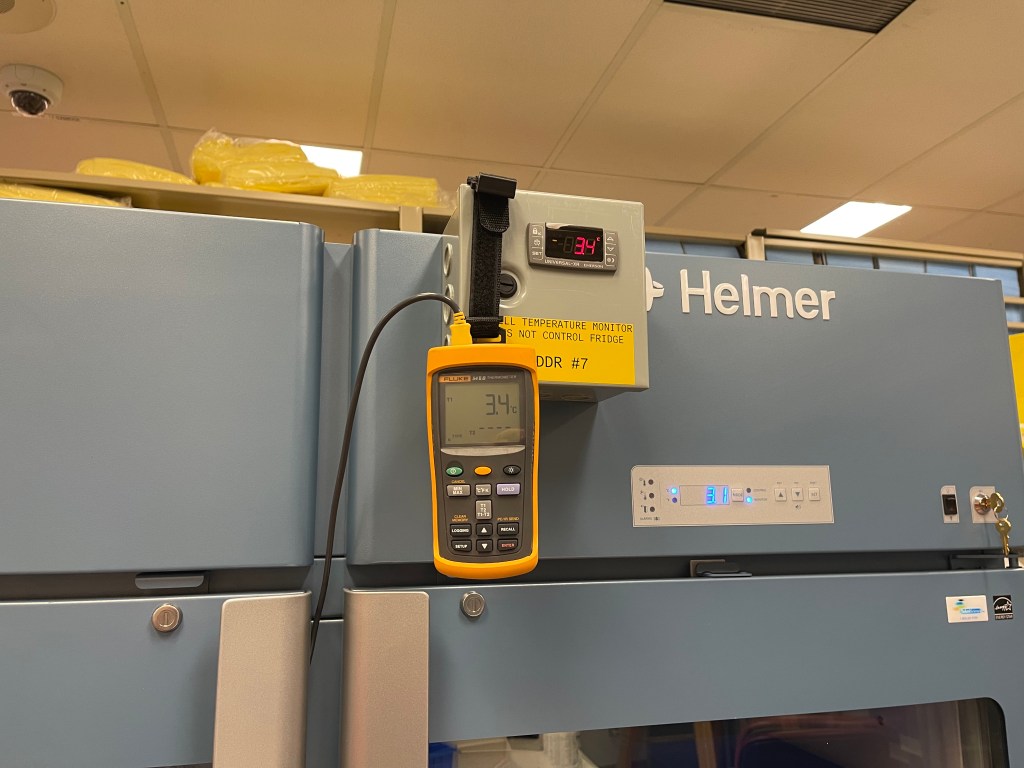
11 – Upgraded the refrigeration monitoring in the hospital.
12- Upgraded the steam control valves for the main heat exchangers to allow for proper tight shut-off when the heating hot water temperature set point was reached.

And on and on and on.

So no. I’m not a societal malcontent with an axe to grind against the Canadian Armed Forces, nor do I frequently jump from employer to employer.

I’ve had a very long and laborious climb up the corporate ladder all the while carrying a sack full of shit from my past that has been tied around my neck.

I’m not rich, nor am I poor. I didn’t really have much growing up, and I never really expected much either.

But Bobbie, what about your class action against the Canadian Armed Forces —- GOTCHA!!!!!! See, you are just in this for the money.

Actually, no.

First, the Canadian Armed Forces and the Department of National Defence did that to themselves.

Second, M.A.i.D. for psychological reasons becomes legal in March of 2023.

I may not in fact be around to collect on the compensation that a judge determines that all class members are entitled to.

So no. I’m not just looking to make a quick buck.

And even with the hell that the Canadian Armed Forces have dragged me through since 1980 I don’t have an axe to grind with the military. Even I can understand that it only takes a few bad apples to spoil the bunch and that you don’t throw the baby out with the bathwater.

Riding my bicycle

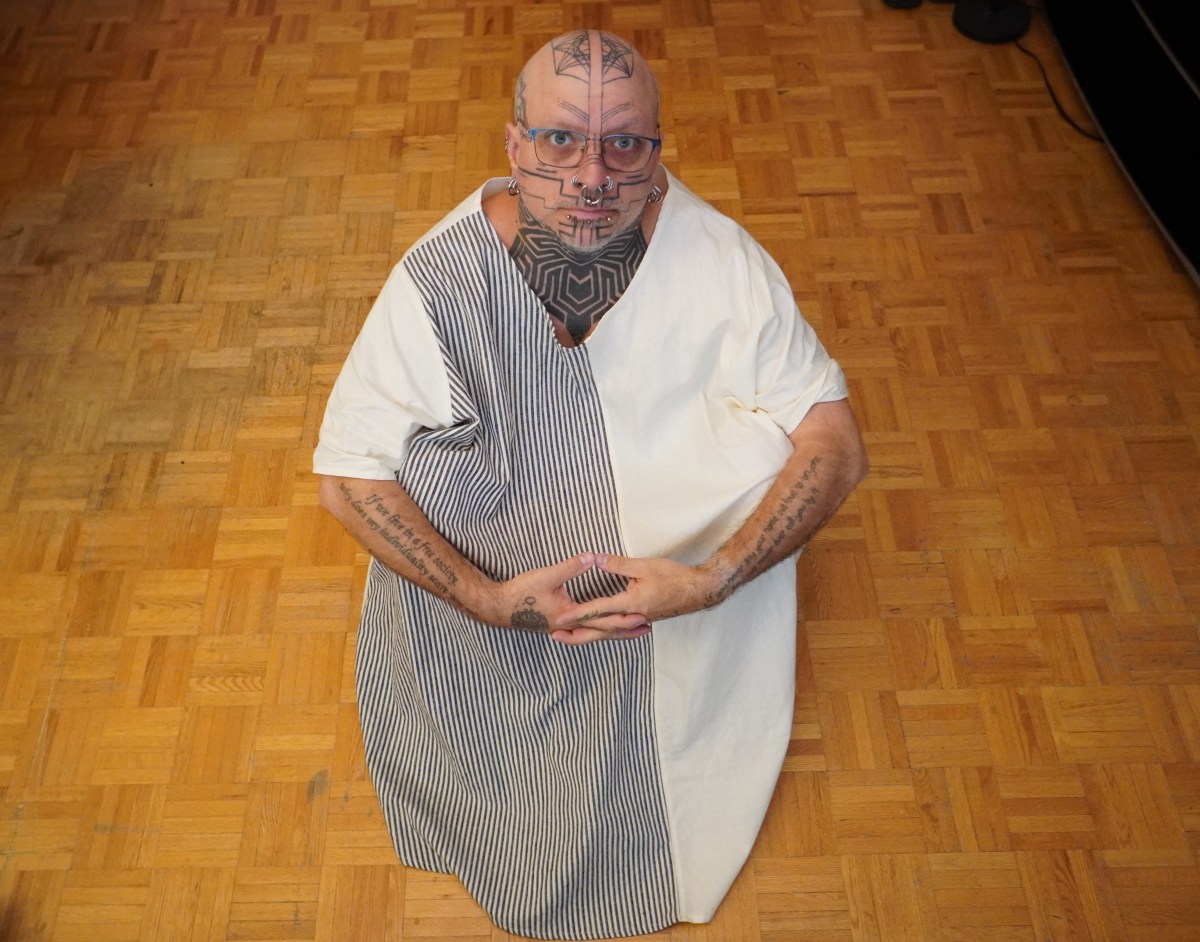
This is me riding my bicycle.

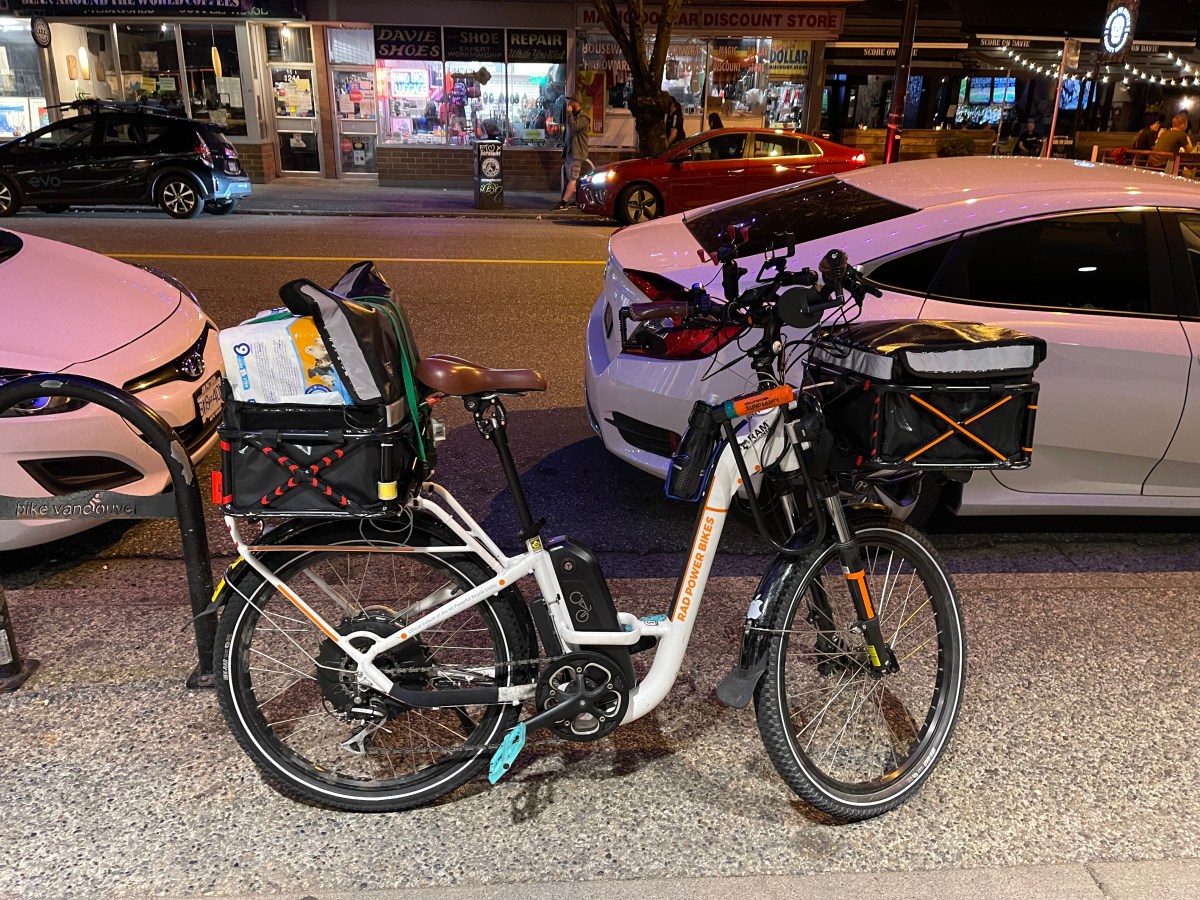
I finally tried mounting my RAM mounts and my GoPro on the front basket of the bike. This seems to give a decent angle of view.

I have a RAM X-Mount for my iPhone. It’s the same mount that I use on my motorcycle.

I use the iPhone for music, and for maps. I don’t text or take phone calls when I’m riding, but having an easy view of the phone makes it easy for me to pull over and answer the important calls and ignore the calls that I can ignore.

Lucky for me I live just off the new bicycle path on Beach Ave. This isn’t a half bad path, but it does get very congested in the summertime. And the nice thing about reducing car traffic to two lanes, one in each direction, is that the racers and speeders have had to find a different place to go.

Vancouver is the bicycle theft capital of Canada. And such my bicycle lives either in my apartment or in my office at work.

Yes, this is what I wear when I ride my bicycle. I don’t own a single piece of “lycra” or “spandex”. I ride to and from work. I ride to and from the supermarket of coffee shop. I go out for dinner on my bicycle. I don’t like the idea of having to change from my “riding clothes” to my “destination clothes”.

Dresses, skirts, and kilts are what I wear. I don’t think I’ve worn a pair of pants on a bicycle since the mid 2000’s.

I ride for comfort. I’m not setting any speed records, nor am I setting any endurance records.

My earphones block much less outside noise than you average car. Most cars these days are extremely soundproofed. With my earphones on, I can still hear cars coming up beside me, I can hear emergency vehicles blocks away. I can hear car horns and voices. These are all things that I wouldn’t be able to hear in the typical everyday Econo-box car.

I’ve done some minor upgrades on the bike, mainly being that I replaced the cable operated disc brakes with hydraulic brakes. I’ve replaced the stock seat post with a shock absorbing post. I have the front and rear baskets. The next upgrade I’ll probably do is upsizing the disc brake rotors from 180 mm to 206 mm.

I’ve always loved bicycling over cars and even motorcycles.

I think there are two reasons for this.

First, as a kid living on military bases, a bicycle was an easy way to escape and for me to get away from Richard or my grandmother.

Second, my father’s temper behind the wheel turned most car trips into anxiety inducing adventures in road rage.

When I had my bicycles I could go for rides and not worry about coming home or needing rides from Richard.

M.A.i.D. pt 2

Okay, so I’ll talk a little bit about the procedure itself.

If I am approved, I hope to undergo the injection method as opposed to the oral method. Yes, both methods are supposed to result in a painless death, but I favour the injection method due to the swiftness.

Which ever method I’m allowed to undertake, I have to initiate it. Whether it’s drinking the glass of barbiturates or pressing the trigger button for the dosing pumps, it’s the patient undergoing the procedure that has to initiate the procedure.

With the oral method you consume a large amount of barbiturates in liquid form. This is supposed to induce unconsciousness and eventually cardiac arrest. Time to death varies from person to person. This is not the way I want to go. I can’t even stand most over-the-counter or prescription pain killers. And the idea of dying from a drug overdose doesn’t appeal to me.

The injection method is almost clinical in its efficiency and swiftness. There are three or four drugs used depending on the drugs selected.

The first drug to be introduced would be Midazolam. Midazolam is a sedative. This is not used to render the person unconscious. This is really just to make the person feel comfortable. Face it, no matter how intense the desire to die, when you’re lying down on your literal death bed with the cannula in your vein, anxiety can become your enemy.

The next drug to be introduced would be Propofol. Propofol is typically used prior to the administration of anesthesia in surgical procedures. For surgical procedures Propofol is usually administered at a rate of 2 mg/kg. In my case, if I was going for surgery I would get a dosage of about 180 mg. However, in the case of M.A.i.D. I would be receiving a doseof 1,000 mg. At this dosing level I will be put into a very deep coma and would lose consciousness and all sensation.

The third drug to be introduced would be Rocuronium. Rocuronium is a neuromuscular blocking agent that targets striated muscles. The Rocuronium would act upon my diaphragm and cease my breathing.

The final drug to be introduced would be Bupivacaine. Bupivacaine would cause cardiac arrest and stop my heart.

So basically the Midazolam is to calm me down prior to the Propofol. The Propofol is to shut my brain down so that I am unaware of the resulting asphyxiation and subsequent cardiac arrest. With the advent of cardiac arrest, arterial blood pressure in my brain would drop to nothing which means that even if the Propofol were to somehow wear off, I would never regain consciousness.

I’m not exactly sure how long after my heart stops before I will be pronounced clinically dead, but it wouldn’t be too long.

The interesting thing is, it won’t just be me dying. It will be P.S., Captain McRae, the man in the sauna, Captain Totzke, my father. There will be no more depression. There will be no more anxiety. There will be no more night terrors. There will be no more grinding my teether. There will be nothing.

I am an atheist.

I don’t believe in magical special friends or an invisible father figure peering down on me from the clouds.

I may be an atheist, but I’ve never had issues with my morals unlike men of the cloth like Captain Father Angus McRae or Brigadier General Roger Bazin.

Being an atheist means that I don’t believe the the great beyond, or the magical city in the sky. Conversely I don’t believe in the fire and brimstone pits of hell.

When I die, I will simply cease to exist.

Will I miss anything after I am dead? No, I’ll be dead.

Will I be sad when I die and will I be full of regret? No, I’ll be dead.

Life is not a competition to see who can live the longest.

You live the life you have.

You do the best with it that you can.

Life is not a miracle. There are over 7 billion people on the planet.

Society is weird in the sense that if I’m out riding my bicycle and I get hit by a car, “oh well, life goes on”. If I go snowboarding down a mountain and crash into a tree “Oh well, he died doing what he liked to do”. If I had developed a drug habit and died of a heroin overdose, everyone would be talking about how rough of a life I had and how it wasn’t fair that I died. Yet if someone undergoes severe psychological trauma society gets all sanctimonious if the topic of suicide or M.A.i.D. comes up. I can go scuba diving with the sharks or skydiving out of a perfectly functional airplane and society is fine with that. Struggle with the fallout from being sexually abused as a child on a military base, gotta keep on struggling. Apparently it builds character.

If this had been 40 years ago, just after the abuse but prior to Captain Totzke getting his hooks into my brain, yeah, maybe counselling or drug therapy could have worked.

I’m fifty years old in a few short days. I’ve had the events from CFB Namao playing back in my head non-stop since 1980. And I think the effect was made even worse by the fact that Captain Totzke and my father both blamed me for what happened and they both blamed me for allowing the babysitter to go after my younger brother.

So it’s not just the untreated trauma from sexual abuse that I’m dealing with, I’m dealing with the fucked up counselling from the military social worker that I receive back then and the scapegoating. Yes, the release of records by DND did vindicate me. But that doesn’t undo the damage done. In fact in some ways knowing that DND and the Canadian Forces knew the truth all along makes the pain even worse.

So, when do I intend to go to sleep?

Well, March 2023 would be the soonest.

But realistically it will probably be closer to 2025 or 2026.

I don’t know what the criteria will be or how many tests I would have to undergo. I would imagine that there would be more than a two question multiple choice questionnaire .

I don’t know if my current physician would be willing to prescribe me the medications or even cannulate me and connect the IV lines and the pumps. Even though I would have to push the button to initiate the process, my doctor would be the one who would have to insert the cannulas and be ready to do manual injections if something went wrong with the pumps. This might cause some physicians to not be willing to participate.

I would like to stick around a while to see what happens with my class action lawsuit. But I do fear that DND and the Department of Justice will try to drag this matter out for as long as possible in the courts. I have no intention of waiting 10 years.

Place of death? More than likely at home in my own bed. Lay down for one final sleep and never wake up again.

What happens after?

Hopefully I get to go to medical school or a body farm.

If I seem cavalier about death, it’s probably just that I refuse to be afraid of death.

The fact is everyone dies. Death is a normal part of life. There is no escaping death no matter how much you want to wish it away.

I don’t want my body pumped full of chemicals and stuck in the ground.

Send me to medical school and let the students learn.

Cut my brain apart and try to figure out why I never ended up on the streets with addiction problems.

Put me on a body farm and let the forensics investigators learn their techniques.

M.A.i.D. pt 1

Okay, so I’m going to delve a little bit into the topic of M.A.i.D. and why I am hoping to be able to avail myself to this procedure.

Let’s face it. I’ve been through quite a lot in this life. And what I’ve been through has left me with some very significant long term psychological issues.

Major depression and severe anxiety would be the most significant issues that I struggle with. Yes, the medications that I am on now have calmed the storm, but the storm is still there. And the storm always will be.

Depression and anxiety have genetic roots. And if I had to say who I inherited what from I’d say that my depression came from my father’s genes and my anxiety came from my mother’s genes.

I went through 1-1/2 years of very depraved and graphic sexual abuse. I went through about 2-1/2 years of “counselling” with Canadian Armed Forces officer Captain Terry Totzke, who was anything but concerned with my mental well-being and was more concerned with keeping the secrets of CFB Namao under wraps, even it that meant depriving me of the psychiatric care that I needed at the time.

My childhood was spent living in the household of a rage fuelled alcoholic with his own inner demons that he could barely deal with.

Because of the meddling of Captain Totzke, I have issues with gender identity and sexual orientation.

I have a lot of people living in my head, and none of them are pleasant. They keep coming back in unwanted flashbacks. If somebody touches me unexpectedly I react. I don’t like being touched. Period. And it’s very hard to be intimate with someone when you don’t like touching.

P.S., Captain McRae, the man from the sauna, Captain Totzke, Earl Ray Stevens, they’re all up there. My father, Richard Gill is up there screaming and yelling about how I fucked with his military career.

I don’t like sex. I guess the lessons that I learnt from 9 to 11 was that sex was disgusting and wrong, just as I was disgusting and wrong for having done what I did on CFB Namao when I was 7 to 8.

Even though I now understand that the mess on CFB Namao was far larger than me apparently enjoying what the 15 year old babysitter was doing to me and in turn allowing the 15 year old babysitter to molest my younger brother, I can’t rewire my brain. Nobody can. There is no erasure procedure that will remove all of this crap.

I don’t want to learn how to deal with it or cope with it. I didn’t ask for it, I didn’t want it, and it’s not up to me to live with it.

Death isn’t something that I’ve just begun to long for recently. It’s been with me since the days of CFB Namao.

The problem though is that no matter how much I really wanted to die, working up the will to follow through is something else.

I have come close in the past. You can’t go through what I did and not want to die. I know of two men who took their own lives due to the events on CFB Namao. How many others took their own lives we’ll never know. There is no way on Earth that the Canadian Armed Forces will go overturning the stones of history.

The closest I came was back in 1994. What stopped me was the image of P.S. and my father holding hands and laughing their heads off like they were buddies.

In the days and years after CFB Namao I must would frequently fantasize my own death and that after my death the police would investigate my father and off to jail he would go.

The more I learnt about suicide over the years, the less inclined I became to commit it. Most suicides are not successful, and if you think you’ve got problems prior to suicide, depending an how bad you botch things up, you’re going to have significantly more problems after.

Suicide is messy. And it’s often not quick. And it’s really not fair to those who discover you and who have to clean up the mess. And it often leaves those who knew you with all sorts of unanswered questions.

In the early aughts I started hearing of medically assisted suicide in places like Scandinavia and I was fascinated. Most if not all of the countries that offered medically assisted suicide didn’t often include depression. It wasn’t until the late aughts early ’10s that I started hearing about medically assisted suicide for depression.

But the reality always was that even if European and Scandinavian countries were allowing people to die who only had mental issues such as depression, there was no way I was going to be able to afford a flight over there.

So my hopes and desires kinda took a back seat.

And besides, I was just about to start discovering the whole rancid truth about CFB Namao and about who knew what back then. The more I learnt about CFB Namao, the more I decided that I needed to stay alive to at least clear my name and see this mess through to a conclusion.

In 2019, something in the Canadian media caught my eye. Due to a court decision in Quebec, the Government of Canada was expected to amend the Criminal Code of Canada to allow medical assistance in dying (M.A.i.D.) in circumstances in which the person requesting M.A.i.D. was experiencing pain, but was not near the expected terminal end of their life. Prior to this, M.A.i.D. could only be given if a person requested it and that person was expected to die naturally in the imminent future.

Parliament passed the amendments to the Criminal Code of Canada in March of 2021 to allow M.A.i.D. in cases where death was not imminent. However, what caught my attention was that the Senate, in reviewing the bill, had determined that to not allow a person suffering solely from psychiatric issues to request M.A.i.D. could be seen as a Charter issue.

Parliament has until March 17th, 2023 to pass the required legislation to allow M.A.i.D. for psychiatric issues such as depression.

Well, it’s now 2021. I’ve somewhat cleared my name. I know that the Canadian Forces knew full well what happened back in 1979 to 1980. I also know why it was buried.

I have a class action lawsuit that is heading before a justice in the spring of 2022. The class action came about due to the release of Captain McRae’s court martial transcripts and the Canadian Forces Special Investigations Unit investigation, both of with indicted that the military police in 1980 were full well aware of what P.S. was doing with younger children on the base and that it was Captain McRae that had taught P.S. and encouraged P.S. to behave in the manner that he did.

I don’t know what the rules will be in March of 2023. I can’t imagine it being something as simple as just walking into your doctor’s office and saying “Doc, I’m depressed, I want to die”. There will more than likely be a barrage of psychiatric tests and evaluations. I will probably have to convince the majority of a panel of at least 3 medical professionals that I am sane, competent, and that I am suffering.

If I succeed, then there will be all of the arrangements. I still don’t know what all of the details will be.

The next post will be M.A.i.D. pt 2

15 mg

Well, I’m up to 15 mg of Escitalopram now.

After returning back to work I found that the benefits of 10 mg were wearing off around noon. Yes, work is stressful and demanding, so that was probably what started to nullify the effect of the 10 mg.

Being on Escitalopram is different. I’ve honestly never felt like this before in my life.

Don’t get me wrong. It’s not like I’ve been given a 2nd chance at life, or have been allowed to start my life over from some arbitrary starting line.

The Escitalopram hasn’t fixed anything. It hasn’t made me “happy”. What it has done is raised the floor to which my depression would drag me down to. I do get somewhat depressed still, but it’s nowhere near as deep as my depressions used to go. I’ve had this untreated depression for far too long. There are also far too many factors that contributed to this depression. I now believe that I was predisposed to depression from my father’s side of the family. Depression can run in families.

The anxiety, which has been a constant companion of mine since the late ’70s had been toned down substantially. I haven’t woken up grinding my teeth once in the last couple of months.

I find that I can concentrate better now and when something disturbs me while I’m in the middle of a thought, it doesn’t completely derail my train of thought.

The dark thoughts are still there, and they always will be. You can’t go through what I’ve gone through and not carry those demons around.

Captain McRae, Captain Totzke, Mcpl Gill, P.S., Earl Ray Stevens. They’re all still up there too. But at least now I can more or less ignore them for the time being.

Even though the Escitalopram has calmed the waves of my emotions the war still rages on behind my eyes. The time for fixing these issues was back in the early ’80s. Not 40+ years later.

But, we’ll have to see how things work out. I’m 50 now. The average life expectancy for a male in Canada now sits at 80 years, so that’s about 30. Most of the men in my family have dropped dead early though, so I’d say that I might have a life expectancy of 70 years. But there are still other factors at play. So let’s just agree that I’m not getting a second chance. I’m just getting a bit of a respite in the final 1/4 of my life.

Riding Bicycles

I’ve ridden bicycles since I was young. I can’t remember exactly when I learnt to ride, but it was on Canadian Forces Base Shearwater.

The nice thing about growing up as a child on military bases is that the living quarters were governed by the Government Property Traffic Regulations. These regulations capped the speed limit in the living quarters to 20km/h. Automobiles also had to yield the right of way to any pedestrian on the streets. So riding bicycles on base was a very safe thing to do.

We also had yearly bicycle rodeos put on by the military police. Every kid that rode a bicycle on base was expected to take part.

And almost every kid on base rode their bicycles to school. Hampton Grey on Shearwater had a large rack. Guthrie School on CFB Namao had a large rack. And Major General Griesbach School had a large rack. CFB Downsview was the only base that I lived on that didn’t have schools on the base for the military children. We had to go to school in the local public schools. This meant crossing some very major streets like Keele St., Sheppard Ave., Wilson Ave.. No parent and no school board in their right mind would allow a child to ride to school in those conditions.

The first time I ever rode a bicycle in the civilian world was when my father was stationed at Canadian Forces Base Summerside in PEI. We didn’t live on the base, we lived in the city in housing that was on long term lease to the Department of National Defence. Military rules applied to the housing, but not to the streets. So things were a lot more dangerous but the City of Summerside was very small. There were still a lot of quiet streets and farm roads to ride on. There was also the cemetery that I could ride around in.

I was hospitalized in my first ever bicycle accident. But that wasn’t due to cars. Someone stuck a stick in my front wheel as I rode by.

When we moved to Canadian Forces Base Namao, it was safe to ride on the streets again as we lived on the base. Even when we moved to Canadian Forces Base Griesbach, we lived on base so it was safe to ride around on base. CFB Griesbach was located within the city of Edmonton, and Edmonton is very much a city in love with the automobile. Being a pedestrian or a bicycle rider in that city is very much having a death wish. It was very seldom that I rode a bicycle in the city of Edmonton.

When we moved to CFB Downsview in Metro Toronto, bicycles were my freedom. I could bicycle downtown whenever I wanted. Yes, Toronto had a good bus service, but bugging Richard for bus fare to go anywhere was like trying to wring blood from a stone. In all of the years that I was eligible for a student bus pass, Richard never got me one. And it was just better not to ask for money as you’d get a lecture of oh just how much money you were costing him and why didn’t I call my mother for money.

I would say that most of my bicycles came from scrap. Posting season on base, which typically lasted from late June to early September meant that old bicycles were often left curb side for trash, or were dumped at the large dumpster usually by the arena or the Canex. On Downsview the dumpster was over by the base auto club. Most of the bikes were in decent condition and required very little in the way of parts or repairs to fix.

I can’t really offer any explanation as to why bicycles were thrown away so frequently on military bases other than parents would promise to buy a new bicycle for their children at the new base as a means of getting the children to be more tolerant of the posting. A bribe if you will.

And no, none of these bicycles were really of any valve. Mainly Supercycle 10 speeds or Sears brand name bikes with only a coaster brake on the rear.

Riding in Toronto traffic really wasn’t bad back in the ’80s. Either that, or I was just plain lucky. There was no such thing as putting you bicycle on the bus, or even taking your bicycle on the subway. Riding to downtown from the living quarters on base which were close to Keele St. and Wilson Ave was about a one hour ride each way.

Every now and again when I had cash, it was a treat to go to Centre Island and ride around from one end of the island to the other.

One of the first lessons that I had to learn when riding downtown was how to cross over the street car tracks. Whatever you do, you don’t want to try to cross the tracks going parallel with them. You need to cross the tracks at a slight angle so that your wheels don’t get sucked into the groove on the rail. Pissed off a couple of street car drivers before I learnt my lesson.

Also, riding a bicycle on a skating rink is doable. I rode my various bikes on the ice at Nathan Philips Square a few times.

After CFB Namao, I was a very lonely child. I didn’t have any friends to speak of. But I had bicycles. And a bicycle could take me away from home and away from Richard and his dysfunctional household.

I briefly stopped riding when I was 16. That’s the year I moved out of the house and on my own. Working full time to pay rent and buy groceries left little time to ride. Bruce and Ed both helped me get my driver’s licence. Ed took me to a notary public so that I could swear that I was living on my own and thus get my learner’s permit without needing Richard’s permission. Bruce and Ed both took turns at teaching me how to drive.

I never liked driving. I never really liked cars. Cars to me always equated with anger and drunk driving. Richard was a menace behind the wheel. Angry. Pissed off. Short temper. Would dump the clutch just to own the slow poke blocking his lane. Brake checking was a hobby of his. And this was when he wasn’t drunk. There was one immature thing that he’d always do if a slow driver “blocked” him. He’d pull around in front of the driver, slow down slightly, and drive slowly to the next intersection with the intention of making the driver behind him get a red light. As soon as the light would turn amber, Richard would then gun it through the intersection.

All told Richard totalled one car in a DUI collision, caused significant damage to another one of his cars in another DUI collision, and drove yet another car into a ditch when he was drunk. The first collision sent me to the base infirmary for stitches. The second collision caused me to get a fat lip the I told the other driver that Richard had just come from the base mess. I was in the car once in Toronto when he rear ended a Jaguar luxury car at a red light. He blamed the collision on me as I had asked him for a ride to work and he was missing an episode of Dr. Who and was in a hurry to drop me off and get back home. In June of 1990, when he took Bill Parker and I to the bar at the Sheraton Inn, he rear ended a civilian police car on Keele street as we were driving towards home on the base.

All told, I’ve only owned cars for 6 years of my 33 year driving life. I had a Plymouth Horizon from the summer of 1990 until the fall of 1992. I had one Volkswagen Rabbit for a few months in 1995. I then bought a better condition Rabbit in late 1995 and owned this until I moved back downtown Vancouver in the summer of 1999.

I’ve owned motorcycles for more years of my life than I’ve owned cars, but not by much, maybe 8 years total.

And all through the years starting when I first moved to Vancouver in February of 1992, I’ve owned bicycles. There’s just something about a bicycle that makes me feel safe. And happy. And content. Maybe because it’s the only vehicle that I don’t associate with Richard.

I can go where I want, when I want. Bicycles are very simple to repair and maintain. They need no gasoline, no oil, no expensive spare parts. It’s not that I’m poor. It’s just that I’d rather eat and travel than blow my money on keeping the oil barons and auto barons swimming in pools of money.

Bicycles don’t get stuck in traffic.

I’m a bicycle rider. I’m not a cyclist. I don’t partake in vehicular cycling.

I try very hard to stay away from the word “cyclist”. The corporate media and the automobile industry have used the word “cyclist” in a very negative sense to portray all bicycle riders of every gender, age, and ability as being “cycling elites” racing around on $10k carbon fibre bicycles. The corporate media and the automobile industry love to rile up car drivers in order to thwart bicycle lanes and bicycle infrastructure in general that would benefit bicycle riders of every age, gender, and ability as there is no way for the corporate media and the automobile industry to profit from something that doesn’t benefit them.

Vehicular cycling is a phrase that I detest with all my being. Vehicular cycling calls for a bicycle rider to pretend that they’re a car and to drive like a car would. Absolute rubbish. In many states in America they have different rules of the road for bicycles. Some states allow bicycles to treat red lights as stop signs if there is no cross traffic. Other states allow bicycles to treat stop signs as yield signs. Some states even have very strict passing laws for bicycles requiring car drivers to either cross the dotted line to pass or at the least pass with 2 to 3 metres of clearance. It’s going to take a lot of effort to change provincial laws here in Canada, but they need to be changed if there’s any hope of increasing the number of bicycle riders in our heavily populated urban centres.

My ride at the moment is an electric upright step through bicycle.

Electric because at my age my knees and hips are starting to show their age. And with electric I can go for longer distances. I can also dress up nicely for special occasions and show up not drenched in sweat.

Upright because much like my knees and hips, my neck is shot. C4-C5-C6 have advanced osteoarthritis, so no more road bikes with drop handlebars for me.

Step through because this works best with my dresses. Riding a standard “Men’s bike” while wearing a dress is awkward. Riding a “woman’s bike” wearing a dress is not much better. A step through allows my dresses or skirts to hang properly.

Shopping isn’t a problem on the bike. It has both front and rear baskets. And with what I don’t pay on insurance, gas, parking, etc. I can pay to have “heavy things” delivered.

And even though it’s electric, I do most of the pedalling. I usually tootle around in power assist 2 or 3. Power assist 5 is something I usually on use on the steep hills. The more you use the power assist, the quicker you kill the battery.

I do have a motorcycle at the moment. It’s a 650cc Suzuki Burgman. It’s a step through motorcycle. Yes, it looks like a scooter, however the engine displacement and the weight of the motorcycle means that ICBC classifies it as a motorcycle. And let’s be honest, scooters don’t do zero to sixty kilometres per hour in under 5 seconds. This motorcycle has no problem keeping up with traffic on the BC highways with the 120 km/h posted speed limits.

As much fun as it is, I still only ride it on occasion. Parking is a hassle. Motorcycles are an easy target for theft. Car drivers just keep getting worse and worse as the years go by. Collisions keep increasing each and every year. It’s just not safe being on a motorcycle on the public street. All it takes is for someone to pull a left hand turn, or a right hand turn into your path and it’s game over. Or some very serious life altering injuries to say the least. Because at 50 to 60 km/h, you might not be at fault, and you might be 100% in the right, but physics and Newton’s laws don’t give a rats ass.

On a bicycle, everything takes time. You can’t race around agitated on a bicycle like a car encourages you to do.

Everything is far more peaceful and serene on a bicycle.

You can smell everything.

You can easily observe everything.

If you see something of interest, you can just pull right on over and check it out.

Cars don’t encourage that, and neither do motorcycles.

So, I’ll more than likely be riding bicycles until the day I die.

Mentally Ill

Yep, I said it.

I’m mentally ill.

Have been for a long time apparently.

The sad thing about my mental illness is that people like my father and Captain Terry Totzke were well aware of the struggles I was having, however it appears that it was more politically expedient to deny me of the treatments and medications that I rightfully deserved in the name of keeping secrets.

How bad were things back then in the early ’80s in Edmonton?

Well, I was supposed to have been placed in a psychiatric facility for children.

I was found to be extremely anxious.

I was found to be well beyond despair.

I was terrified of men, including my own father whom I thought was going to kill me.

I did not like being touched at all by anyone.

I was afraid of my grandmother who had been living with us and raising my brother and I during my father’s absences with the Canadian Forces.

My teacher noted that I did not fit in with the other kids at all. I preferred to be left alone to read books. My teacher did remark that the other kids would often use me as a scape goat.

I remember not having a lot of friends. The kids I hung out with were usually kids from other dysfunctional families living on base.

Alone.

And isolated.

Flailing around in the depths of my despair, my depression, my anxiety.

By myself.

Issues caused by my depression or anxiety would often be straightened out with a backhand or the belt.

I remember as a kid in the aftermath of CFB Namao and up until I was around 15 or 16 I always felt like I wasn’t inside of my brain. I always felt like I was behind myself, watching myself do things, and that I was powerless to do anything. Almost like I was watching a TV show.

Nothing felt real.

I frequently wet the bed right up until I moved out of the house when I was 16. It was only after moving out of the house that I never wet the bed again.

I had no hobbies as a kid, I had no interests.

For 42 years I suffered through severe depression and extreme anxiety.

I knew I was having problems and I knew I was floundering all these years. But you have to work hard and hide it, and pretend it doesn’t exist.

But the depression and anxiety are always there. Ready to flare up when you least expect it. Always trying to sabotage your life because deep down inside you know that your life is worthless and meaningless.

I’ve kinda skimmed along the surface of normalcy from the spring of 1980 until April of 2021.

It took the extreme stress of dealing with the COVID-19 outbreak at my work place to push me over the edge.

I’ve managed to keep employment due to my technical abilities.

Did my depression and anxiety come from the events of CFB Namao?

Not entirely. But I do think genetics played a major part. It would be a very safe bet to say that the paternal side of my family has depression encoded into its genes.

My anxiety is so bad that most of my teeth have been destroyed by grinding. I’ve already had one tooth extracted because I cracked it from grinding and I have a feeling that a few more teeth will need extraction in the short while.

Grinding my teeth was nothing new, I remember my father waking me up when we lived on CFB Downsview due to my grinding.

When COVID struck, the facility that I work at became a hotbed of activity. At first it was easy keeping up with the demands, but as weeks turned into months, the overtime went from being a treat to being a major cause of stress. The facility was designed in the late ’60s / early ’70s and construction was started in the late ’70s. The building HVAC systems meet the ’70s CSA standards. It does not meet 2021 standards. Being caught between parties that wanted todays standards flogged from 1960s technology was also very stress inducing.

So yeah, this was not fun.

Not fun at all.

But it did push me hard enough that I started to suffer constant panic attacks and anxiety attacks. My depression was hitting so hard that I was feeling physically ill and nauseated most of the time. I’d go to work and I couldn’t concentrate and I couldn’t think. My brain felt like it was on fire.

I ended up having to go on sick leave.

And this is how I ended up on Escitalopram.

Escitalopram is a SSRI. Selective Serotonin Reuptake Inhibitor.

Let’s be very clear, Escitalopram is not going to cure my depression, nor is it going to cure my anxiety. Those two issues have been with me for so long that they’ve more than likely fucked with my brain’s wiring.

The Escitalopram will not stop the war that goes on inside my head.

The Escitalopram will not evict Captain Terry Totzke, Captain Father Angus McRae, P.S., Richard Gill, Earl Stevens, or the many others who reside inside my skull.

The Escitalopram had a very noticeable effect on my depression and my anxiety. It has really turned down my anxiety. The depression is still there. However the Escitalopram has numbed my emotions. I find that for the first time in my life I can actually concentrate on matters and I can hold two thought simultaneously.

The thing about Escitalopram is the more severe the depression and anxiety, the more noticeable the effect it has on the person taking the medication.

And the fact that Escitalopram had such a drastic effect on me shows just how bad the depression and anxiety were.

I’m at 10mg right now. That might have to go up to 20mg due to the stresses of work.

Negative side effects?

Only two that I’ve noticed.

Getting to sleep takes a bit of work.

And I know, TMI, but I can’t orgasm at the time being.

Both of these are well known side effects of SSRIs

Sleep is becoming easier.

Couple of interesting things that I’ve noticed about being on SSRIs.

My dreams are fucking vivid and wild in a good way. My dreams before SSRIs were sporadic and were often nightmares. Now my dreams are different. More colourful. Playful you could say.

And waking up in the morning is far easier now. I’m often up before the alarms go off.

I don’t need naps during the day.

I’ll probably be on these medications for the rest of my life.

As I said, these drugs will not fix my brain. The damage has been done, and the damage is very extensive. I hope that my body doesn’t build up a tolerance to these SSRIs. Apparently the crash back into depression and anxiety can be pretty horrific.

And even though I am emotionally numbed at the moment, I can tolerate this better than drowning in the pits of despair.

But I also don’t want to spend the next 20 to 30 years of my live living with muted emotions while the war rages on in my head.

There is possibility of a solution, but I won’t find out what the rules are until March 2023.

That’s probably enough for now.

It’s time for bed.