The Canadian Forces Provost Marshal and the fine art of Bending the Truth.

Unless you’ve had first hand experience with the Canadian Forces Provost Marshal, or even the Canadian Armed Forces Military Police Group for that matter, you will never truly understand the ability of agencies such as the Canadian Armed Forces to define what the truth actually is.

Under the rules governing complaints about the Canadian Forces National Investigation Service a person wishing to make a complaint against the CFNIS must first submit the complaint to the provost marshal.

This would be the same provost marshal that oversaw the CFNIS investigation in the first place. Remember, no matter how the Canadian Forces, the provost marshal, or the CFNIS like to spin things, everyone within the Canadian Forces Military Police Group are subject to the Code of Service Discipline. Each and every member of the Canadian Forces Military Police Group must obey the “lawful” command of their superiors.

As a retired JAG practicing in Victoria BC told me to remember, members of the CFNIS are Soldiers First and police officers second.

So far as the provost marshal goes, the provost marshal has the sole discretion to control which documents the Military Police Complaints Commission receives and which documents are withheld from the Military Police Complaints Commission.

And during a review the MPCC cannot subpoena documents from the CFPM, the CFMPG, or the CFNIS. The MPCC literally has to reach their conclusions based upon the documents that were skillfully selected and submitted to the MPCC.

As there are absolutely no oaths administered during an MPCC review, the provost marshal has absolute free reign to lie to and feed bullshit to the MPCC and there are no penalties or sanctions that can be applied for this deceptive behaviour.

What information did the provost marshal intentionally withhold from the MPCC?

  • Canadian Forces Special Investigations Unit investigation investigation paperwork DS 120-10-80 which indicated that it was the babysitter’s sexual abuse of children on the base that initiated the investigation of captain McRae
  • The court martial transcripts from McRae’s court martial that described in detail one the penetrative assaults the babysitter committed on a trio of ten-year-old boys behind the rec centre.
  • I’d also bet the the CFPM also wouldn’t explain to the MPCC that their investigation was stymied by the fact that while they could lay charges against the babysitter, they wouldn’t be able to lay charges against Angus McRae due to the summary-investigation-flaw and the three-year-time-bar flaw.
  • The existence of the out-of-court settlement reached between the babysitter, the DOJ, the CAF, and the DND in November of 2008 which appears to have implications for any subsequent investigation of the babysitter.
  • The fact that a senior officer within the CFNIS Western Region told a member of the Royal Canadian Mounted Police that the investigation of my complaint “was likely to go nowhere due to a complete lack of evidence”. This was weeks before the CFNIS contacted my father, my brother, the babysitter, and the babysitter’s family. One of the babysitter’s replies to the CFNIS in 2011 was that “anything he had been involved in as a youth has already been handled by the military” and that if charges were brought against him “a lawyer would handle that”.
  • My social service records that indicated that I started having problems in school on CFB Namao. Behavioural problems are nothing unheard of with sexually abused children and dysfunctional households.
  • My social service records which also indicated that my grandmother was living with us on base and raising my brother and I. This was important as my father’s statement to the CFNIS in 2011 made it sound as if grandma popped in for a visit one weekend.
  • My social service records also indicated that my father was having anger issues and often had anger outbursts. My social service records also indicated that my father blamed my issues on my grandmother whom he viewed as “being cruel to his children, especially when she was intoxicated, which was quite frequently”, he would also tell social services that “his mother refused to seek treatment for her alcoholism”

And it wasn’t just the MPCC that the CFPM and the CFNIS lied to. The CFPM and the CFNIS had also lied to the Alberta Attorney General and the Alberta Crown Prosecutor. When the CFNIS submitted their summary to the Crown, they left out all of the above bullet points. However, in their summary to the Crown the CFNIS also “forgot” to mention to the Crown that I had tried twice before to report the sexual abuse to the military police.

All of this resulted in Mr. Weribiki observing that it was very significant that I had never told anyone about the abuse and that I had never tried to report the abuse in the previous 30 years. Who was I going to tell? My father who was frequently absent either on training exercises or living off base with his girlfriends? My “frequently cruel and intoxicated” grandmother who had an insane attachment to the catholic church? And I did try to report the abuse in 1984 and 1991.

My father’s statement was so detached from reality that when the CFNIS received a copy of my social service paperwork you would think that they would have gone back to my father and asked him to explain the horrific and glaring differences between his statement and the contents of my paperwork.

Nope, the CFNIS never approached him to explain the differences. Which leads me to believe that my father had been told what to say. Why would my father go along with what the CFNIS wanted? More than likely he had received some favour back in 1980 for agreeing to not make a fuss about his two sons being sexually abused. After all, if Mr. Gill had been at home on base with his kids instead of bringing his alcoholic mother on base to raise his kids in his absence, then his sons never would have been abused. So, I can see my father parroting whatever the CFNIS wanted him to say. Just like colonel Munro, captain McRae, and the various other men of ill intent, I don’t see why my father wouldn’t be willing to lie to save his own ass.

I know that at least one investigator with the CFNIS lied through his teeth when interviewed by the MPCC in 2012. This one investigator claimed that he had flown out to Victoria, BC to meet with me in person. The MPCC cited this as showing how the MPCC went above and beyond standard practice. The only problem is that I never net this investigator, nor have I ever met anyone from the CFNIS in person other than when I was interviewed in late March of 2011 by two investigators who had come to see me at the Vancouver Police Department Headquarters.

The sad thing is the members of the Canadian Forces Military Police group couldn’t tell the truth if they wanted to. They can only tell what the chain of command allows them to say. And the chain of command is full of sad sacks who believe that their primary function is to protect and shield the Canadian Armed Forces from outside scrutiny and criticism.

In 2006 the Canadian Forces Chaplaincy Branch issued a directive related to the release of baptismal records for military dependents that had been baptized by Canadian Forces chaplains on defence establishments. This memo indicated that the reason the rules for access to the baptism records was being restricted was due to the increasing number of child sexual abuse cases being brought against chaplains of the catholic church.

Worth less than a donkey.

And an imaginary one at that.

It’s a very good day in Canada if you’re a donkey.

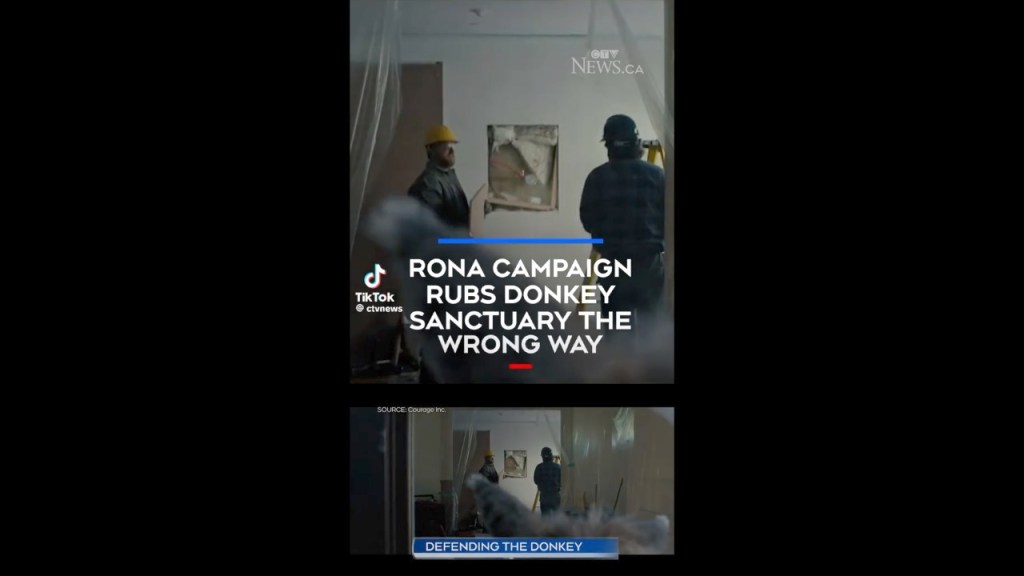
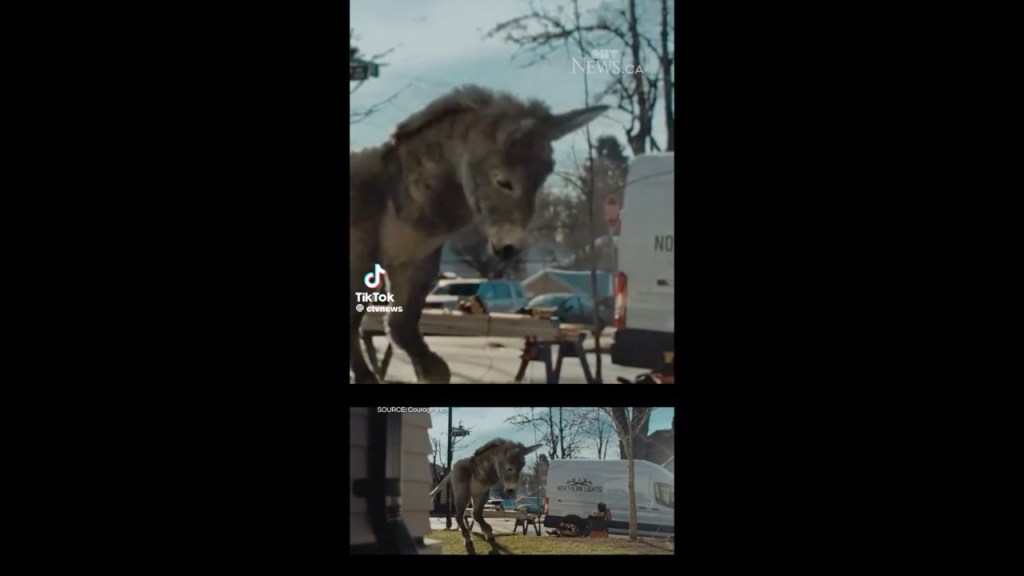
Rona, a Canadian hardware and home improvement chain, ran a commercial based upon the English language slang term “half-assed” which generally means to do something poorly or ineptly.

The commercial is cute in the sense that it shows the front half of a donkey, other wise known as an ass, wandering around as people disparage jobs that are done “half-assed”.

Well, someone at a donkey sanctuary got their nose out-of-joint and had to let the public know that the term “half-ass” and “half-assed” are offensive to donkeys.

Canada’s top notch media sprang into action!

CTV actually ran a fucking news story on this.

And no, this wasn’t an April fool’s day prank, or an Onion Article.

Workers complaining about “half-assed” work.
Half-ass leaving the job site.
Half-ass wandering from job site to job site.
Half-ass pulling an Iron Eyes Cody tear……

It’s shit like this that makes me realize just how completely fucked the media is in this country.

I’ve tried to get CTV NEWS and CTV’s W5 interested in the issue of how the Canadian Armed Forces handled child sexual abuse on the bases pre-1998, not the slightest bit of interest.

I’ve been trying to get the media to pay attention to the fact that the modern day Canadian Armed Forces and Department of National Defence hide behind flaws in the pre-1998 National Defence Act that make sure that crimes of a criminal code in nature stay buried in the past.

Both the DND and the CAF could ask parliament to pass legislation that would subject persons who were subjected to the code of service discipline prior to 1998 to prosecution in the modern justice system, but both the DND and the CAF just don’t seem to want to risk this.

LS-311E(1998) was authored by Government of Canada lawyer David Goetz in 1998 to explain in plain English that certain flaws in the National Defence Act had to be removed in order to prevent fiascos in the military justice system from ever occurring again like which had occurred in Bosnia and Somalia.

Two of the most grievous flaws were the 3-year-time-bar flaw, and the summary investigation flaw.

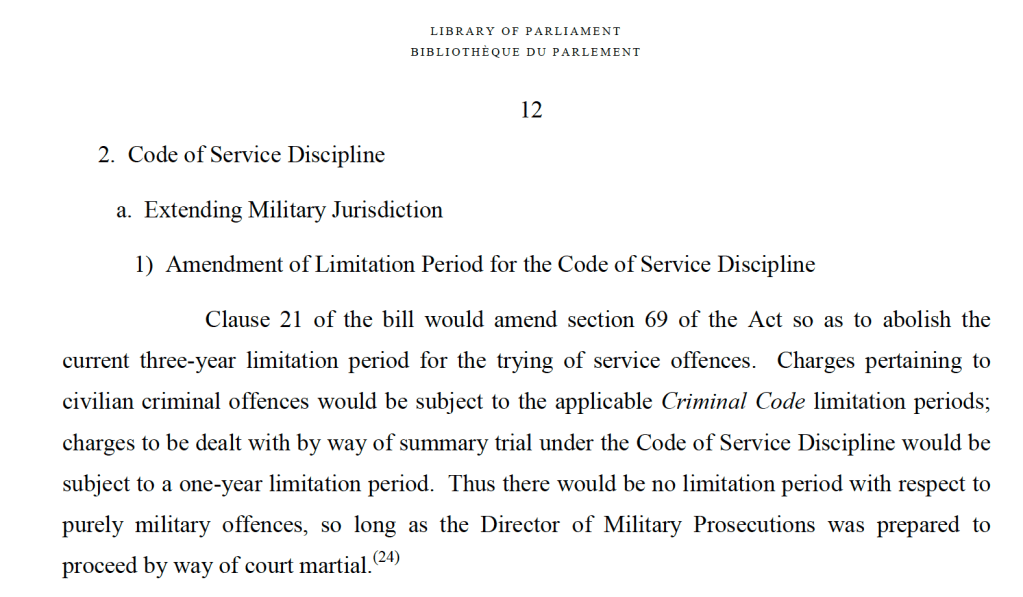
The 3-year-time-bar flaw meant that service offences could only be investigated if the investigation would lead to a summary trial, a courts martial, or a civilian trial within 3-years of the date of the alleged offence.

One thing that people completely misunderstand, and believe me there are lawyers that misunderstand this, but service offences include not only all offences of a military nature, but all criminal code offences as well.

What criminal code offences would be affected by this 3-year-time-bar?

Don’t believe me that the Canadian Armed Forces had the ability to try these crimes?

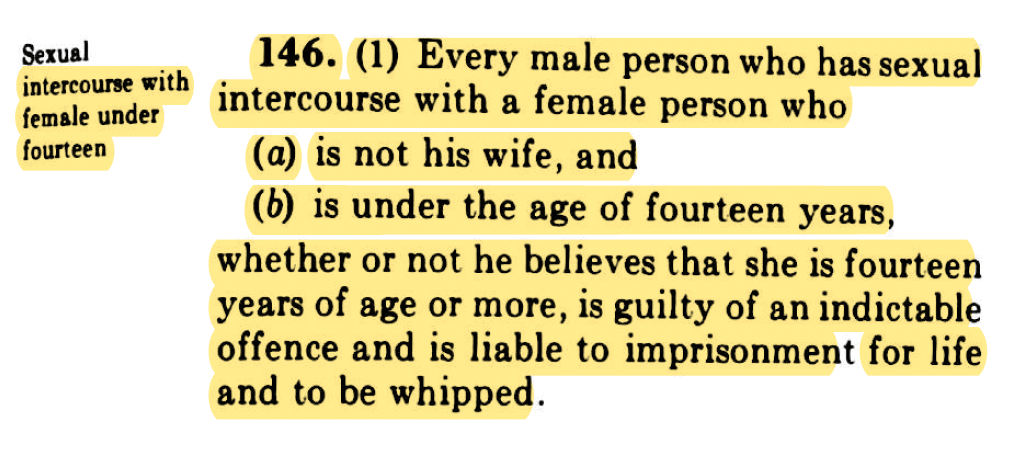
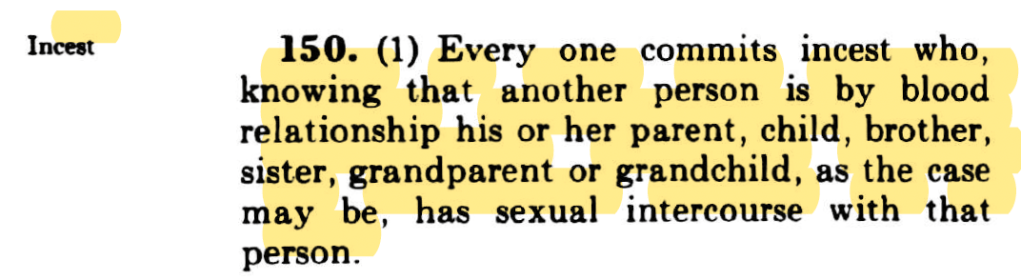
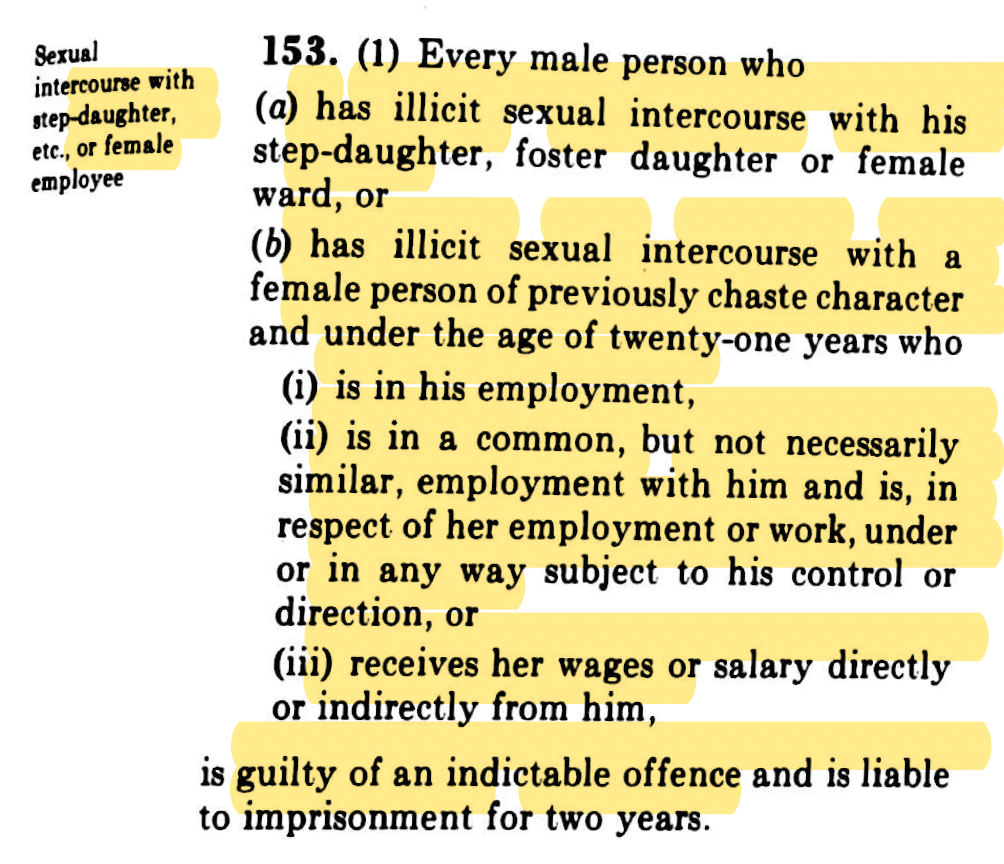
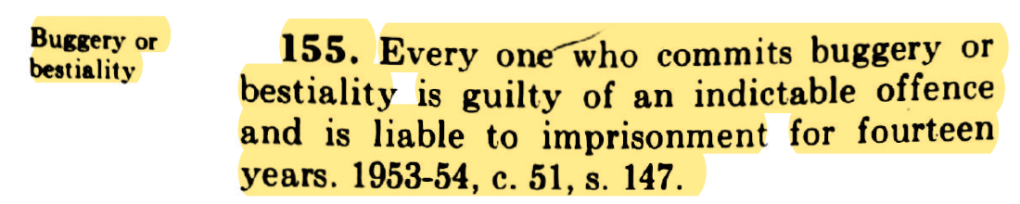
Here are the Criminal Code of Canada offences that Captain McRae was subjected to a Courts Martial in a military tribunal for.

These are all criminal code offence that are being handled as service offences.

In the civilian world there is no statute of limitations on these criminal code offences. In the military world, any child who was sexually abused on a defence establishment by a person subject to the code of service discipline only had three years from the date of the offence to bring charges.

And no, these charges can’t simply be moved into the civilian justice system. If they were committed by a person subject to the code of service discipline while that person was on a defence establishment, the Canadian Forces retained the jurisdiction for the investigation and prosecution.

The even more insidious flaw was the summary investigation flaw.

Prior to 1998 the charges involving the sexual assault of children was not handed to the provincial crown prosecutors for review. Prior to 1998, it was the commanding officer of the accused that would be required to determine the fate of their subordinate.

The disturbing aspect of this is that these commanding officers had no legal training and no legal or law enforcement background. And they were found by the Somalia inquiry to often taken improper matters into consideration when reviewing the charges that had been brought against their subordinates.

It’s right there in plain English. The commanding officer could simply dismiss any charge that had been brought against their subordinate.

When I grew up on the bases, for the most part it was the Revised Statutes of Canada, chapter C-34 Criminal Code of Canada, that was in effect.

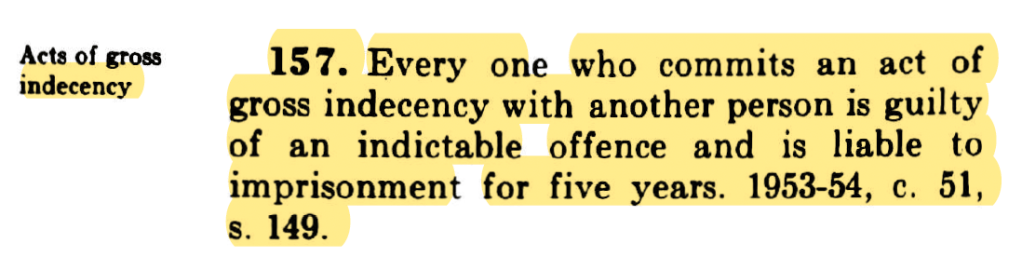
This meant that commanding officers had the full authority to dismiss criminal code offences such as Sections 146, 148, 149, 150, 153, 155, 156, and 157. These are all sections that applied to children under the age of 16.

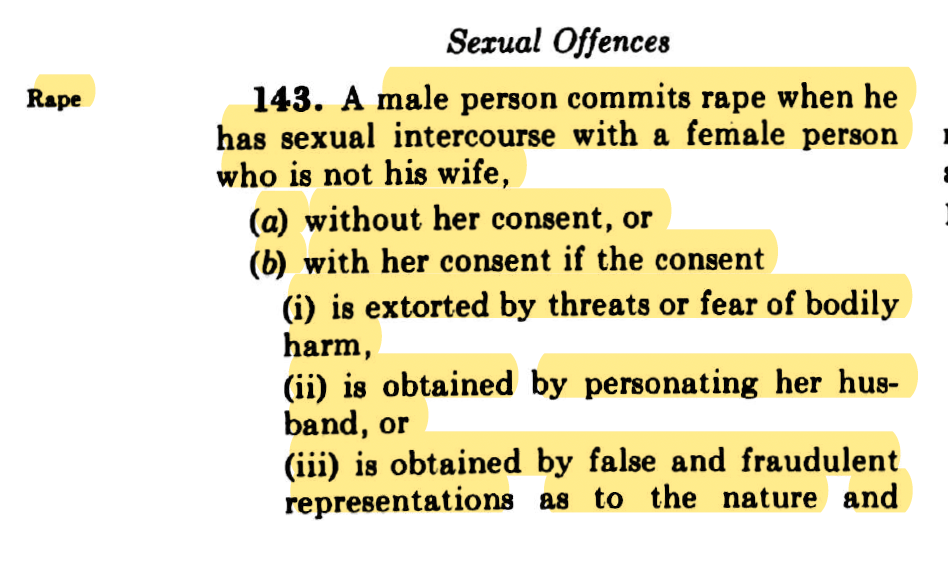
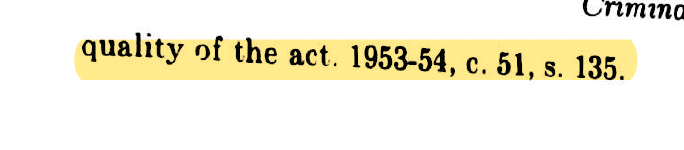
And yes, the Canadian Armed Forces were precluded from conducting service tribunals for Murder, Manslaughter, and Rape, rape was not a crime that could be committed against girls under the age of 16.

Rape was section 143. Sexual intercourse with girls under 16 was handled by sections 146(1) and 146 (2).

The custom in the justice system is to prosecute the offence as it would have been prosecuted at the date of the offence. The accused would have the right to enjoy the same protections that they would have enjoyed at the time of the alleged offence.

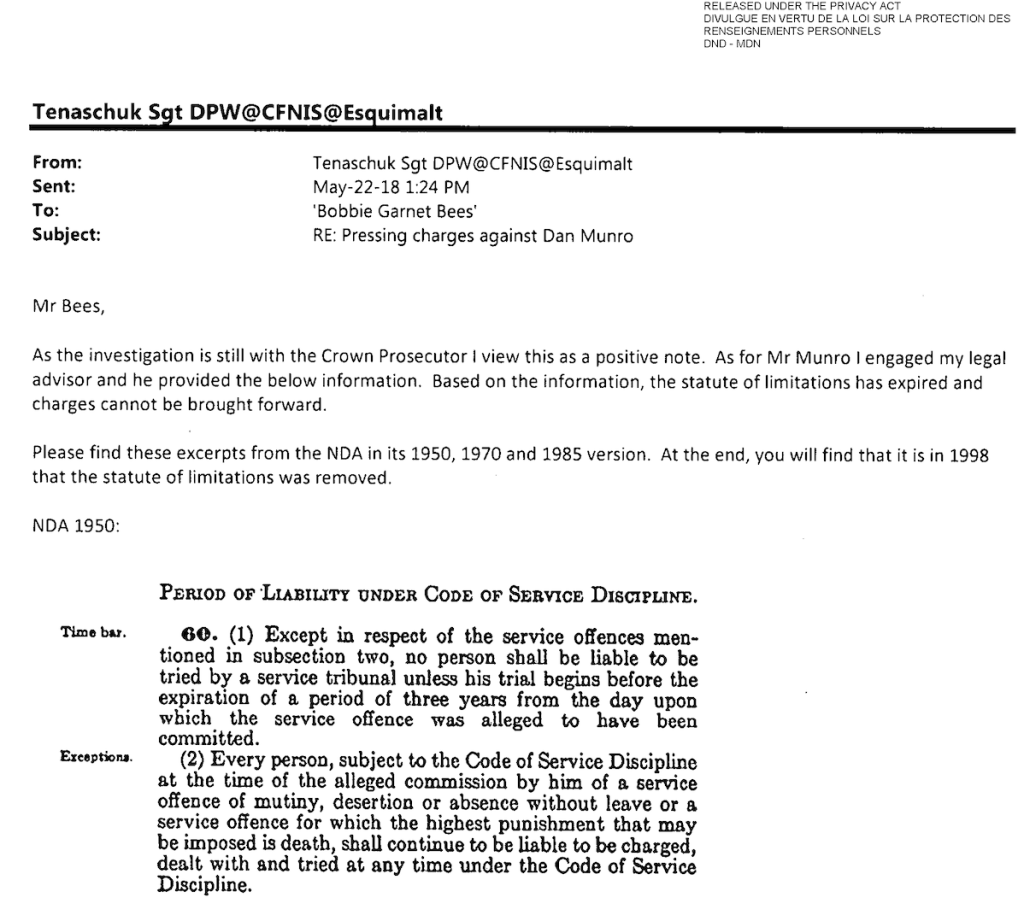
This means that as the 3-year-time-bar was never retroactively removed from the National Defence Act, it still applies to all Service Offences that occurred prior to 1998.

Don’t believe me?

This was the response from the Office of the Judge Advocate General in 2018 when I asked the CFNIS if they could talk to Daniel Edward Munro about who made the decision in 1998 to reduce the number of charges that had been brought against Captain McRae.

The Crown Prosecutor is in regard to the babysitter.
The legal advisor was in regard to Daniel Edward Munro, the commanding officer of Captain Father Angus McRae.

The three-year-time-bar posed an interesting dilemma for the CFNIS in 2011.

Angus McRae was still alive in March of 2011 when the Edmonton Police Service transferred my complaint to the CFNIS. Angus McRae didn’t die until May 20th, 2011. The CFNIS had the 1980 CFSIU paperwork, and the 1980 Courts Martial transcripts. So the CFNIS knew of the direct and irrefutable link between Captain Angus McRae and his accomplice, P.S., whom had been my babysitter in 1978 to 1980.

And while the CFNIS could charge the babysitter with sexual offences against a child under the age of 12 as the babysitter was over 14 when the majority of the crime occurred, the CFNIS could never charge Angus McRae for his sexual offences against children as the 3-year-time-bar prohibited it.

How many children were sexually abused on the bases prior to 1998 and can’t lay charges due to the 3-year-time-bar or the summary investigation flaw?

Who knows?

How many times pre-1998 did the CFSIU conduct sham dog ‘n’ pony show investigations to make the victim feel like something was being done when nothing could ever be done?

Who knows?

How many times post-1998 did the CFNIS conduct sham dog ‘n’ pony show investigations to make the victim feel like something was being done when the pre-1998 flaws meant that nothing could ever be done?

Who knows?

How many times has the chain of command interfered with CFNIS investigations to shield the Canadian Armed Forces and the office of the Minister of National Defence from civil actions related to child sexual abuse in the defence community at the hands of the employees of the Canadian Armed Forces?

Again, who the fuck knows.

I know who doesn’t want to know.

The media doesn’t want to know.

But the media sure wants to know how the donkeys feel about silly advertisements on TV.

Portland, OR

So, here I am on my last night in Portland, OR.

Nice city. It’s walkable. But it’s also dominated by car culture.

Massive freeways all over the place.

It’s hard to get away from the car.

The downtown is nice and walkable.

Same homelessness and drug use issues that Seattle and Vancouver, BC have, but still no where near as bad as the drug problems in Edmonton, AB.

Did the usual thing, just walked around the city, steering clear of anything that looked like a tourist trap.

Came down here to buy socks.

Yep, socks.

Place down here sells nice cotton knee high and thigh high socks that come in an assortment of colours and patterns.

They work out to about $30/pr in Canada, but with Sir Misogyny the Orange wanting to start a trade tariff war, I thought that it would be a great time to pop on down for a long weekend to grab some socks and take advantage of the duty exemption that comes into play after one has been in the US of A for more than 48 hours.

A panorama of the Willamette River

.

water fountains

There are a lot of these water fountains around the city. And it looks like they keep them running around the year.

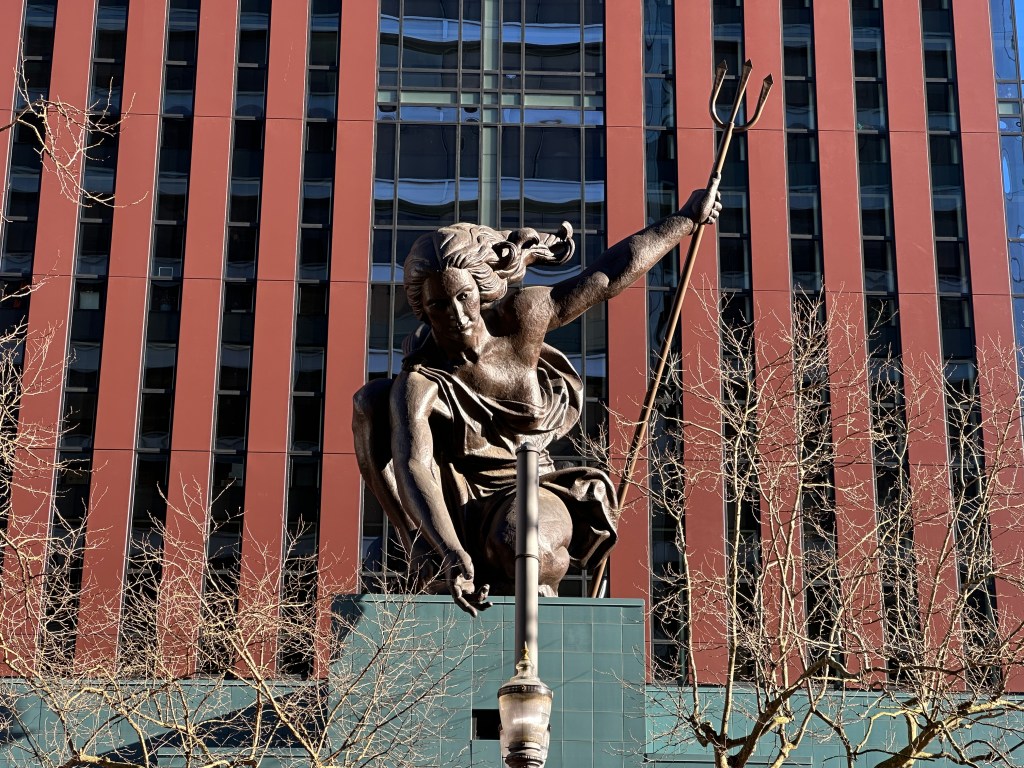
Portlandia, a sculpture by Raymond Kaskey.

If you ever get to Portland, you gotta check the statute of Portlandia out. It’s perched over the entrance of the Portland Municipal Services Building located on S.W. 5th Ave., between S.W. Main St. and S.W. Madison St.

This city has a lot of bridges. 12 large bridges and a good half dozen pedestrian bridges.

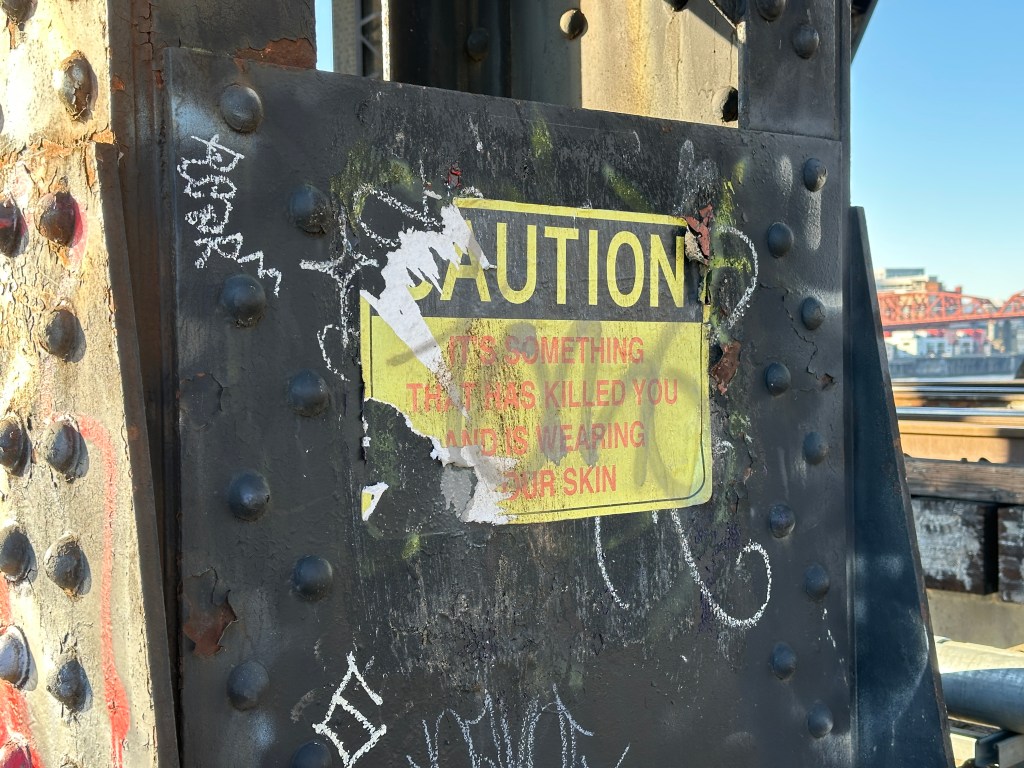
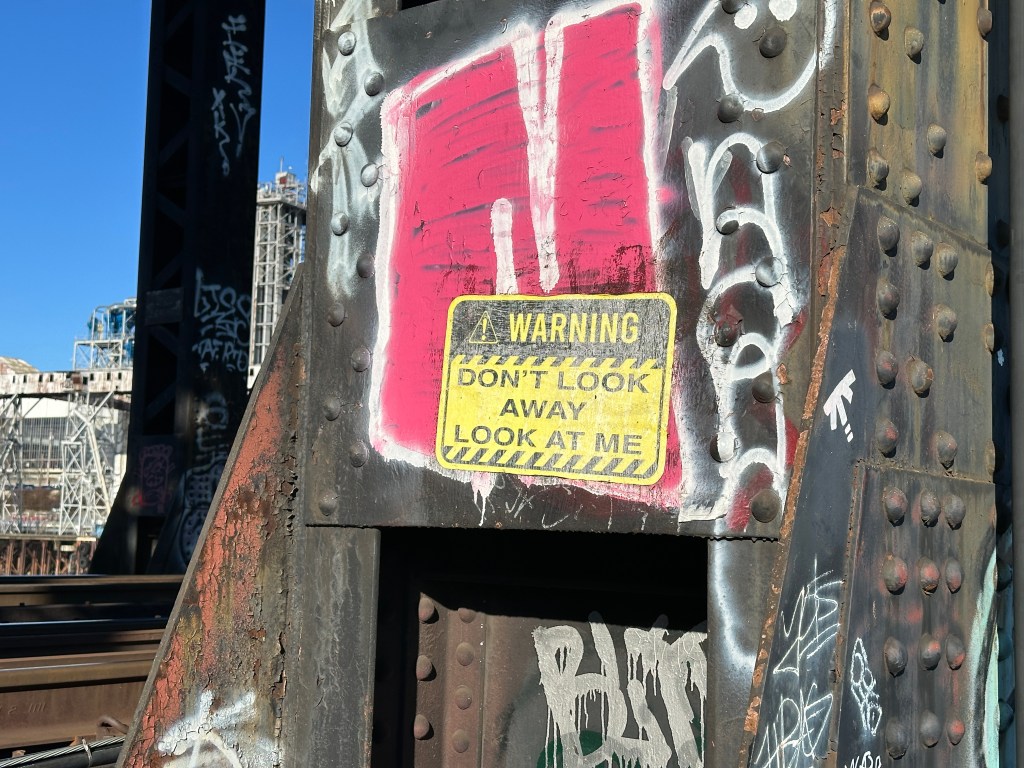
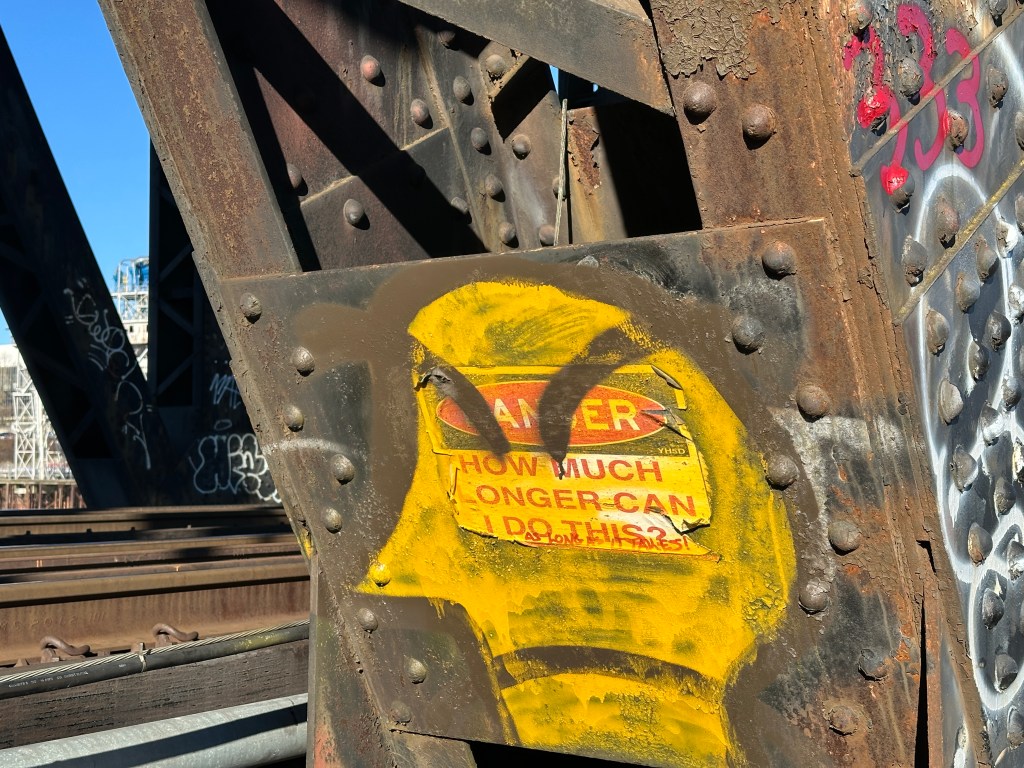
Most of the bridges have a good coating of graffiti, stickers, and other colourful distractions from the banality of life.

My hotel room had one of these in it.

Kept waiting for the psychologist to come in to analyze me, but they never showed up.

Another panorama, this time facing downtown.

And me on a bridge.

And one more panorama shot…

And finally, no trip would be complete without me checking out the HVAC system in the hotel where I’m staying. Polished spiral duct. Long radius elbows. Looks like a variable flow refrigerant system so it can do heating and cooling. Easy access to the filter.

Why don’t you find other brats?

If there’s one thing that the public misunderstands about base brats it’s that as kids we moved around a lot. And not only were we moving, but the other kids on base would move as well.

Kids from dysfunctional families were pretty well segregated and ignored on base.

The Canadian Forces and the Department of National Defence will bray endlessly that your serving parent’s rank had no influence in the PMQ patch and that your serving parent would drop their military mindset at the front door of the PMQ.

That was absolute bullshit.

The PMQ patches were in all sense of the word the ultimate company town.

And as such children from dysfunctional homes were pretty well isolated from the others.

Sexually abused children, especially males, were seen to be willing participants in their own abuse and as such they were seen to be a risk to the other kids on base.

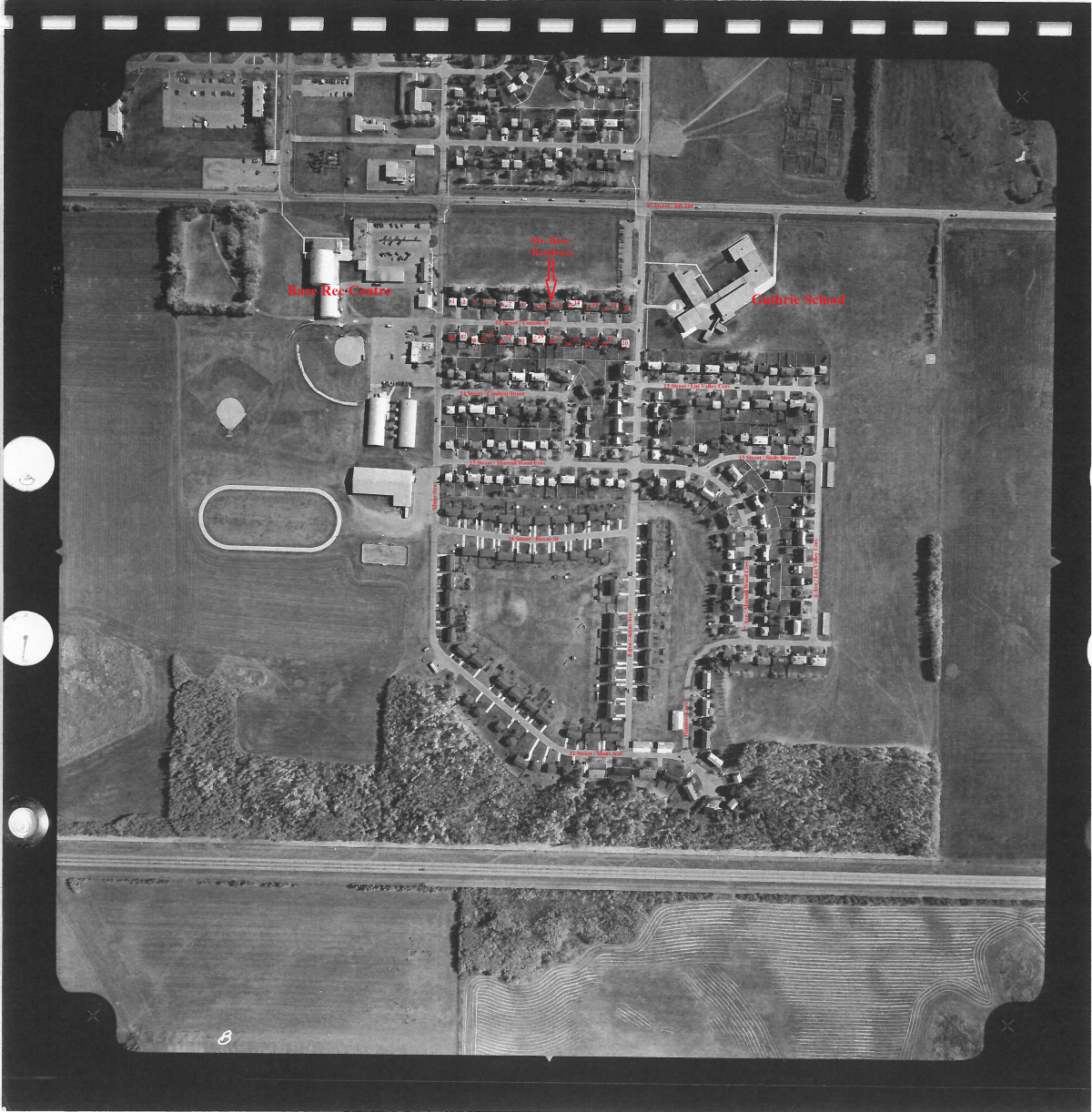
In the days after the CFB Namao child sexual abuse sex scandal my family, like others, were posted off CFB Namao. The babysitter’s family was the first to move. This more than likely had to do with rumblings on base that some of the junior ranks wanted to lynch the babysitter.

My family was punted off CFB Namao and down to CFB Griesbach in October of 1980. This was a total trip distance of 10 km, paid for by the Canadian tax payers.

So, how am I supposed to know who the other kids are or how to find them.

The DND, the CAF, and the DOJ all have access to the listings of military families that resided on the base from the summer of 1978 until the summer of 1980, but this is “protected” as personal information.

The CFSIU investigation paperwork and the courts martial transcripts contain the names of the other potential victims, but again this is “personal information” and can’t be released to protect the victims.

There was a crime stoppers appeal for victims of sexual assault on the base between 1978 to 1980 that was released in 2018. According to the MPCC paperwork this provided “hits”, but nothing that could be directly tied to me. This could be used to find other victims. But the DOJ, the DND, and the CAF would fight this tooth and nail.

Why don’t I go on line to the facebook groups? or Xitter, or Bluesky, or Threads?

The one problem with that is there is a certain contingent of former military dependent that will not acknowledge that bad things happened to children on the bases because if they did then they would have to face the fact that they were often the ones shunning, teasing, taunting, and isolating the hurt kids.

So, here we are in 2024.

My clock is quickly winding down.

And the DOJ knows full well well that they have nothing to fear as the organization that I am squaring off against controls all of the information required for my claim to be successful.

Unlike the kids who got diddled by sports players, priests, police officers, school teachers, etc., I have to contend with an agency that can legally silence potential witnesses that were part of the military back in the day. The security of information act / the official secrets act is so extremely vague when it comes to persons who were subject to the code of service discipline when they learnt about “information” on a defence establishment.

The section of the official secrets act / security of information act that deals with members of the Canadian Armed Forces on base isn’t limited to “secret” or “classified” documents, plans, sketches, etc. These acts cover “all information” which could include “police investigations”, “reasons for chain of command decisions”, “orders to subordinates”, etc.

Also, the 3-year-time-bar legally protects anyone who was subjected to the code of service discipline in 1980 from any modern day legal action, and I would also interpret that to also protect these people from any civil liabilities.

Even if the RCMP wanted to go have a chit-chat with retired Canadian Armed Forces officer Brigadier General Daniel Edward Munro, the National Defence Act protects Munro from any criminal investigation.

Charges against McRae pg1
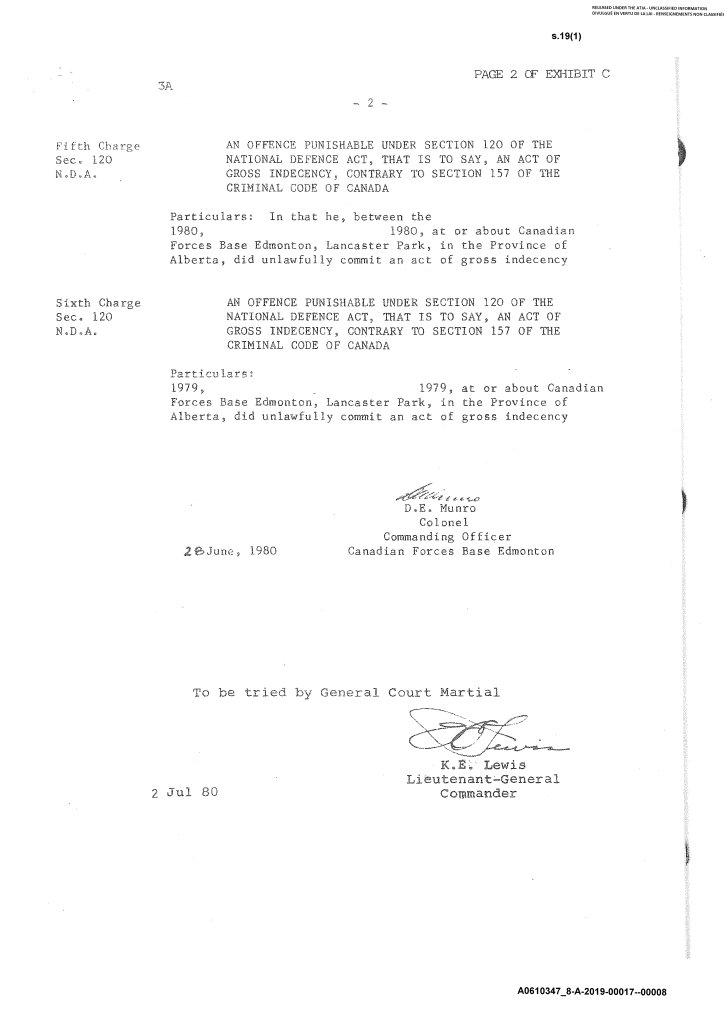
Charges Against McRae pg2

The above two pages are from the 1980 courts martial of Captain McRae. They are what are known as the “charge sheets”.

Yes, the Canadian Forces have ALWAYS had the authority to try service members on Code of Service Discipline matters, and that the National Defence Act allowed the military to try Criminal Code offences as Service Offences.

This also meant that the crimes of Gross Indecency, Indecent Assault, Buggery, and just about every other charge related to sexual offences against children were subject to the 3-year-time-bar that stipulated that no person that committed a service offence could be prosecuted for that offence if the tribunal for said offence commenced more that 3 years after the date of the offence.

The fact that the Canadian Forces could try sexual assaults against children as service offences meant that the summary investigation flaw would also apply. The Summary Investigation Flaw required that the commanding officer of the accused review the charges that had been brought against their subordinate. If the charges would result in a sentence of less than 2 years and not dismissal from the Canadian Forces , the commanding officer could conduct a summary trial where the commanding officer would be the judge.

If there was the risk that the charges would in charges of more than two years or dismissal from the Canadian Forces the commanding officer would cause the charges to proceed to courts martial or the civilian justice system.

However, the commanding officer could also chose to simply dismiss any or all of the charges brought against their subordinate. And once dismissed, those charges or similar charges arising out of the same or similar facts could never be brought against the subordinate at a later date by either a military or civilian tribunal.

When I asked the CFNIS in 2018 if they could talk to Daniel Edward Munro, whom was residing in the vicinity of the CFNIS detachment at CFB Esquimalt, this was the response the CFNIS investigator received from Ottawa.

3 year time bar pg1
3 year time bar pg2

So, not only is Munro immune from explaining to the military or civilian police what he did in 1980 and who may have possibly ordered him to do what he did, but he would also be silenced by the Security of Information Act as anything that he did on CFB Namao related to the investigation and prosecution of Captain McRae would be considered “information”.

As I mentioned in other blog postings, I had become acquainted with Fredrick R. Cunningham on November 27th, 2011. He filled me in on numerous details of the Captain McRae fiasco. He wouldn’t name names, but he would state that the military police were prevented by the “brass” from calling in the RCMP to deal with the babysitter, and that the military police had many more charges against Captain McRae but that the “brass” reduced that number of charges to those only related to the babysitter, all other charges related to other children had been dropped. Cunningham also noted that the military police at the time wanted to move this case into the civilian justice system but that the “brass” refused their requests. Cunningham wouldn’t say what his rank was or what unit that he was involved with, but he also begged me not to tell anyone that he had told me anything about the babysitter and Captain McRae.

I mentioned the contents of my conversation with Cunningham in a letter to the Provost Marshal. Weeks later Gilles Sansterre, the commander of the CFNIS telephoned me to say that the CFNIS couldn’t find any evidence to substantiate what this “Cunningham” guy said. Sansterre said he doubted that Cunningham could have known anything about the 1980 investigation and that Cunningham probably heard about this information 2nd or 3rd hand.

In 2020 with the release of the CFSIU investigation paperwork I would learn that Cunningham was in fact the Acting Section Commander of the CFSIU on CFB Namao and that he had been personally tasked by the base security officer, Captain David Pilling, with investigating Captain McRae for having committed “Acts of Homosexuality” with young boys on the base.

Everything that Cunningham had told me had been backed up by the CFSIU paperwork.

How powerful are the Canadian Armed Forces and the Department of National Defence at keeping secrets?

In 2016, during part 2 of the CFNIS investigation into my complaint against the babysitter, the CFNIS tried to talk to Fred Cunningham. Fred outright refused to go for an interview at the CFNIS detachment located on Canadian Forces Garrison Steele Barracks (formerly CFB Namao). He would only talk to the CFNIS as long as no audio or video recordings were made. That’s an odd thing for the lead investigator of a major child sexual abuse scandal involving more than 25 children to say.

What was Fred afraid of?

Well, I think that Fred was afraid that if what he told the CFNIS in 2016 came anywhere near close to what he told me in 2011, then that meant that we would have run afoul of the security of information act / official secrets act. The actual penalties aren’t anything too serious under the acts.

BUT……..

What if the Canadian Forces were to retroactively dishonourably discharge Fred from the Canadian Forces effective the time period of the Captain McRae fiasco. I don’t know when Fred retired, but that would be a hell of a lot of pension money, wages, and housing allowances to have to pay back to the government.

Do I think it would have resulted in that? No. But who the hell would want to go against a government agency governed by intentionally vague and overreaching acts and regulations and spend all sorts of retirement money and retirement time fighting the government?

And this is the problem facing any lawyer dealing with matters against the Department of National Defence and the Canadian Armed Forces. You’re not dealing with acts and regulations that are set in concrete. You’re dealing with acts and regulations that are so vague that they can be whatever the DND and the CAF want them to be from one day to the next.

The catholic church or even the scouts can be required to hand over the names of members of their organizations to police investigators, prosecutors, and even civil litigants. The DND and the CAF don’t have to meet those obligations as any information they have is considered “personal information” as the abusers and the serving parents of the victims were members of the Canadian Armed Forces and as such were “employees” and as such they would need to seek the permission of the involved parties to release said information.

So back to the topic at the start of this post, “why don’t I simply find other brats”? The secrecy surrounding the CAF and the military communities guards the military community with a large impenetrable wall of secrecy.

Throw into this the number of frequent relocations across the country, and then the children moving off and on their own when they “age off” the bases, and you have former brats scatted all over the country.

In the day and age that I lived on the bases children could only live in the PMQs on base until the 19th birthday. There were exceptions for children going to college or university. They had until 24 to get out of the military housing. The only other exception was for handicapped children.

I lived in 7 different PMQs, on 5 different bases, in four different provinces by the time I was 12. Might not be a lot of moves in and of itself, but when the other kids are also moving around this creates a lot of churn.

As I said, dysfunctional families on base were a dime a dozen. I spoke to my father only a handful of times between 1990 when I moved out of the house for the second time and 2006. I never spoke to my father again between 2006 and when he died in 2017. I suspect that there were a lot of other brats like this.

I know of another department manager at work that was a base brat as a child. They absolutely refuse to talk about their childhood as they’re ashamed of what they went through and they’re afraid of others finding out.

And this is why I don’t think that the Canadian Armed Forces or the Department of National Defence will ever have to own up to the full extent of child sexual abuse on Canadian Forces Base Namao nor any other defence establishment across Canada.

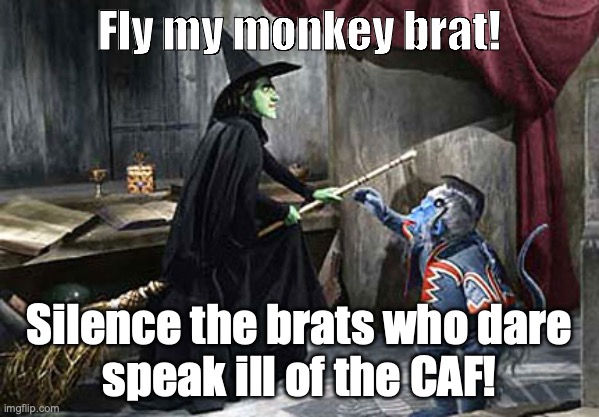
The impenetrable walls of secrecy, and the online army of flying monkey base brats ensure that the Canadian Armed Forces and the Department of National Defence never have to worry their pretty little heads off. When the tools of secrecy can’t conceal the child sexual abuse, the legion of flying monkey base brats will attack the abused brats.

The Military Police Complaints Commission

Flying under the radar of the public was the 2023 Annual Report written by the Chairperson of the MPCC Madame Tammy Tremblay.

The full report is available here:
https://www.mpcc-cppm.gc.ca/corporate-organisation/reports-rapports/annuel-report-rapport-annuel/annual-report-rapport-annuel-2023-eng.html

From the report:
“Our most significant challenge this year was the erosion of the MPCC’s ability to exercise civilian oversight of the military police. The MPCC used a great deal of resources and effort to obtain relevant documents from the CFPM to enable it to conduct fair and fulsome investigations. In too many instances, we have seen resistance or refusal to disclose information the MPCC needs to investigate complaints; a reduction in the number of recommendations accepted by the CFPM; a refusal to respond to recommendations; a refusal to provide updates on files currently being reviewed by the Office of Professional Standards of the CFPM; and restrictive and unilateral interpretation of the MPCC’s jurisdiction. The MPCC has been forced to turn to the Federal Court to obtain the documents it is legally entitled to review as part of its mandate. These unfortunate barriers dilute the will of Parliament in setting up a strong oversight system for the police and must be addressed.”

The MPCC was created in 1998 as part of the passing of Bill C-25 in 1998 and the restructuring of the military police in the aftermath of the fallout from the failures of the military police to conduct proper criminal investigations in Bosnia and Somalia when the Canadian Forces were on “peace keeping” missions there but ended up with members of the CAF conducting illegal activities.

The Military Police Complaints Commission was created with input from the Canadian Armed Forces and the Department of National Defence, meaning that the CAF and the DND knew how they wanted their new police forces to operate and that through careful consideration the MPCC would be relegated to the status of toothless hound dog.

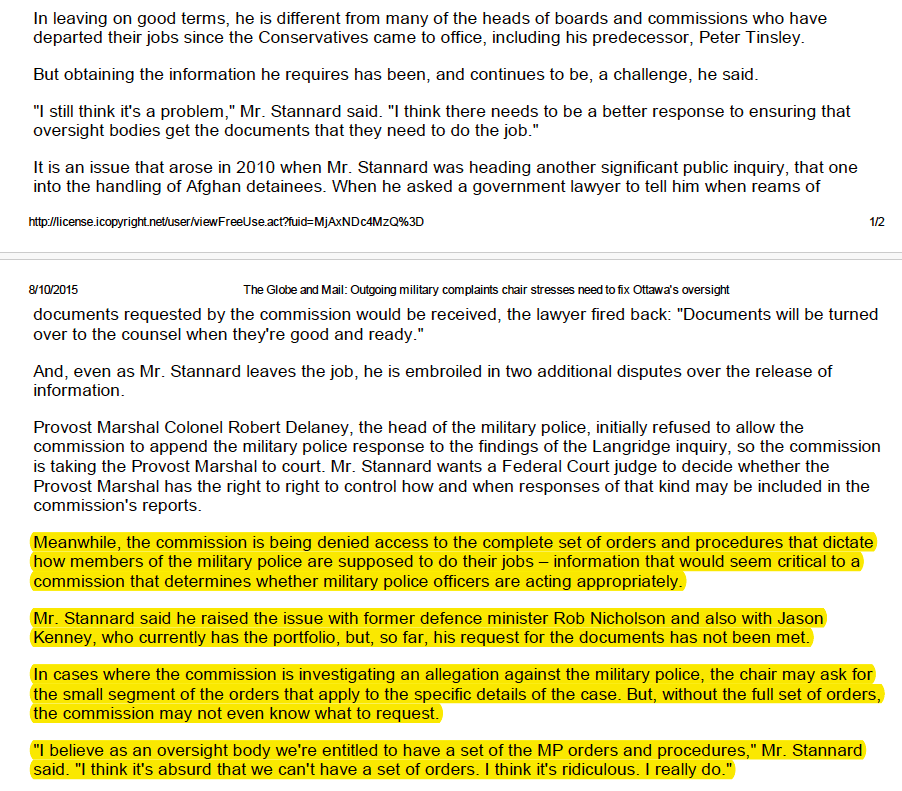
The issues that Madame Tammy Tremblay raised above are nothing new. In 2015 then outgoing MPCC chairman Glenn Stannard has this to say in his interview with Gloria Galloway of The Globe and Mail.

The Canadian Forces Provost Marshal has the ability to control the findings of the Military Police Complaints Commission.

During a review, the MPCC cannot subpoena documents or witnesses. The MPCC also cannot administer oaths.

Without the ability to administer oaths the members of the CFNIS subject to the complaint can utter falsehoods all day long and there will be absolutely no repercussions.

If a person such as myself wishes to make a complaint against the base military police or the Canadian Forces Special Investigations Unit we have to first submit our complaint to the Provost Marshal. The Provost Marshal then knows what the complaint is about and can then tailor the documents released to the MPCC to paint the narrative that the Provost Marshal or the Vice Chief of Defence Staff which for the MPCC to see.

Even if the MPCC suspects that something is off and not right, there’s nothing the MPCC can do as the MPCC cannot demand the release of documents from the Provost Marshal. Sure, they can go to Federal Court to ask the court to instruct the Provost Marshal to hand over the records, but that would mean that the MPCC would have to know what documents to request.

As I learnt during the 2012 review of my complaint against the 2011 CFNIS investigation, the complainant cannot simply supply the MPCC with all the documents in their possession. The MPCC can only consider documents that are relevant to the documents supplied to the MPCC by the Provost Marshal.

And as the Provost Marshal is under no obligation to tell the complainant what they’ve supplied and what they’ve withheld from the Military Police Complaints Commission, following through with a MPCC review is almost 100% a waste of time.

This is why when I was interviewed by Claude Bergeron and Peter Cicalo of the MPCC in July of 2012 they were practically popping the champagne and cheering for the CFNIS.

I’m on the left….. the MPCC is on the right.

Peter and Claude were very impressed with the CFNIS investigation even though the Provost Marshal had actually withheld all of my email communications between myself and Master Corporal Christian Cyr detailing the 5 visits to the chapel.

After my interview with Peter and Claude I was so fucking nauseated that I just wandered around the city aimlessly until about 03:00 in the morning trying to work up the courage to jump off the Granville Street bridge.

The Provost Marshal withheld the fact that the CFNIS had in its possession the 1980 CFSIU investigation paperwork and the 1980 courts martial transcripts from the MPCC.

Both of these sets of documents indicated that in 1980 the military police and the CFSIU were very well aware of the babysitter’s abuse of young children on the base and the fact that it was the investigation of the babysitter that exposed the actions of Canadian Armed Forces officer Captain Father Angus McRae.

This of course ran counter to was I was told by Petty Officer Steve Morris on November 4th, 2011 when he stated that the CFNIS could find absolutely no evidence that the babysitter was capable of what I accused him of.

Well, if you don’t like the findings of the MPCC, file an application for Judicial Review.

Don’t think that the Federal Court will be of any relief. The Federal Court can only render judgements based upon the documents that the Provost Marshal submitted to the MPCC. Anything else is considered “New Evidence” and the Department of Justice will fight tooth and nail to have all “new evidence” dismissed.

When I entered all of my emails between myself and Master Corporal Christian Cyr detailing the visits to the chapel the DOJ demanded that these be struck from the proceedings as they were “new evidence”. Because the Provost Marshal failed to notify the MPCC about these emails, I couldn’t introduce these emails at Federal Court level.

And it gets goofier than this.

In 1998, the Provost Marshal issued CFPM 2120-4-0 to the commanding officers of the new CFNIS, and all of the detachments across Canada. This document was further reissued in 2006. This document stated that matters involving civilian victim are to be handed over to the outside civilian authorities having jurisdiction. This document further stipulated that the CFNIS could only conduct an investigation of offences involving civilian victims if the outside civilian authorities outright refused to conduct the investigation.

I introduced this document into my applicant’s records for my application for judicial review.

The Department of Justice requested this document be struck from my hearing as this was also “New Evidence”. New evidence even though this was a standing operating procedure of the Canadian Forces Military Police. But it appears that the Military Police Complaints Commission was never given a copy of this document even though this document has guided military police and CFNIS operations since 1998.

I can’t help but wonder if the Provost Marshal’s new found energy to fight the MPCC over documents has to do with the fact that the MPCC went around the firewall that the CFNIS and the Provost Marshal had constructed around the investigation into my complaint of sexual abuse on Canadian Forces Base Namao and accesses a parallel investigation being conducted into the sexual assaults on CFB Namao and discovered the CFSIU investigation paperwork and the 1980 courts martial transcripts in the possession of the CFNIS.

Militaries like the Canadian Armed Forces really don’t like outside civilian agencies and do-gooders sticking their noses into the military’s business. Militaries view themselves as being the saviours of their respective country, and therefore they should never be questioned.

The Catholic church did the exact same thing that the Canadian Armed Forces are doing. And that’s using their immense power and prestige to place themselves above examination by pesky civilians.

The only difference between the Catholic church and the Canadian Armed Forces is that the Catholic church is subject to civilian laws and the civilian courts. The Canadian Armed Forces are a law unto themselves.