If there’s one thing that the public misunderstands about base brats it’s that as kids we moved around a lot. And not only were we moving, but the other kids on base would move as well.
Kids from dysfunctional families were pretty well segregated and ignored on base.
The Canadian Forces and the Department of National Defence will bray endlessly that your serving parent’s rank had no influence in the PMQ patch and that your serving parent would drop their military mindset at the front door of the PMQ.
That was absolute bullshit.
The PMQ patches were in all sense of the word the ultimate company town.
And as such children from dysfunctional homes were pretty well isolated from the others.
Sexually abused children, especially males, were seen to be willing participants in their own abuse and as such they were seen to be a risk to the other kids on base.
In the days after the CFB Namao child sexual abuse sex scandal my family, like others, were posted off CFB Namao. The babysitter’s family was the first to move. This more than likely had to do with rumblings on base that some of the junior ranks wanted to lynch the babysitter.
My family was punted off CFB Namao and down to CFB Griesbach in October of 1980. This was a total trip distance of 10 km, paid for by the Canadian tax payers.
So, how am I supposed to know who the other kids are or how to find them.
The DND, the CAF, and the DOJ all have access to the listings of military families that resided on the base from the summer of 1978 until the summer of 1980, but this is “protected” as personal information.
The CFSIU investigation paperwork and the courts martial transcripts contain the names of the other potential victims, but again this is “personal information” and can’t be released to protect the victims.
There was a crime stoppers appeal for victims of sexual assault on the base between 1978 to 1980 that was released in 2018. According to the MPCC paperwork this provided “hits”, but nothing that could be directly tied to me. This could be used to find other victims. But the DOJ, the DND, and the CAF would fight this tooth and nail.
Why don’t I go on line to the facebook groups? or Xitter, or Bluesky, or Threads?
The one problem with that is there is a certain contingent of former military dependent that will not acknowledge that bad things happened to children on the bases because if they did then they would have to face the fact that they were often the ones shunning, teasing, taunting, and isolating the hurt kids.
So, here we are in 2024.
My clock is quickly winding down.
And the DOJ knows full well well that they have nothing to fear as the organization that I am squaring off against controls all of the information required for my claim to be successful.
Unlike the kids who got diddled by sports players, priests, police officers, school teachers, etc., I have to contend with an agency that can legally silence potential witnesses that were part of the military back in the day. The security of information act / the official secrets act is so extremely vague when it comes to persons who were subject to the code of service discipline when they learnt about “information” on a defence establishment.
The section of the official secrets act / security of information act that deals with members of the Canadian Armed Forces on base isn’t limited to “secret” or “classified” documents, plans, sketches, etc. These acts cover “all information” which could include “police investigations”, “reasons for chain of command decisions”, “orders to subordinates”, etc.
Also, the 3-year-time-bar legally protects anyone who was subjected to the code of service discipline in 1980 from any modern day legal action, and I would also interpret that to also protect these people from any civil liabilities.
Even if the RCMP wanted to go have a chit-chat with retired Canadian Armed Forces officer Brigadier General Daniel Edward Munro, the National Defence Act protects Munro from any criminal investigation.

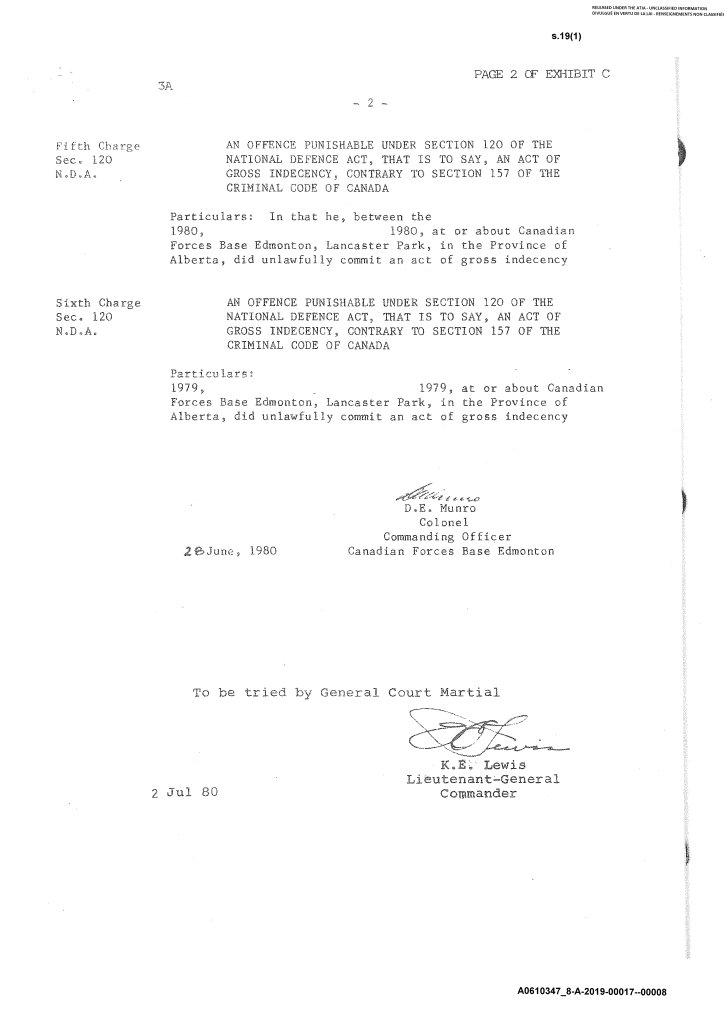
The above two pages are from the 1980 courts martial of Captain McRae. They are what are known as the “charge sheets”.
Yes, the Canadian Forces have ALWAYS had the authority to try service members on Code of Service Discipline matters, and that the National Defence Act allowed the military to try Criminal Code offences as Service Offences.
This also meant that the crimes of Gross Indecency, Indecent Assault, Buggery, and just about every other charge related to sexual offences against children were subject to the 3-year-time-bar that stipulated that no person that committed a service offence could be prosecuted for that offence if the tribunal for said offence commenced more that 3 years after the date of the offence.
The fact that the Canadian Forces could try sexual assaults against children as service offences meant that the summary investigation flaw would also apply. The Summary Investigation Flaw required that the commanding officer of the accused review the charges that had been brought against their subordinate. If the charges would result in a sentence of less than 2 years and not dismissal from the Canadian Forces , the commanding officer could conduct a summary trial where the commanding officer would be the judge.
If there was the risk that the charges would in charges of more than two years or dismissal from the Canadian Forces the commanding officer would cause the charges to proceed to courts martial or the civilian justice system.
However, the commanding officer could also chose to simply dismiss any or all of the charges brought against their subordinate. And once dismissed, those charges or similar charges arising out of the same or similar facts could never be brought against the subordinate at a later date by either a military or civilian tribunal.
When I asked the CFNIS in 2018 if they could talk to Daniel Edward Munro, whom was residing in the vicinity of the CFNIS detachment at CFB Esquimalt, this was the response the CFNIS investigator received from Ottawa.


So, not only is Munro immune from explaining to the military or civilian police what he did in 1980 and who may have possibly ordered him to do what he did, but he would also be silenced by the Security of Information Act as anything that he did on CFB Namao related to the investigation and prosecution of Captain McRae would be considered “information”.
As I mentioned in other blog postings, I had become acquainted with Fredrick R. Cunningham on November 27th, 2011. He filled me in on numerous details of the Captain McRae fiasco. He wouldn’t name names, but he would state that the military police were prevented by the “brass” from calling in the RCMP to deal with the babysitter, and that the military police had many more charges against Captain McRae but that the “brass” reduced that number of charges to those only related to the babysitter, all other charges related to other children had been dropped. Cunningham also noted that the military police at the time wanted to move this case into the civilian justice system but that the “brass” refused their requests. Cunningham wouldn’t say what his rank was or what unit that he was involved with, but he also begged me not to tell anyone that he had told me anything about the babysitter and Captain McRae.
I mentioned the contents of my conversation with Cunningham in a letter to the Provost Marshal. Weeks later Gilles Sansterre, the commander of the CFNIS telephoned me to say that the CFNIS couldn’t find any evidence to substantiate what this “Cunningham” guy said. Sansterre said he doubted that Cunningham could have known anything about the 1980 investigation and that Cunningham probably heard about this information 2nd or 3rd hand.
In 2020 with the release of the CFSIU investigation paperwork I would learn that Cunningham was in fact the Acting Section Commander of the CFSIU on CFB Namao and that he had been personally tasked by the base security officer, Captain David Pilling, with investigating Captain McRae for having committed “Acts of Homosexuality” with young boys on the base.
Everything that Cunningham had told me had been backed up by the CFSIU paperwork.
How powerful are the Canadian Armed Forces and the Department of National Defence at keeping secrets?
In 2016, during part 2 of the CFNIS investigation into my complaint against the babysitter, the CFNIS tried to talk to Fred Cunningham. Fred outright refused to go for an interview at the CFNIS detachment located on Canadian Forces Garrison Steele Barracks (formerly CFB Namao). He would only talk to the CFNIS as long as no audio or video recordings were made. That’s an odd thing for the lead investigator of a major child sexual abuse scandal involving more than 25 children to say.
What was Fred afraid of?
Well, I think that Fred was afraid that if what he told the CFNIS in 2016 came anywhere near close to what he told me in 2011, then that meant that we would have run afoul of the security of information act / official secrets act. The actual penalties aren’t anything too serious under the acts.
BUT……..
What if the Canadian Forces were to retroactively dishonourably discharge Fred from the Canadian Forces effective the time period of the Captain McRae fiasco. I don’t know when Fred retired, but that would be a hell of a lot of pension money, wages, and housing allowances to have to pay back to the government.
Do I think it would have resulted in that? No. But who the hell would want to go against a government agency governed by intentionally vague and overreaching acts and regulations and spend all sorts of retirement money and retirement time fighting the government?
And this is the problem facing any lawyer dealing with matters against the Department of National Defence and the Canadian Armed Forces. You’re not dealing with acts and regulations that are set in concrete. You’re dealing with acts and regulations that are so vague that they can be whatever the DND and the CAF want them to be from one day to the next.
The catholic church or even the scouts can be required to hand over the names of members of their organizations to police investigators, prosecutors, and even civil litigants. The DND and the CAF don’t have to meet those obligations as any information they have is considered “personal information” as the abusers and the serving parents of the victims were members of the Canadian Armed Forces and as such were “employees” and as such they would need to seek the permission of the involved parties to release said information.
So back to the topic at the start of this post, “why don’t I simply find other brats”? The secrecy surrounding the CAF and the military communities guards the military community with a large impenetrable wall of secrecy.
Throw into this the number of frequent relocations across the country, and then the children moving off and on their own when they “age off” the bases, and you have former brats scatted all over the country.
In the day and age that I lived on the bases children could only live in the PMQs on base until the 19th birthday. There were exceptions for children going to college or university. They had until 24 to get out of the military housing. The only other exception was for handicapped children.
I lived in 7 different PMQs, on 5 different bases, in four different provinces by the time I was 12. Might not be a lot of moves in and of itself, but when the other kids are also moving around this creates a lot of churn.
As I said, dysfunctional families on base were a dime a dozen. I spoke to my father only a handful of times between 1990 when I moved out of the house for the second time and 2006. I never spoke to my father again between 2006 and when he died in 2017. I suspect that there were a lot of other brats like this.
I know of another department manager at work that was a base brat as a child. They absolutely refuse to talk about their childhood as they’re ashamed of what they went through and they’re afraid of others finding out.
And this is why I don’t think that the Canadian Armed Forces or the Department of National Defence will ever have to own up to the full extent of child sexual abuse on Canadian Forces Base Namao nor any other defence establishment across Canada.
The impenetrable walls of secrecy, and the online army of flying monkey base brats ensure that the Canadian Armed Forces and the Department of National Defence never have to worry their pretty little heads off. When the tools of secrecy can’t conceal the child sexual abuse, the legion of flying monkey base brats will attack the abused brats.

 Beeshive