Flying under the radar of the public was the 2023 Annual Report written by the Chairperson of the MPCC Madame Tammy Tremblay.
The full report is available here:
https://www.mpcc-cppm.gc.ca/corporate-organisation/reports-rapports/annuel-report-rapport-annuel/annual-report-rapport-annuel-2023-eng.html
From the report:
“Our most significant challenge this year was the erosion of the MPCC’s ability to exercise civilian oversight of the military police. The MPCC used a great deal of resources and effort to obtain relevant documents from the CFPM to enable it to conduct fair and fulsome investigations. In too many instances, we have seen resistance or refusal to disclose information the MPCC needs to investigate complaints; a reduction in the number of recommendations accepted by the CFPM; a refusal to respond to recommendations; a refusal to provide updates on files currently being reviewed by the Office of Professional Standards of the CFPM; and restrictive and unilateral interpretation of the MPCC’s jurisdiction. The MPCC has been forced to turn to the Federal Court to obtain the documents it is legally entitled to review as part of its mandate. These unfortunate barriers dilute the will of Parliament in setting up a strong oversight system for the police and must be addressed.”
The MPCC was created in 1998 as part of the passing of Bill C-25 in 1998 and the restructuring of the military police in the aftermath of the fallout from the failures of the military police to conduct proper criminal investigations in Bosnia and Somalia when the Canadian Forces were on “peace keeping” missions there but ended up with members of the CAF conducting illegal activities.
The Military Police Complaints Commission was created with input from the Canadian Armed Forces and the Department of National Defence, meaning that the CAF and the DND knew how they wanted their new police forces to operate and that through careful consideration the MPCC would be relegated to the status of toothless hound dog.
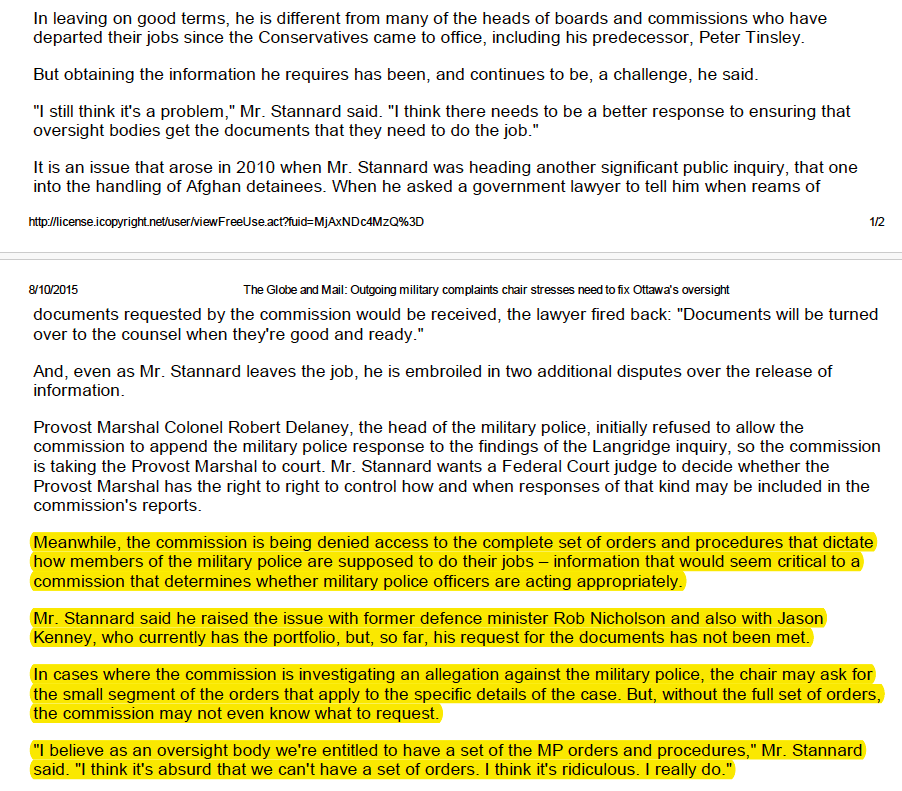
The issues that Madame Tammy Tremblay raised above are nothing new. In 2015 then outgoing MPCC chairman Glenn Stannard has this to say in his interview with Gloria Galloway of The Globe and Mail.
The Canadian Forces Provost Marshal has the ability to control the findings of the Military Police Complaints Commission.
During a review, the MPCC cannot subpoena documents or witnesses. The MPCC also cannot administer oaths.
Without the ability to administer oaths the members of the CFNIS subject to the complaint can utter falsehoods all day long and there will be absolutely no repercussions.
If a person such as myself wishes to make a complaint against the base military police or the Canadian Forces Special Investigations Unit we have to first submit our complaint to the Provost Marshal. The Provost Marshal then knows what the complaint is about and can then tailor the documents released to the MPCC to paint the narrative that the Provost Marshal or the Vice Chief of Defence Staff which for the MPCC to see.
Even if the MPCC suspects that something is off and not right, there’s nothing the MPCC can do as the MPCC cannot demand the release of documents from the Provost Marshal. Sure, they can go to Federal Court to ask the court to instruct the Provost Marshal to hand over the records, but that would mean that the MPCC would have to know what documents to request.
As I learnt during the 2012 review of my complaint against the 2011 CFNIS investigation, the complainant cannot simply supply the MPCC with all the documents in their possession. The MPCC can only consider documents that are relevant to the documents supplied to the MPCC by the Provost Marshal.
And as the Provost Marshal is under no obligation to tell the complainant what they’ve supplied and what they’ve withheld from the Military Police Complaints Commission, following through with a MPCC review is almost 100% a waste of time.
This is why when I was interviewed by Claude Bergeron and Peter Cicalo of the MPCC in July of 2012 they were practically popping the champagne and cheering for the CFNIS.

Peter and Claude were very impressed with the CFNIS investigation even though the Provost Marshal had actually withheld all of my email communications between myself and Master Corporal Christian Cyr detailing the 5 visits to the chapel.
After my interview with Peter and Claude I was so fucking nauseated that I just wandered around the city aimlessly until about 03:00 in the morning trying to work up the courage to jump off the Granville Street bridge.
The Provost Marshal withheld the fact that the CFNIS had in its possession the 1980 CFSIU investigation paperwork and the 1980 courts martial transcripts from the MPCC.
Both of these sets of documents indicated that in 1980 the military police and the CFSIU were very well aware of the babysitter’s abuse of young children on the base and the fact that it was the investigation of the babysitter that exposed the actions of Canadian Armed Forces officer Captain Father Angus McRae.
This of course ran counter to was I was told by Petty Officer Steve Morris on November 4th, 2011 when he stated that the CFNIS could find absolutely no evidence that the babysitter was capable of what I accused him of.
Well, if you don’t like the findings of the MPCC, file an application for Judicial Review.
Don’t think that the Federal Court will be of any relief. The Federal Court can only render judgements based upon the documents that the Provost Marshal submitted to the MPCC. Anything else is considered “New Evidence” and the Department of Justice will fight tooth and nail to have all “new evidence” dismissed.
When I entered all of my emails between myself and Master Corporal Christian Cyr detailing the visits to the chapel the DOJ demanded that these be struck from the proceedings as they were “new evidence”. Because the Provost Marshal failed to notify the MPCC about these emails, I couldn’t introduce these emails at Federal Court level.
And it gets goofier than this.
In 1998, the Provost Marshal issued CFPM 2120-4-0 to the commanding officers of the new CFNIS, and all of the detachments across Canada. This document was further reissued in 2006. This document stated that matters involving civilian victim are to be handed over to the outside civilian authorities having jurisdiction. This document further stipulated that the CFNIS could only conduct an investigation of offences involving civilian victims if the outside civilian authorities outright refused to conduct the investigation.
I introduced this document into my applicant’s records for my application for judicial review.
The Department of Justice requested this document be struck from my hearing as this was also “New Evidence”. New evidence even though this was a standing operating procedure of the Canadian Forces Military Police. But it appears that the Military Police Complaints Commission was never given a copy of this document even though this document has guided military police and CFNIS operations since 1998.
I can’t help but wonder if the Provost Marshal’s new found energy to fight the MPCC over documents has to do with the fact that the MPCC went around the firewall that the CFNIS and the Provost Marshal had constructed around the investigation into my complaint of sexual abuse on Canadian Forces Base Namao and accesses a parallel investigation being conducted into the sexual assaults on CFB Namao and discovered the CFSIU investigation paperwork and the 1980 courts martial transcripts in the possession of the CFNIS.
Militaries like the Canadian Armed Forces really don’t like outside civilian agencies and do-gooders sticking their noses into the military’s business. Militaries view themselves as being the saviours of their respective country, and therefore they should never be questioned.
The Catholic church did the exact same thing that the Canadian Armed Forces are doing. And that’s using their immense power and prestige to place themselves above examination by pesky civilians.
The only difference between the Catholic church and the Canadian Armed Forces is that the Catholic church is subject to civilian laws and the civilian courts. The Canadian Armed Forces are a law unto themselves.

 Beeshive