
When will the federal government ever learn that the Canadian Armed Forces are incapable of operating their own police service.
The Canadian Forces Provost Marshal has absolutely no business whatsoever investigating or prosecuting for any criminal code offence.

Since my first tango with the Canadian Forces Provost Marshal and the Military Police Complaints Commission in 2013 I’ve always said that there is massive fuckery afoot within the confines of the Provost Marshal’s office.
What type of batshit insane lunacy allows for the provost marshal to determine what, if any, information will be handed over to the military police complaints commission?
Nothing more than poorly written legislation that allows the provost marshal to do so at whim.
Now, I fully understand that there will be those amongst you that will say “But Bobbie, why didn’t you tell the MPCC about the missing information”.
That’s not how it works.
That’s not how any of this works.
When a person makes a complaint about a military police investigation, the first place it goes is to the exact agency that you’ve made a complaint against.
And actually, a person such as myself can’t complain about an investigation or the outcome of an investigation. The only persons who can complain about interferance in an investigation are the investigators. But the MPCC pointed out previously that relying on the investigators themselves to make interferance complaints on their own may be impossible as the investigator themself may be completely unaware of any interference if the interference occurs high enough up the chain of command.
All a person like me can complain about is the actions of specific investigators.
If the investigation went off the rails due to “lawful” commands from up the chain of command, the last thing that the provost marshal will do is publically announce that the Vice Chief of Defence Staff or someone higher up gave instructions to the CFNIS about the investigation.
Remember, under the National Defence Act the Provost Marshal is directly subordinate to the Vice Chief of Defence Staff, and that the VCDS has the full authority under the National Defence Act to issue instructions to ANY CFNIS investigation.
The provost marshal has absolutely no interest in covering themselves with shit. So the first thing they do is they take the information in your complaint and use that to sanitze the complaint investigation. They know that you’re more than likely going to make a follow up complaint to the Military Police Complaints Commission so they take all of the information they have at hand and then package it up in a pretty little package with a pretty little bow on top.

And as luck would have it, the Military Police Complaints Commission has to accept whatever documents the provost marshal choses to pass along to the MPCC. During a complaint review the MPCC cannot subpoena documents, it cannot subpoena witnesses, it cannot administer oaths.
As recently as 2015 the Military Police Complaints Commission said that it really didn’t know how the Canadian Forces Military Police Group operated as it had never been given access to the orders and procedures governing the military police. And this means that the MPCC might not even know what evidence to ask for.
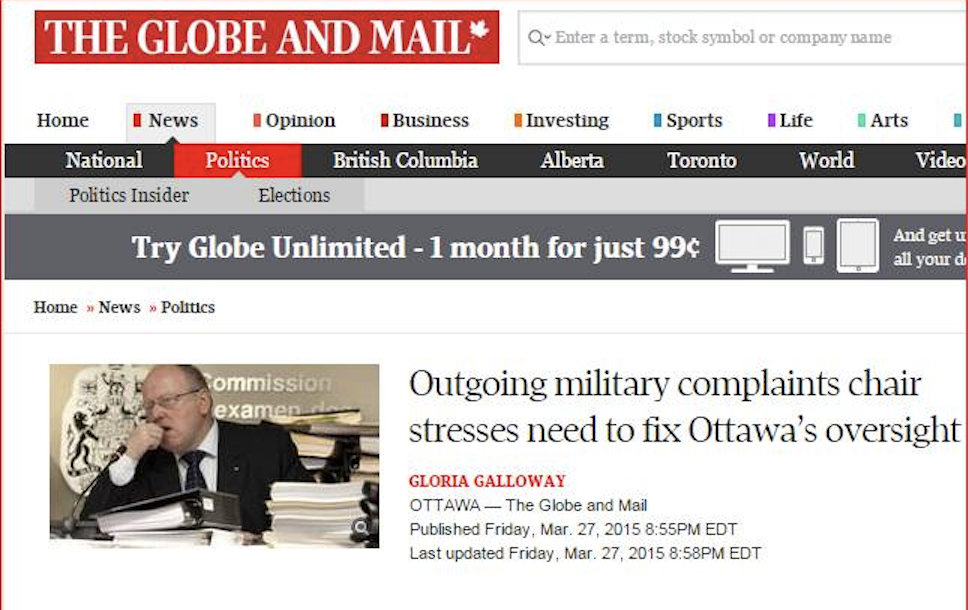

It’s not very confidence inspiring when the agency overseeing a particular agency doesn’t know how that agency is supposed to work.
When I was interviewed by the MPCC in July of 2012 I seriously felt sick to my stomach after the interview. I went for a very, very long walk and it took ever fibre in my body to keep from jumping off the Granville Bridge.
The two MPCC interviewers from Ottawa basically gave me a lecture on why they weren’t going to find any fault with the CFNIS investigation. They came to Vancouver with their minds made up already. The sad thing is, they’re retired civilian police officers who viewed the CFNIS as just being a military version of the civilian police and therefore their “brothers in blue”.
When I filed for Judicial Review in February of 2013, the CFNIS was required to forward to me a certified copy of all of the documents that the Provost Marshal had given to the MPCC in 2012.
It was fucking disturbing just how many records were missing and how many “errors” there were in the SAMPIS.
What an absolute fucking joke this was.
Basically what the Provost Marshal submitted to the MPCC was that I was a cheap two-bit conman looking to milk the Canadian Armed Forces for some easy money.
The MPCC really should have known better. But as it turns out it’s not allowed to know better.
“But Bobbie, why didn’t you introduce all off these missing documents during your hearing for Judicial Review”.
That’s the problem, you can’t.
Under the rules for MPCC Judicial Review you CANNOT introduce to the court ANY document or evidence that was not before the MPCC while they were conducting their review.
And the Chief of Defence Staff knows this.
And the Vice Chief of Defence Staff knows this.
And the Provost Marshal knows this.
The CDS, the VCDS, and the CFPM know that they can sell any bullshit story to the MPCC as the MPCC doesn’t have the power or authority to question what they’re being told.
And if the MPCC doesn’t like what it’s being told and instead wants to have an inquiry? That requires the permission of the Minister of National Defence.
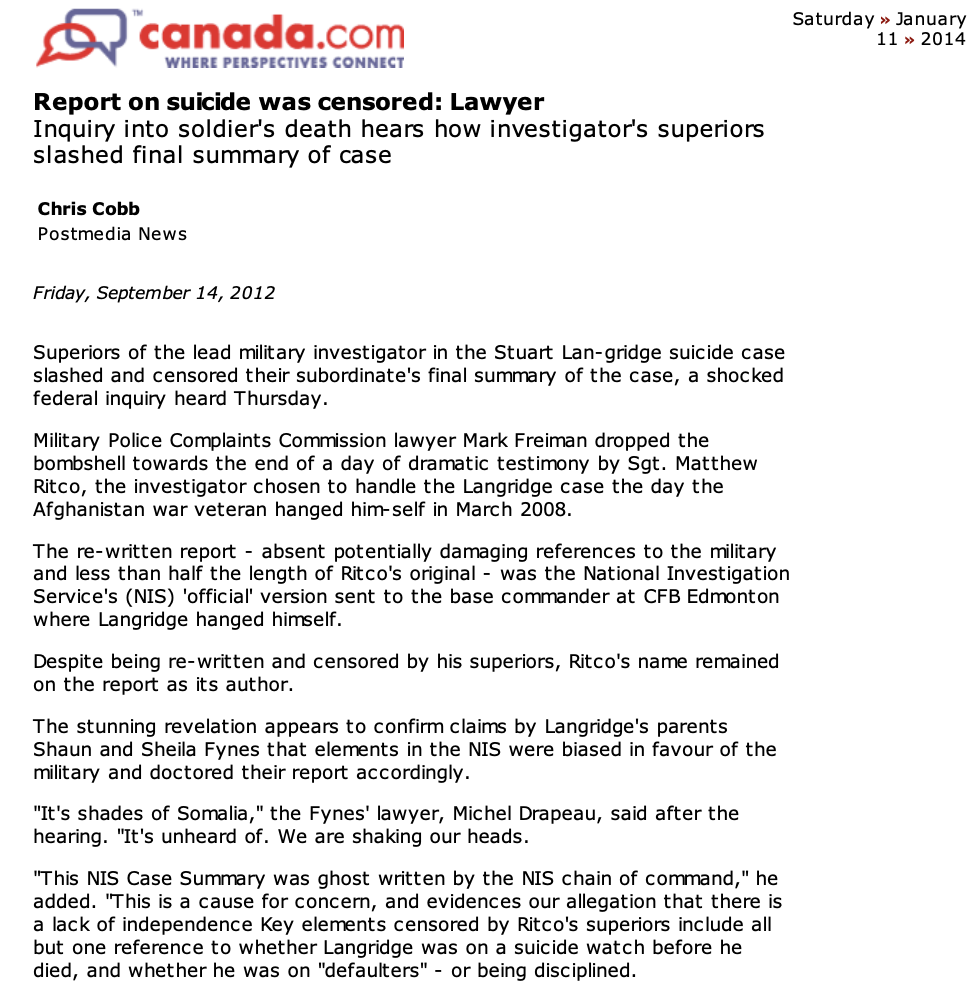
Inquiries have too much potential to damage the Canadian Forces Military Police and that’s why they’re held so very infrequently. Just look at how damaging the MPCC review of the CFNIS investigation of the death of corporal Stuart Langridge was. The ass-whooping the CFNIS received from Michel Drapeau could never have happened anywhere outside of an MPCC inquiry.
The military chain of command does NOT allow for independent investigations.
Yes, you’ll have the provost marshal and the Chief of Defence Staff and the Minister of National Defence tripping all over themselves to exclaim that investigators with the CFNIS are free and independent of the chain of command.
This is absolutely B.S. and they know it.
There are absolutely no exceptions to the service offence of “Insubordination” in the National Defence Act. All members of the Canadian Armed Forces are subject to being charged with having committed the service offence of “Insubordination” if they disobey the “lawful” command of a superior.
And yes, there is a significant difference between “lawful” and “legal”. Basically “legal” infers that the command does not violate any criminal code statute. “Lawful” just means that the person issuing the command has the authority to issue the command, lawful does not vouch for the legal status of the command.
Insubordination is the most serious service offence that a member of the Canadian Forces can commit. Insubordination comes with an automatic sentence of life in prison or a lesser sentence.
In between when I became ensnared with the defective military justice system in 2011 and now we’ve had the External Review conducted by Madame Marie Deschamps, a retired Supreme Court justice.
Then we had another External Review conducted by the Honourable Louise Arbor.
Both reviews basically said the exact same thing. The Canadian Forces Military Police are inept and unskilled when it comes to sexual assault investigations.
Then we had the Third Independent Review of the National Defence Act conducted by the Honourable Morris J. Fish, a retired Supreme Court justice.
While Mr. Fish makes some very powerful recommendations it would appear that Mr. Fish was shielded from the fact that the CFNIS and the Provost Marshal often overstep their jurisdictional boundaries and involve themselves with investigations involving only civilians. This runs counter to the spirit of CFPM 2120-4-0.
These reviews resulted in the Minister of National Defence instructing the military police in 2021 to hand over all sexual assault investigations to the civilian police. The investigation into my complaint against the man in the sauna was retained by the CFNIS with no explanation as to why other than that I was told by the CFNIS that the CFNIS was the only police agency able to work on historical military cases.
And before my time there was the military police fiasco in Bosnia and then subsequently the military police fiasco in Somalia which led to the elimination of the CFSIU, the creation of the Provost Marshal, and the creation of the CFNIS.
And who can forget the “CFB Gagetown Rape Controversy”.

The CFB Gagetown Rape Controversy is well worth the read, and it highlights all of the long standing flaws in the National Defence Act and how civilians are an afterthought to the military justice system and how civilians are at a substantial disadvantage when navigating the military justice system.
And as the offences that are alleged to have occurred during the CFB Gagetown Rape Controversy occurred pre-1998, even if the RCMP were to become involved with this investigation they’d have to hand it right on over to the CFNIS as these offences occurred on a defence establishment making them service offences. And as we all know, there is a 3-year-time-bar on all service offences that occurred prior to 1998. Yes, Rape was a crime that was specifically excluded from prosecution by the military tribunal system, but there was nothing stopping the military police and the CFSIU at the time from investigating this matter. In fact as this occurred on a defence establishment it would have been well within the mandate of the base military police and the CFSIU to investigate. So yes, the 3-year-time-bar would apply. And as these service offences occurred prior to 1998, the commanding officer of the accused would be required to review the charges before sending these charges to the provincial crown prosecutor. There was no mechanism in the pre-1998 National Defence Act to allow for the military police or the CFSIU to bypass the commanding officer and go straight to the provincial crown.
And as luck would have it, the Military Police Complaints Commission is not allowed to look at or review pre-1998 military police or CFSIU investigations.
So here we are again. It’s now 2024 and the CFPM, the CFMPG and the CFNIS still exist.
How many more years of dysfunctional and unaccountable military police will Canadians be willing to endure? Or is this a case of “out of sight, out of mind”?
Will the recommendations from Deschamps, Arbour, and Fish amount to anything or will the MoD, the CDS, and the VCDS slap a fresh coat of paint over the mildewy wallpaper without addressing the rot and disease underneath?
The Provost Marshal and the military police, including the CFNIS need to be scaled down. They need to have their responsibilities limited to offences of a purely military nature. Any crime of a civilian nature that occurs on a defence establishment or involves someone subjected to the Code of Service Discipline, especially if the victims are civilian, needs to be handed over without question or delay to the outside civilian authorities having jurisdiction.
Sure, you’re going to get a lot of naysaying from those involved with the Canadian Forces. But that’s only because the people making those complaints understand the need for the military to retain its own police agency in order for the military to hide secrets from the civilian world.
Many of our NATO allies currently operate with civilian police attending to civilian matters and the military police attending to purely military matters. Doing the same in Canada shouldn’t be out of the question, and its definately preferable to allowing the military to keep doing its own thing.

 Beeshive