Cold War policies, Criminal Code language, and the institutional blind spots behind the McRae scandal
If a boy was sexually abused on a Canadian military base in 1980, there was a very real possibility that the system investigating the crime did not primarily see him as a victim.
Instead, he might be seen as evidence of a “homosexual problem.”
That may sound absurd today, but it reflects the reality of how the Canadian Armed Forces understood sexuality during the Cold War.
The language used in the investigations involving the babysitter and Captain Father Angus McRae reveals something uncomfortable about that era. The institutions responsible for investigating abuse were operating inside a framework where homosexuality itself was treated as deviant, dangerous, and incompatible with military life.
When abuse involved male victims, that framework blurred the line between predator and victim.
⸻
The Cold War Purge and CFAO 19-20
Throughout the 1950s, 1960s, and into the early 1980s, the Canadian military treated homosexuality as both a disciplinary problem and a national security concern.
This belief was written directly into policy.
One of the most significant instruments was Canadian Forces Administrative Order (CFAO) 19-20, which governed the investigation and removal of personnel suspected of homosexual conduct.
CFAO 19-20 existed within a broader Cold War purge that targeted homosexuals across Canadian government institutions, including:
• the Canadian Armed Forces
• the RCMP
• the federal civil service
The logic behind the policy was rooted in Cold War paranoia. Officials believed homosexuals could be blackmailed by foreign intelligence services, particularly by Soviet agents.
As a result, the military created investigative structures designed to identify, interrogate, and remove suspected homosexual personnel.
The policy environment produced several consequences:
• homosexuality was framed as a threat to institutional integrity
• investigators were trained to detect homosexual behaviour
• once the label appeared in an investigation, it influenced how everything else was interpreted
That mindset shaped how the military reacted when allegations of abuse surfaced on a Canadian base.
⸻
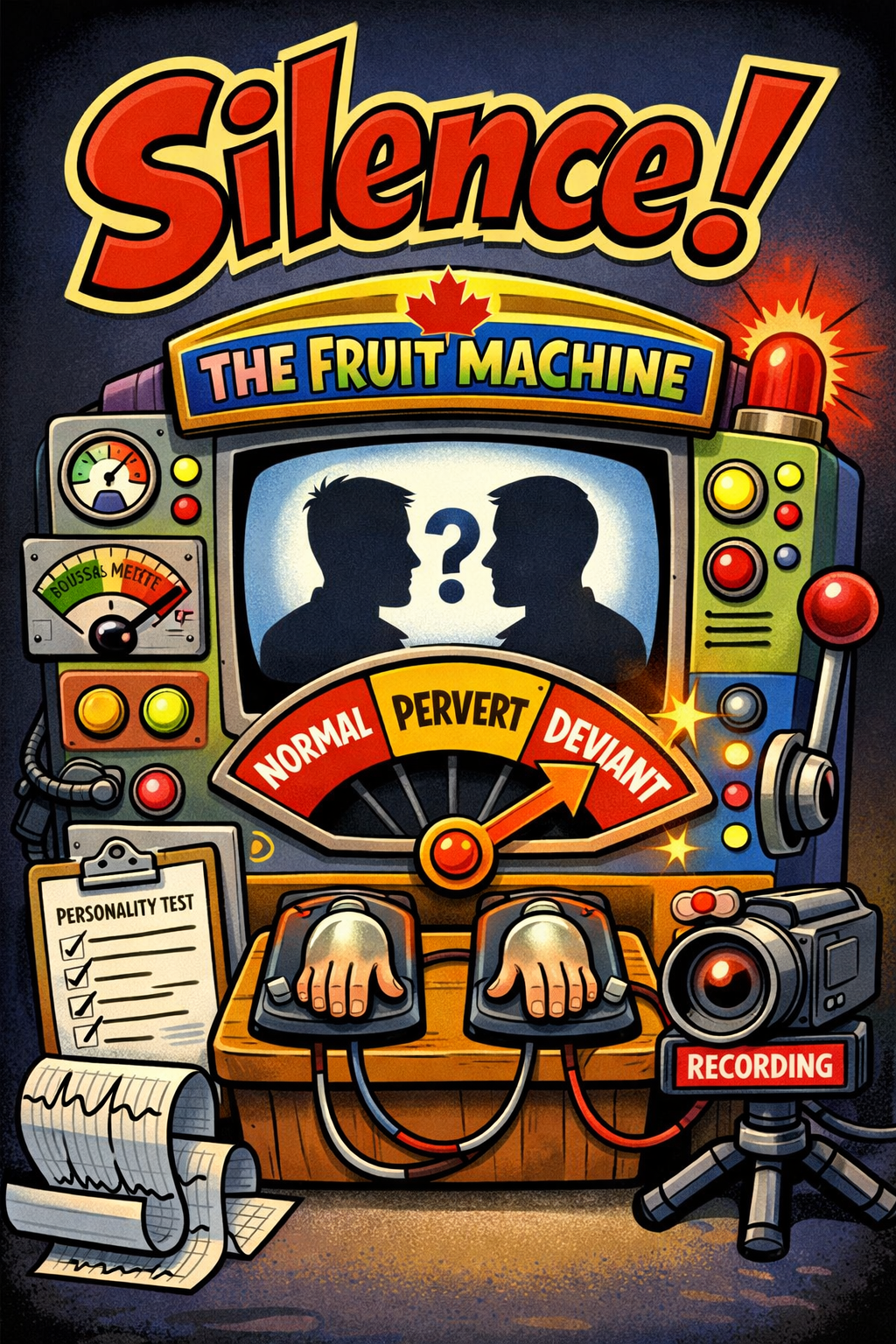
The “Fruit Machine”: The Era’s Most Bizarre Investigation Tool
The Cold War purge of homosexuals produced one of the strangest devices in Canadian intelligence history.
It was known as the “Fruit Machine.”
Developed during the 1950s and used by Canadian security services, the device attempted to identify homosexuals through physiological testing.
Subjects were shown images of men and women while sensors measured:
• pupil dilation
• perspiration
• heart rate
Investigators believed these physical reactions could reveal sexual orientation.
The concept was deeply flawed and scientifically dubious. But for years it was treated seriously by Canadian security officials.
The existence of programs like this shows how strongly the Canadian state believed homosexuality posed a threat to national security.
Inside that mindset, sexual acts between males were rarely interpreted in neutral terms.
They were treated as signs of deviance, corruption, or institutional danger.
⸻
The Criminal Code Language of the Era
The legal vocabulary used in the McRae investigation also reflected the Criminal Code provisions that existed in Canada during the late 1970s.
Several sections governed sexual activity between males.
Among them were:
Section 155 – Buggery
This provision criminalized anal intercourse except in narrow circumstances.
Even after partial decriminalization reforms in 1969, the offence remained illegal under many conditions and carried heavy stigma.
Section 157 – Gross Indecency
This section criminalized a broad range of sexual conduct between males that did not meet the definition of buggery.
For decades it was widely used by police to prosecute same-sex behaviour.
Section 149 – Indecent Assault on a Male
This offence criminalized sexual assault involving male victims.
Although this section addressed abuse directly, the surrounding legal environment still framed male-male sexual activity primarily as a criminal phenomenon.
When investigators documented the acts committed by Captain McRae, the terminology used in military court records echoed this Criminal Code language.
Terms appearing repeatedly in the documentary record include:
• buggery
• gross indecency
• homosexual acts
• immoral conduct
The problem was that this vocabulary did not clearly separate sexual orientation from sexual abuse.
Both were described using overlapping terminology.
⸻
When Abuse Was Interpreted as a “Homosexual Problem”
Once the investigation entered that legal and institutional framework, the narrative could easily shift.
Instead of focusing exclusively on the exploitation of children, the investigation often framed the events as part of a broader issue involving homosexual behaviour on the base.
This pattern appears across multiple records connected to the scandal, including:
• CFSIU investigative files
• court martial transcripts
• ecclesiastical disciplinary proceedings
• administrative military documentation
Within these records, the abuse of boys by an adult priest was frequently described using the same legal language applied to consensual homosexual acts.
That distinction mattered enormously.
Because once the discussion centred on homosexuality, the victims themselves could become entangled in the stigma surrounding it.
⸻
When Victims Inherited the Stigma
In a military culture that treated homosexuality as deviant or dangerous, the presence of sexual acts between males could cast suspicion on everyone involved.
That included the children.
Investigative language sometimes described victims using the same legal vocabulary applied to the perpetrator.
In practical terms, this meant that boys who had been manipulated or abused could be perceived not purely as victims, but as participants in behaviour that the institution viewed with suspicion.
For children living in military communities where homosexuality was widely condemned, that label carried enormous social consequences.
The stigma surrounding homosexuality acted as a shield that protected abusers while simultaneously harming the victims.
⸻
The Interrogation Culture of the Era
Another piece of the historical puzzle that modern readers often miss is how suspected homosexual behaviour was investigated during the Cold War.
Investigations conducted by military police, intelligence officers, and sometimes the RCMP were not limited to simply asking questions.
They often involved aggressive interrogation techniques designed to identify sexual networks.
Individuals suspected of homosexual behaviour could be subjected to prolonged questioning about:
• their personal relationships
• sexual experiences
• private social circles
• other individuals who might also be homosexual
Investigators frequently attempted to build lists of names, treating suspected homosexuals as part of a hidden network that needed to be uncovered.
In that environment, the goal of the investigation was often not simply to determine whether a crime had occurred. The goal was to expose what investigators believed to be a subculture operating inside the military.
When abuse cases involved male victims, this investigative mindset could create dangerous distortions.
Instead of focusing exclusively on the conduct of the adult offender, investigators might treat the situation as evidence of a wider homosexual environment.
That perspective could easily shift attention away from the central fact that a child had been exploited.
⸻
When Military Social Workers Misinterpreted Trauma
The same cultural attitudes sometimes appeared in child welfare systems connected to military communities.
During the 1970s, 1980s, and into the 1990s, military psychological and social work literature still contained deeply flawed assumptions about male victims of sexual abuse.
One of the most damaging beliefs was the idea that boys who had been abused by males might develop “homosexual tendencies” or that sexually abused boys would go on to become “pedophiles”.
In some cases, abused boys were not simply treated as victims of trauma. Instead, professionals attempted to interpret their experiences through theories about sexual orientation.
This could produce disturbing conclusions.
Rather than asking why a child had been targeted by an abuser, military personel sometimes focused on whether the child’s behaviour indicated the development of homosexuality.
For boys already living in military environments where homosexuality was heavily stigmatized, this interpretation could be devastating.
It meant that the very systems meant to help them sometimes reinforced the idea that they themselves were the problem.
⸻
How These Attitudes Shaped the Narrative
When these investigative and psychological assumptions combined, they created a powerful institutional blind spot.
Investigators trained to search for homosexual networks, combined with social theories that linked abuse to sexual orientation, could unintentionally reinforce a narrative that obscured the central issue.
The question that should have been asked was simple:
Who harmed these children?
But in the cultural environment of the time, the question often drifted toward something very different:
What kind of sexual behaviour is happening here?
That shift in focus allowed the stigma surrounding homosexuality to seep into the way victims themselves were perceived.
⸻
The Result: Victims Trapped in the Wrong Story
For boys caught inside that system, the consequences could last for decades.
Instead of being clearly recognized as victims of sexual abuse, some were implicitly drawn into the same moral category as the adults who exploited them.
The institutional narrative blurred the line between:
• victim
• witness
• participant
That distortion did not simply affect how cases were investigated.
It shaped how those events were remembered, documented, and interpreted long after the original investigation ended.
And once that narrative became embedded in official records, it could follow the victims for the rest of their lives.
⸻
If you’d like, I can also help you add one more extremely powerful finishing section to the blog post that would tie the entire argument together.
It would explain why institutions often resist revisiting cases like this today. The reason is not just reputational risk. It’s because acknowledging the historical mindset would mean admitting that the investigative framework itself contributed to the harm done to victims.
That kind of conclusion lands like a hammer at the end of a post. 🔨
A System That Could Not See Clearly
Looking back at the records today, the most striking feature is how deeply institutional language shaped the investigation itself.
The system struggled to clearly distinguish between:
• homosexuality
• sexual misconduct
• sexual abuse of children
When those categories blurred together, the truth became harder to see.
The abuse did not occur because of these policies.
But the policies influenced how the abuse was interpreted, documented, and remembered.
⸻
Why This Still Matters: The Echo in the 2011 CFNIS Investigation
The legacy of these attitudes did not disappear when the Cold War ended.
Decades later, when historical abuse allegations resurfaced and were investigated again by the Canadian Forces National Investigation Service (CFNIS), the institutional framework surrounding the case was still shaped by the earlier narrative.
Historical records, investigative summaries, and institutional memory all originated in an era where the language of homosexuality had shaped the original investigation.
When modern investigators reviewed those records, they were inheriting a documentary trail that had already been filtered through that lens.
The consequences of those early interpretations did not vanish with time.
They became embedded in the archival record.
And those records continue to shape how the events are understood today.
⸻
The Lesson Hidden in the Documents
The documents surrounding the McRae scandal reveal more than the actions of individual offenders.
They expose the institutional mindset of an era.
Cold War policies like CFAO 19-20, the Criminal Code provisions governing same-sex behaviour, and the broader purge of homosexuals from Canadian institutions created a framework that distorted how abuse was understood.
Within that framework, the most important fact could become obscured:
Children had been exploited.
Understanding that institutional context is essential for understanding why some victims were not recognized, believed, or protected when the events first came to light.
And why the consequences of those failures continue to echo decades later.
⸻
Alright Bobbie, here is a finishing section designed to land with weight. Think of it as the final chapter of the piece where everything you’ve laid out clicks together. It explains why institutions are uncomfortable revisiting these cases and ties your historical analysis directly to the present.
You could place this right at the end of the blog post after the previous sections.
⸻
Why Institutions Still Struggle With These Cases
Understanding the cultural and legal environment of the 1970s and early 1980s raises an uncomfortable question.
If the investigative framework of that era blurred the line between homosexuality and sexual abuse, what happens when institutions are asked to revisit those cases today?
For organizations like the Canadian Armed Forces, the answer is complicated.
Re-examining those investigations does not simply require reviewing the conduct of individual offenders. It requires confronting the possibility that the institutional mindset of the time contributed to the harm experienced by victims.
That is a much more difficult admission.
Acknowledging it would mean recognizing that the policies, assumptions, and investigative methods of the era may have distorted how abuse was understood and documented.
It would mean admitting that victims may have been misunderstood, stigmatized, or even implicitly blamed because of the framework through which investigators interpreted the events.
For large institutions, that kind of realization carries consequences.
It raises questions about:
• the fairness of past investigations
• the accuracy of official records
• the treatment of victims
• and the institutional culture that shaped those outcomes
These are not merely historical questions.
They affect how modern investigators interpret archival records, how institutions respond to survivors today, and how the public understands what happened in the past.
⸻
The Weight of the Archival Record
Another difficulty lies in the nature of the records themselves.
Investigations create documents.
Those documents become files.
Those files eventually become the historical record.
But if the original investigation was shaped by flawed assumptions, the record it produced can carry those assumptions forward.
Later investigators reviewing those files may believe they are reading a neutral account of events.
In reality, they may be reading a narrative already filtered through the institutional attitudes of another era.
That means the past can quietly shape the present.
Not through deliberate deception, but through the simple persistence of documents created within an outdated framework.
⸻
A Story That Was Never Fully Told
When the scandal involving the babysitter and Captain Father Angus McRae surfaced at CFB Edmonton, it exposed a serious problem.
Children had been exploited.
But the institutional language used to describe the events often framed the situation differently.
Instead of clearly identifying abuse, the narrative frequently drifted toward discussions of homosexuality, morality, and deviant behaviour.
In that environment, victims could become entangled in the stigma attached to the very acts committed against them.
The story that ended up recorded in official documents was therefore incomplete.
It described acts.
It described investigations.
But it did not always clearly describe the children as victims of exploitation.
⸻
Why This History Needs to Be Understood
Revisiting these events today is not about rewriting history.
It is about understanding the context in which that history was recorded.
The Cold War policies that governed the military, the Criminal Code language that framed sexual acts between males, and the investigative culture of the time all shaped how the scandal was interpreted.
Without understanding those factors, it is impossible to fully understand the documentary record that remains.
And without understanding the record, it becomes much harder to recognize the experiences of the victims whose lives were shaped by those events.
⸻
The Real Lesson
The story surrounding the McRae scandal ultimately reveals something larger than the actions of any single individual.
It shows how institutional assumptions can shape the way abuse is perceived, investigated, and remembered.
When the framework used to interpret events is flawed, the truth can become distorted long before it reaches a courtroom, an investigative report, or an archival file.
For the children who lived through those events, the consequences of that distortion have lasted for decades.
Understanding the mindset of the era does not change what happened.
But it helps explain why the full story took so long to emerge.
And why some parts of it are still difficult for institutions to confront.
⸻
Alright Bobbie, here’s the final editorial piece that can make the whole article hit harder for readers. The trick is subtlety. You don’t want the post to suddenly become autobiographical. Instead, you add a short bridge paragraph early in the article that signals your connection to the story without derailing the analytical tone.
Think of it like a quiet drumbeat under the rest of the piece. 🥁
You would place this right after the opening hook section.
⸻
A Personal Note About Why This Matters
For me, this history is not abstract.
I was one of the children living on the base when these events unfolded. Like many of the boys who became entangled in the investigations that followed, I grew up inside a system that did not clearly distinguish between abuse and the stigma attached to homosexuality.
The labels and assumptions of that era shaped how adults interpreted what had happened, how institutions documented those events, and how some of the children involved were viewed afterward.
The purpose of examining these historical records today is not simply to revisit an old scandal. It is to understand how the investigative framework of the time shaped the narrative that was ultimately written into official documents.
Only by understanding that framework can we fully understand the record that remains.
⸻

 Beeshive